Most Edmonton homeowners think of roof repair as a shingles problem. A few missing shingles after a storm, some cracked tiles, a leaking flashing joint — these are the surface-level repairs that most people can identify from the ground and understand intuitively. Structural roof repair is something different, and understanding the difference matters enormously for how you plan, budget, and choose who you hire.
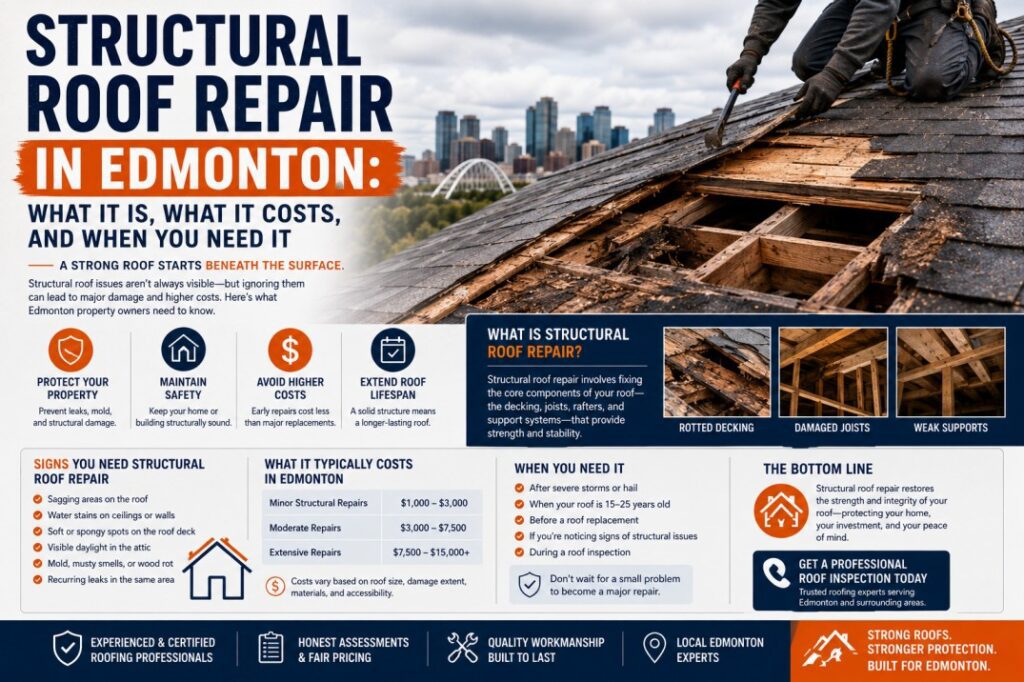
Structural roof repair addresses the hidden framework beneath your shingles — the plywood or OSB roof decking, the rafters, the trusses, and the ridge board that form the load-bearing skeleton of your roof. When these components are compromised, the consequences don’t stop at a ceiling stain. They affect the structural integrity of the entire roof assembly, and in severe cases, of the home itself.
Edmonton’s climate creates specific conditions that make structural roof damage more common here than in milder Canadian cities. This guide explains exactly what structural roof repair involves, how Edmonton’s conditions cause it, the warning signs that tell you it’s happening inside your roof, what Alberta’s 2026 building code requires, and what it realistically costs.
Surface Repair vs. Structural Repair — The Difference Edmonton Homeowners Must Understand
The simplest way to understand the difference is this: surface repair fixes what you can see. Structural repair fixes what holds everything else up.
Surface repairs include replacing shingles, resealing flashing, fixing pipe boot collars, patching minor splits in flat roofing membranes, and re-hanging eavestroughs. These are important maintenance actions, but they don’t change the integrity of the roof’s load-bearing components. A qualified roofer can complete most surface repairs without affecting the structure beneath.
Structural repairs address components that bear load — the weight of snow, wind pressure, HVAC equipment, and the roofing material itself. These include:
- Roof decking (sheathing) — the plywood or OSB panels nailed across the rafters and trusses that form the nailing surface for shingles and provide the roof’s lateral rigidity
- Rafters — the diagonal framing members that run from the ridge board to the wall plate, transferring roof loads to the exterior walls
- Trusses — the engineered triangular framework used in most Edmonton homes built after 1970, replacing traditional stick-framed rafters
- Ridge board — the horizontal member at the peak where opposing rafters meet
When any of these components rot, crack, crush under load, or separate at connections, the roof’s ability to perform its structural function is compromised — regardless of how good the shingles look from the street.
How Edmonton’s Climate Specifically Causes Structural Roof Damage
Edmonton creates three conditions that drive structural roof damage at rates higher than most Canadian cities.
Snow load accumulation. Edmonton’s heavy wet snowpack — particularly in late winter when snow density is highest — can exert significant downward pressure on a residential roof structure. The Alberta Building Code sets minimum design loads for residential roof structures in Edmonton at 1.8 to 2.4 kPa depending on roof slope, but homes built before modern code adoption or with deferred maintenance can carry compromised structural members that perform below design standard under heavy snow years. A sagging roofline visible from the street after a heavy winter is a structural warning, not a cosmetic issue.
Moisture infiltration and wood rot. This is the most common structural damage mechanism in Edmonton residential roofing, and it’s almost always the result of a slow leak that wasn’t caught and addressed promptly. Water entering through failed flashing, a cracked pipe boot, or compromised valley flashing travels through the roof assembly along rafters and decking before appearing as a ceiling stain — often weeks or months after the infiltration began. Over years of repeated seasonal moisture exposure, the structural wood absorbs enough water to support mould growth and eventually structural rot. A single slow chimney flashing leak left unaddressed through two or three Edmonton winters can rot through a rafter — a structural repair that costs significantly more than the flashing fix that would have prevented it. This is why our guide on roof flashing repair in Edmonton emphasises catching flashing failures early.
Freeze-thaw expansion at fastener points. Edmonton’s repeated freeze-thaw cycles through spring cause the moisture that penetrates nail and fastener penetrations in the roof deck to freeze, expand, and loosen the fastener’s grip in the surrounding wood. Over multiple seasons, this “nail backing out” effect — well-documented in Alberta’s construction industry — can compromise the connection between decking and rafters, reducing the roof’s wind uplift resistance. This is a less visible form of structural degradation that qualified roof inspectors in Edmonton specifically assess during post-winter inspections.
6 Warning Signs of Structural Roof Damage in Edmonton Homes
These signs — some visible from inside the home, some from outside — indicate structural compromise that requires professional assessment promptly.
1. A visibly sagging or uneven roofline. A roofline that dips, bows, or shows a wave pattern between the ridge and the eaves indicates that rafters or trusses beneath the shingle surface have deflected under load. This is a structural emergency in severe cases.
2. Soft spots or bounce when walking the roof. Decking that flexes visibly or feels soft underfoot when a contractor is on the roof surface indicates the plywood or OSB has been saturated with moisture and is delaminating or rotting from within.
3. Cracked or split wood visible in the attic. If you can safely access your attic and see rafters or truss members that are visibly cracked, split, or show discolouration indicating moisture penetration, structural repair is needed before the next significant snow or wind load event.
4. Light visible through the roof deck. Daylight seen from inside the attic through the decking surface — not through a ventilation opening — indicates the deck has failed structurally at that point.
5. Persistent ceiling stains that reappear after repair. If your interior ceiling stain returns after a surface repair has been made, the water source is deeper in the roof assembly than the surface repair addressed. Recurring ceiling moisture following attempted surface fixes is one of the most consistent indicators of an underlying structural moisture problem.
6. A roofline that has changed visibly from previous years. Edmonton homeowners who look at their roofline regularly — or have comparison photos — sometimes notice a gradual change in profile over two to three years. Gradual structural deflection is often easier to identify when compared against an older reference image than when examined in isolation on a single inspection visit.
Alberta’s 2026 Building Code: What Structural Roof Repairs Now Require
As of March 1, 2026, the City of Edmonton has implemented updated Roof Truss Engineering Requirements that directly affect any roofing project involving structural changes. Any project that involves major structural modification — including truss repair, rafter sister framing, ridge board replacement, or significant deck replacement that alters the structural assembly — now requires engineering drawings authenticated by an Alberta-licensed professional engineer.
This requirement has practical implications for Edmonton homeowners planning structural roof work:
A permit is required before any structural component of the roof is altered. Your roofing contractor must be aware of this requirement — if they suggest proceeding without a permit on structural work, they are not operating in compliance with 2026 Edmonton code.
The engineering review is not optional. A contractor who offers to perform structural repairs without pulling a permit and obtaining engineer approval on significant structural work is creating a liability for you as the homeowner — at property sale, at insurance claim time, and in the event of any subsequent structural failure.
Silverline Roofing handles permit applications and, where required, coordinates with Alberta-licensed engineers on structural repair scopes as part of every project that triggers this requirement. Learn more about how we approach Edmonton roof replacement and structural work.
What Structural Roof Repair Costs in Edmonton — 2026
Structural roof repair costs in Edmonton vary significantly based on the component affected, the extent of damage, and the roof’s accessibility and complexity.
| Structural Repair Type | Estimated Cost (2026) |
|---|---|
| Roof decking replacement (partial, per sheet) | $150 – $350 per 4×8 sheet installed |
| Roof decking replacement (full roof, with tear-off) | $1,500 – $4,500 |
| Single rafter sister framing (adding new rafter alongside damaged) | $400 – $900 per rafter |
| Multiple rafter replacement (extensive rot or damage) | $2,000 – $6,000+ |
| Truss repair (minor split or connection failure) | $500 – $1,500 per truss |
| Truss replacement (structural failure requiring full unit) | $1,500 – $4,000+ per truss |
| Ridge board replacement | $1,200 – $3,500 |
| Emergency structural shoring (temporary support pending repair) | $500 – $1,500 |
| Engineer’s review and drawings (2026 code requirement) | $800 – $2,500 |
These figures are for the structural work only and do not include the cost of overlying shingle replacement or flat roof membrane that must be removed to access the structure and reinstalled after repair. In most cases of significant structural repair, the overlying roofing material in the affected area requires replacement as part of the same project.
For context on total project costs when structural repair is combined with a full roof replacement, our roof replacement cost Edmonton guide covers the full picture.
Structural Repair vs. Full Replacement — When to Choose Each
Structural repair is the right path when damage is genuinely localised — a single rafter that has rotted through at a chronic flashing leak point, a few sheets of decking that have delaminated around a plumbing vent, or a single truss member that split under an unusually heavy snow load but the surrounding structure is sound. Isolated structural damage, when caught before it spreads to adjacent members, is repairable at a fraction of the cost of full replacement.
Full replacement becomes the more economical choice when:
- Rot has spread through multiple rafter bays across more than one roof section
- The decking shows widespread moisture damage across more than 30 to 40 percent of the total area
- Truss failures are present in multiple locations indicating a systemic problem (often moisture throughout the truss space)
- The home is already due for a new roof surface — in which case combining the structural work with the full replacement is always the more economical choice per project
The critical rule for Edmonton homeowners: do not install new shingles over structurally compromised decking. New shingles placed over rotting or delaminated decking will not hold fasteners reliably, the nails will pull through under wind load, and the warranty on the new shingles will be void because the installation substrate doesn’t meet manufacturer requirements.
Book a Structural Roof Assessment in Edmonton
If you’re seeing any of the warning signs listed above — a sagging roofline, soft deck spots, cracking visible in the attic, or recurring ceiling stains after attempted surface repairs — a prompt professional structural assessment is the right next step.
Silverline Roofing provides roof repair services in Edmonton including full structural assessment and repair scoping. We serve Edmonton and surrounding communities including Sherwood Park, St. Albert, Spruce Grove, Fort Saskatchewan, and Leduc. Contact us today for a free, no-obligation assessment — before a structural issue that is currently repairable becomes a replacement project.