Commercial Flat Roofing in Edmonton: What Property Owners Need to Know
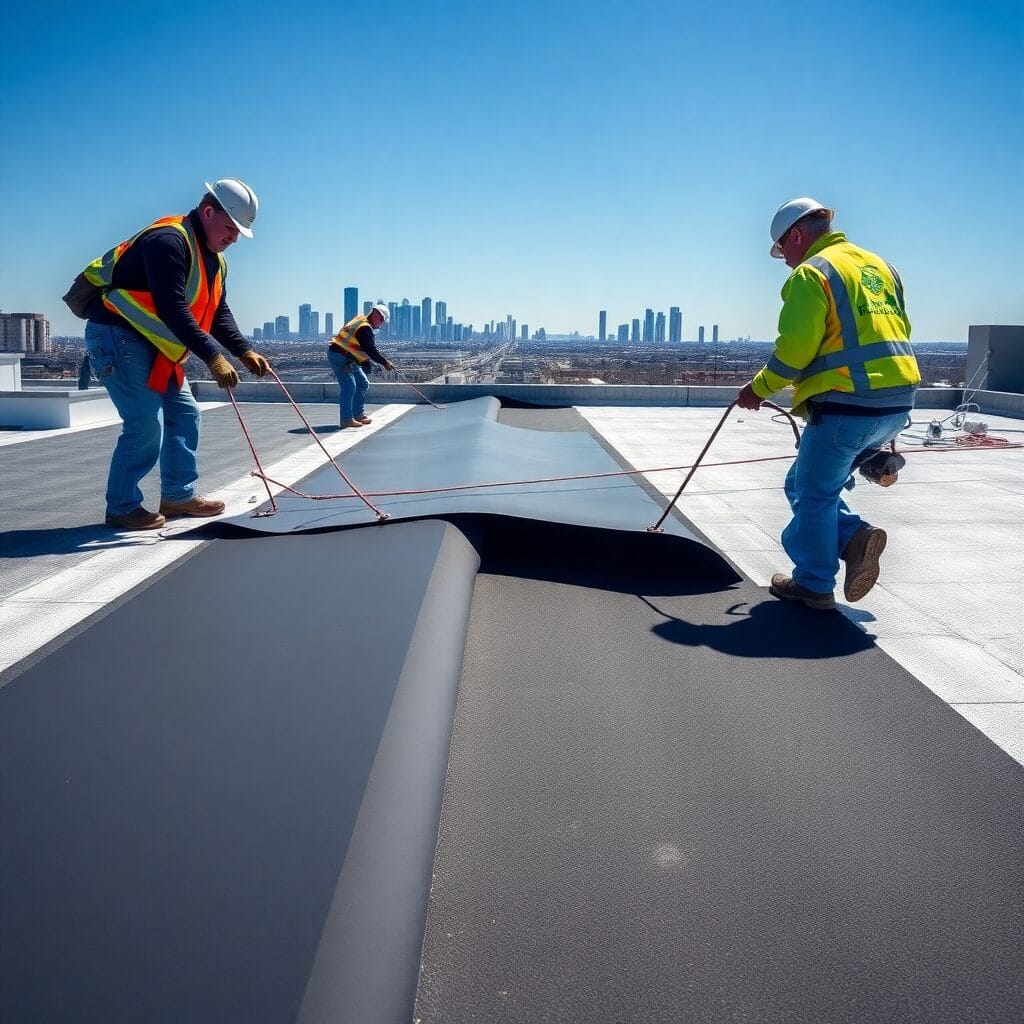
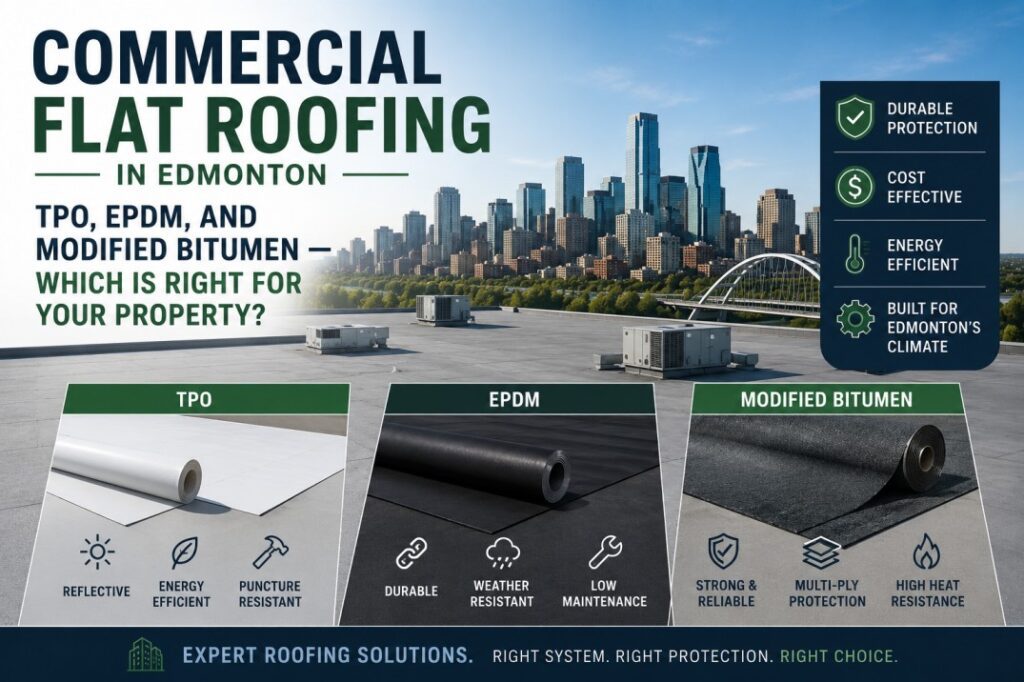
If you own or manage a commercial property in Edmonton — a retail strip, office building, industrial unit, multi-family complex, or commercial warehouse — your roof is one of the highest-value and highest-risk components of the entire asset. Commercial flat roofs in Edmonton face a specific set of demands that residential pitched roofs simply don’t: larger surface areas accumulating more water and debris, rooftop HVAC equipment that requires maintenance access, and the unforgiving physics of ponding water that flat and low-slope systems must manage precisely or fail early. Most Edmonton commercial property owners know they need a flat roofing system. Far fewer know the meaningful differences between the three primary options — TPO, EPDM, and modified bitumen — and which one performs best under the specific conditions their building faces. Making the wrong choice at the point of installation doesn’t just cost money upfront. It costs money every year of the roof’s life in energy, maintenance, and eventually premature replacement. This guide gives you the complete, honest picture — written specifically for Edmonton’s climate, not for a generic Canadian or North American audience. Why Flat Roofing in Edmonton Is More Demanding Than Most Property Owners Realise Edmonton’s climate creates a combination of stresses that commercial flat roofs in milder cities simply don’t experience at the same intensity. Spring thaw and ponding water is the single biggest risk factor for commercial flat roofs in Edmonton. When weeks of accumulated snowpack melts over a compressed spring period, enormous volumes of water arrive on the roof surface in a short window. If drainage is even partially blocked — by debris, ice, or inadequate slope design — water ponds on the membrane surface. Ponding water accelerates membrane degradation, stresses seams, and in severe cases creates structural load risk. A properly designed Edmonton flat roof must have drainage engineered to handle spring thaw volumes, not just typical rainfall. Freeze-thaw cycling through winter and early spring repeatedly stresses every seam, flashing, and membrane termination point on the roof. Each cycle is a small expansion-contraction event — and over hundreds of cycles per winter season, seam adhesives and mechanical fastener penetrations are tested in ways that warmer climates never produce. Temperature extremes in Edmonton span roughly 60°C between peak summer and deep winter. Roofing membranes that perform well across this full range are not the same as membranes chosen for temperate climates. Flexibility at -30°C and UV stability at +30°C are both non-negotiable requirements for any membrane system specified in Edmonton. Rooftop equipment access on commercial buildings — for HVAC maintenance, mechanical systems, and satellite/communication equipment — introduces foot traffic as an ongoing stress on commercial flat roof membranes that residential applications don’t face. The Three Primary Commercial Flat Roofing Systems for Edmonton Properties TPO (Thermoplastic Polyolefin) — The Modern Default TPO has become the most specified flat roofing membrane for new commercial installations across Edmonton and Canada broadly, and for well-founded reasons. A single-ply thermoplastic membrane available in white, grey, and tan, TPO is installed in large rolls that are heat-welded at the seams — creating a continuous, essentially permanent bond that is as strong as the surrounding membrane itself. The heat-welded seam advantage is TPO’s most important attribute for Edmonton. Unlike adhesive-bonded systems, heat-welded TPO seams don’t degrade through freeze-thaw cycling or UV exposure. The bond doesn’t age out. This is the primary reason experienced Edmonton commercial roofing contractors have shifted toward TPO as the default specification for new flat roof installations. TPO’s white reflective surface also provides meaningful energy performance benefits during Edmonton’s increasingly intense July and August. Roof surface temperatures on a white TPO membrane run 20–35°C cooler than black EPDM under the same solar exposure — translating directly to reduced cooling costs for any air-conditioned commercial space beneath. Edmonton TPO installed cost: $8.00 – $14.00 per square foot, including membrane, insulation, fasteners, and labour. Lifespan with quality installation: 25–35 years. For more on Silverline Roofing’s flat roofing services, visit our flat roofing Edmonton service page. EPDM (Ethylene Propylene Diene Monomer) — The Proven Cold-Climate Performer EPDM is the roofing membrane with the longest proven track record in North American commercial construction — commercially installed since the 1960s, with some original installations still functional today. A synthetic rubber membrane, EPDM is manufactured in large sheets (up to 15 metres wide), which dramatically reduces the number of seams compared to TPO and is one of its most meaningful practical advantages. EPDM’s rubber composition maintains flexibility at temperatures as low as -60°C — well below anything Edmonton winters produce. This cold-weather flexibility makes EPDM the most forgiving membrane for extreme freeze-thaw cycling, and it’s why EPDM remains the preferred specification for long-hold institutional properties like schools, hospitals, and warehouses where maximum lifespan and minimum replacement frequency are the primary objectives. The key trade-off versus TPO is seam technology. EPDM seams are adhesive-bonded rather than heat-welded. High-quality EPDM installations with premium seam tape perform well — but adhesive systems are inherently more dependent on installation conditions, surface preparation, and long-term adhesive durability than welded systems. Most EPDM roofs that fail before their rated lifespan do so at seams, typically between years 15 and 25. EPDM is also available in 45, 60, and 90-mil thicknesses. For Edmonton commercial applications, 60-mil is the industry standard minimum — 90-mil is specified where foot traffic, equipment access, or extreme hail exposure is a factor. Edmonton EPDM installed cost: $8.00 – $16.00 per square foot depending on membrane thickness and attachment method. Lifespan with quality 60-mil installation: 25–40 years. Modified Bitumen — The High-Traffic and Layered Performance Option Modified bitumen is a multi-layer asphalt-based system that has been used on Edmonton commercial roofs for decades and remains the right specification for specific building types and use conditions. Unlike single-ply membranes, modified bitumen is applied in multiple layers — typically a base sheet mechanically fastened to the deck, an interply layer, and a granulated or smooth cap sheet — creating a roofing assembly with inherent redundancy. Modified bitumen is the strongest
Commercial Flat Roofing in Edmonton: What Property Owners Need to Know Read More »