August 2026

Eavestrough Installation in Edmonton: Cost, Materials & What to Expect (2026)

Eavestrough Installation in Edmonton: Cost, Materials & What to Expect (2026)

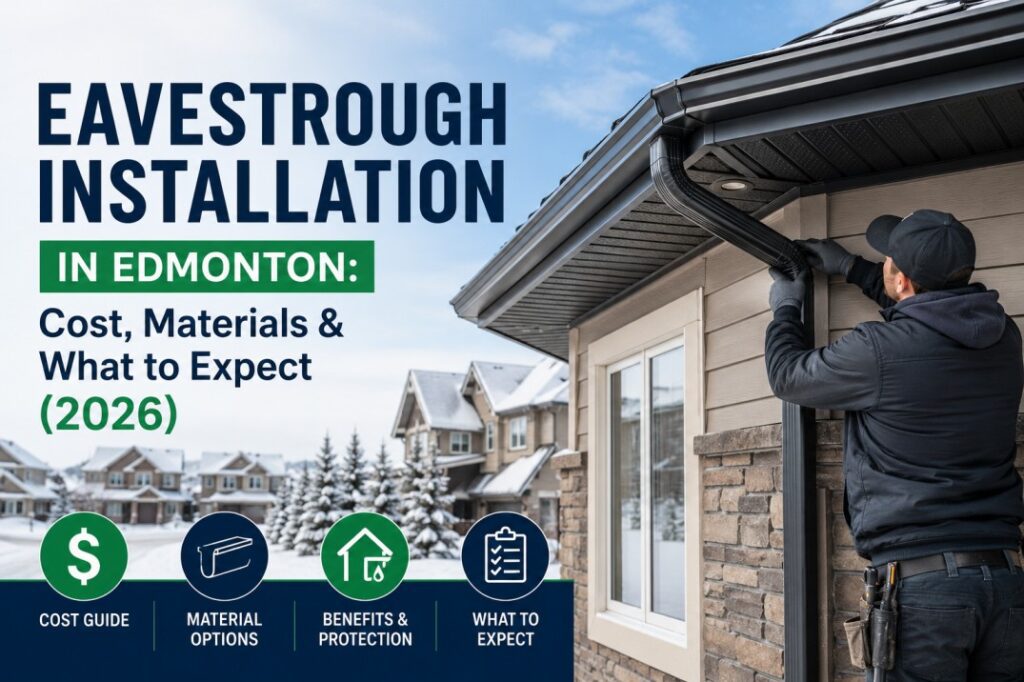
How Much Does Eavestrough Installation Cost in Edmonton? Eavestrough installation in Edmonton typically costs $8 to $16 per linear foot for seamless 5″ aluminum gutters, or $10 to $18 per linear foot for 6″ oversized systems, fully installed. A complete system for an average bungalow (140–180 linear feet) runs $1,500 to $2,800, while a two-storey home (180–240 linear feet) typically costs $2,200 to $4,200. If your current gutters are past saving, or you’re finishing a new build and need a first-time system installed, eavestrough installation is a different job from a repair — different materials, different sizing decisions, and a different price structure. This guide walks through exactly what goes into a proper eavestrough installation in Edmonton, what it costs in 2026, and how to tell whether you need a fresh install or just a repair. Why Proper Eavestrough Installation Matters in Edmonton Eavestroughs aren’t a cosmetic add-on — they’re your home’s primary defence against foundation damage. Water that isn’t captured and redirected away from your house pools against the foundation, seeps into basements, and causes frost-heave under walkways and driveways during Edmonton’s freeze-thaw cycles. Properly graded downspout discharge is also a requirement under the City of Edmonton’s lot grading and drainage bylaw, so an install that ignores drainage direction can put you offside with the city, not just risk water damage. A poorly installed system — wrong slope, undersized gutters, sectional joints in the wrong places — tends to fail within a few years regardless of material quality. This is why the installation itself matters as much as what you install. Seamless vs. Sectional Eavestroughs Seamless aluminum eavestroughs are formed on-site to the exact length of each roofline run, cut with a truck-mounted roll-former so there are no joints along the straight sections — only at corners and outlets. Fewer joints means fewer leak points, which matters enormously in a climate where expansion and contraction from -30°C to +30°C stresses every seam. Sectional eavestroughs are pre-cut lengths joined with sealant at regular intervals. They’re less expensive upfront but every joint is a future leak point, and Edmonton’s temperature swings degrade sectional sealant faster than milder climates. Sectional systems are increasingly rare on new installations for this reason — seamless has become the local standard. Choosing the Right Gutter Size: 5″ vs. 6″ Standard residential eavestroughs come in two sizes: Your installer should size this based on your actual roof area and pitch, not default to whichever size is cheaper to install. Materials Compared Material Durability in Edmonton’s Climate Typical Use Case Aluminum Excellent — lightweight, rust-resistant, doesn’t crack in cold Most common choice for residential homes Steel Superior strength, handles heavy snow/ice load Homes needing extra resilience, some commercial Vinyl Budget-friendly, but becomes brittle in deep cold Lower-cost option, less ideal for harsh winters Copper Premium, long lifespan, develops a patina over time Heritage homes, high-end architectural projects Aluminum remains the practical standard for most Edmonton homes because it resists rust, holds paint finishes well, and stays flexible enough to handle temperature swings without cracking — something vinyl struggles with once temperatures drop well below freezing. What a Proper Eavestrough Installation Involves Eavestrough Installation Cost in Edmonton — 2026 Item Estimated Cost (2026) Seamless aluminum, 5″ K-style (per linear foot, installed) $8 – $16 Seamless aluminum, 6″ oversized (per linear foot, installed) $10 – $18 Steel eavestrough (per linear foot, installed) $14 – $22 Downspout installation (per downspout) $100 – $250 Gutter guard installation (per linear foot) $6 – $12 Full bungalow system (140–180 linear feet) $1,500 – $2,800 Full two-storey system (180–240 linear feet) $2,200 – $4,200 These are Edmonton-area 2026 market ranges. Final pricing depends on roofline complexity, number of corners and outlets, fascia condition, and downspout routing. If your existing eavestroughs have isolated damage rather than widespread failure, a repair is almost always the more cost-effective route — full replacement makes sense once you’re seeing multiple sagging sections, rust throughout, or a system older than 20 years. Are Gutter Guards Worth It in Edmonton? For homes surrounded by mature trees — especially spruce and poplar — gutter guards significantly reduce how often you need to clean your eavestroughs and help prevent the clogs that lead to ice damming in winter. Aluminum mesh and micro-mesh guards perform well in Edmonton’s climate, though homeowners should be aware that no guard system is fully maintenance-free; an annual visual check is still recommended. New Construction Eavestroughing If you’re finishing a new build, eavestrough installation should be coordinated with your new roof installation so the drainage system is planned around your actual roof design from the start, rather than retrofitted afterward. This is also the ideal time to confirm your downspout discharge points meet city lot grading requirements before landscaping is finished. Repair or Full Installation? A Quick Way to Decide If you’re not sure which you need, our full eavestrough repair guide breaks down the specific warning signs, but as a general rule: Frequently Asked Questions How much does eavestrough installation cost per linear foot in Edmonton? Seamless aluminum installation typically runs $8–$16 per linear foot for 5″ K-style, and $10–$18 for 6″ oversized gutters, installed. Is seamless or sectional better for Edmonton homes? Seamless is the local standard because it eliminates the multiple joints that fail under Edmonton’s freeze-thaw temperature swings. Sectional systems cost less upfront but require more maintenance and repair over time. What size eavestrough do I need — 5″ or 6″? Most bungalows and moderate-pitch roofs do well with 5″ K-style gutters. Larger roof areas, steep pitches, or homes with heavy runoff should use 6″ oversized gutters, which carry roughly three times the water volume. How long does eavestrough installation take? A standard residential installation typically takes one day, since seamless gutters are formed on-site to exact lengths rather than assembled from pre-cut sections. Do I need new eavestroughs, or can mine be repaired? If damage is isolated to a section or two, repair is usually the more cost-effective choice. Full installation makes sense when

Eavestrough Installation in Edmonton: Cost, Materials & What to Expect (2026) Read More »

Structural Roof Repair in Edmonton: What It Is, What It Costs, and When You Need It

Structural Roof Repair in Edmonton: What It Is, What It Costs, and When You Need It

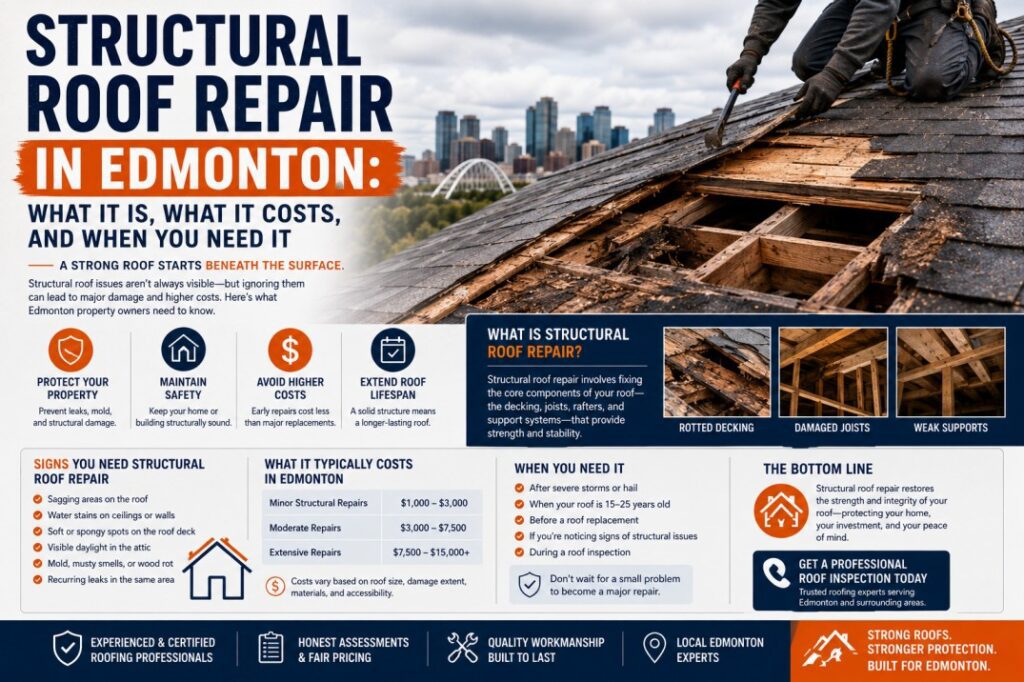
Most Edmonton homeowners think of roof repair as a shingles problem. A few missing shingles after a storm, some cracked tiles, a leaking flashing joint — these are the surface-level repairs that most people can identify from the ground and understand intuitively. Structural roof repair is something different, and understanding the difference matters enormously for how you plan, budget, and choose who you hire. Structural roof repair addresses the hidden framework beneath your shingles — the plywood or OSB roof decking, the rafters, the trusses, and the ridge board that form the load-bearing skeleton of your roof. When these components are compromised, the consequences don’t stop at a ceiling stain. They affect the structural integrity of the entire roof assembly, and in severe cases, of the home itself. Edmonton’s climate creates specific conditions that make structural roof damage more common here than in milder Canadian cities. This guide explains exactly what structural roof repair involves, how Edmonton’s conditions cause it, the warning signs that tell you it’s happening inside your roof, what Alberta’s 2026 building code requires, and what it realistically costs. Surface Repair vs. Structural Repair — The Difference Edmonton Homeowners Must Understand The simplest way to understand the difference is this: surface repair fixes what you can see. Structural repair fixes what holds everything else up. Surface repairs include replacing shingles, resealing flashing, fixing pipe boot collars, patching minor splits in flat roofing membranes, and re-hanging eavestroughs. These are important maintenance actions, but they don’t change the integrity of the roof’s load-bearing components. A qualified roofer can complete most surface repairs without affecting the structure beneath. Structural repairs address components that bear load — the weight of snow, wind pressure, HVAC equipment, and the roofing material itself. These include: When any of these components rot, crack, crush under load, or separate at connections, the roof’s ability to perform its structural function is compromised — regardless of how good the shingles look from the street. How Edmonton’s Climate Specifically Causes Structural Roof Damage Edmonton creates three conditions that drive structural roof damage at rates higher than most Canadian cities. Snow load accumulation. Edmonton’s heavy wet snowpack — particularly in late winter when snow density is highest — can exert significant downward pressure on a residential roof structure. The Alberta Building Code sets minimum design loads for residential roof structures in Edmonton at 1.8 to 2.4 kPa depending on roof slope, but homes built before modern code adoption or with deferred maintenance can carry compromised structural members that perform below design standard under heavy snow years. A sagging roofline visible from the street after a heavy winter is a structural warning, not a cosmetic issue. Moisture infiltration and wood rot. This is the most common structural damage mechanism in Edmonton residential roofing, and it’s almost always the result of a slow leak that wasn’t caught and addressed promptly. Water entering through failed flashing, a cracked pipe boot, or compromised valley flashing travels through the roof assembly along rafters and decking before appearing as a ceiling stain — often weeks or months after the infiltration began. Over years of repeated seasonal moisture exposure, the structural wood absorbs enough water to support mould growth and eventually structural rot. A single slow chimney flashing leak left unaddressed through two or three Edmonton winters can rot through a rafter — a structural repair that costs significantly more than the flashing fix that would have prevented it. This is why our guide on roof flashing repair in Edmonton emphasises catching flashing failures early. Freeze-thaw expansion at fastener points. Edmonton’s repeated freeze-thaw cycles through spring cause the moisture that penetrates nail and fastener penetrations in the roof deck to freeze, expand, and loosen the fastener’s grip in the surrounding wood. Over multiple seasons, this “nail backing out” effect — well-documented in Alberta’s construction industry — can compromise the connection between decking and rafters, reducing the roof’s wind uplift resistance. This is a less visible form of structural degradation that qualified roof inspectors in Edmonton specifically assess during post-winter inspections. 6 Warning Signs of Structural Roof Damage in Edmonton Homes These signs — some visible from inside the home, some from outside — indicate structural compromise that requires professional assessment promptly. 1. A visibly sagging or uneven roofline. A roofline that dips, bows, or shows a wave pattern between the ridge and the eaves indicates that rafters or trusses beneath the shingle surface have deflected under load. This is a structural emergency in severe cases. 2. Soft spots or bounce when walking the roof. Decking that flexes visibly or feels soft underfoot when a contractor is on the roof surface indicates the plywood or OSB has been saturated with moisture and is delaminating or rotting from within. 3. Cracked or split wood visible in the attic. If you can safely access your attic and see rafters or truss members that are visibly cracked, split, or show discolouration indicating moisture penetration, structural repair is needed before the next significant snow or wind load event. 4. Light visible through the roof deck. Daylight seen from inside the attic through the decking surface — not through a ventilation opening — indicates the deck has failed structurally at that point. 5. Persistent ceiling stains that reappear after repair. If your interior ceiling stain returns after a surface repair has been made, the water source is deeper in the roof assembly than the surface repair addressed. Recurring ceiling moisture following attempted surface fixes is one of the most consistent indicators of an underlying structural moisture problem. 6. A roofline that has changed visibly from previous years. Edmonton homeowners who look at their roofline regularly — or have comparison photos — sometimes notice a gradual change in profile over two to three years. Gradual structural deflection is often easier to identify when compared against an older reference image than when examined in isolation on a single inspection visit. Alberta’s 2026 Building Code: What Structural Roof Repairs Now Require As of March 1,

Structural Roof Repair in Edmonton: What It Is, What It Costs, and When You Need It Read More »

Roof Warranty in Edmonton - What's Actually Covered — and What Quietly Voids It

Roof Warranty in Edmonton: What’s Actually Covered — and What Quietly Voids It

When you get a new roof installed in Edmonton, you’ll almost certainly be handed a warranty document — sometimes two. Most homeowners file it away without reading it carefully, assuming they’re covered for whatever goes wrong over the next 25 to 50 years. That assumption costs Edmonton homeowners real money when claims are denied for reasons they never knew existed. Roof warranties in Edmonton are more conditional than they appear. The conditions aren’t hidden — they’re in the fine print that most people skip. This guide explains every type of roof warranty in plain English, what each one actually covers, the specific Edmonton climate actions that void coverage without most homeowners realising it, and how to make sure you’re actually protected before you need to make a claim. There Are Two Separate Warranties on Every New Roof — And Most Homeowners Only Know About One The single most important thing to understand about roofing warranties in Edmonton is that a new roof almost always comes with two distinct and entirely separate documents. They cover different things, come from different sources, and fail for different reasons. Treating them as one warranty is one of the most common and most expensive roofing mistakes Edmonton homeowners make. The Manufacturer’s Material Warranty is provided by the company that makes your shingles — IKO, Owens Corning, GAF, Malarkey, or another manufacturer. It covers defects in the roofing material itself: premature granule loss, cracking or splitting under normal conditions, delamination, and failure to meet the product’s stated performance specifications. It does not cover installation errors. It does not cover storm damage. And it does not cover any damage caused by conditions the manufacturer lists as exclusions — which, in Alberta, include some situations that are very common. Standard manufacturer warranties on architectural asphalt shingles in Edmonton run 25 to 50 years depending on the product tier. The word “lifetime” appears on premium product warranties and is used to mean the product is warranted for as long as the original purchaser owns the home — not 50 years, not forever. When you sell the home, a “lifetime” warranty either expires or transfers to the new owner in a reduced form, typically for the balance of a set number of years. The Contractor’s Workmanship Warranty is provided by the roofing company that installed your roof. It covers how the roof was installed — whether the shingles were correctly nailed, the flashing properly seated, the ventilation correctly configured, the drip edge correctly installed, and whether all the installation details were done in accordance with the manufacturer’s specifications and Alberta Building Code. This is the warranty that covers the vast majority of actual roof failures, because the research consistently shows that most roof leaks trace to installation errors, not material defects. Workmanship warranty terms in the Edmonton market vary significantly — from one year from budget contractors to ten or more years from quality installers. The length of workmanship warranty is one of the most meaningful indicators of a contractor’s confidence in their own installation quality. Short workmanship warranties from low-bid contractors should be a significant red flag before you sign any contract. Silverline Roofing provides written workmanship warranties on every installation — confirm the specific current terms when you receive your quote. For more on what to look for when selecting a roofing contractor, read our roof replacement Edmonton guide. What Specifically Voids Your Roof Warranty in Edmonton This is the section most homeowners never read until after a claim has been denied. These are real warranty exclusions that apply in Edmonton’s specific climate and maintenance environment. Inadequate attic ventilation. Every major shingle manufacturer requires that their product be installed on a roof with ventilation meeting the manufacturer’s minimum specifications — typically aligned with the 1/300 net free area rule under Alberta Building Code. If your attic ventilation is found to be inadequate at the time of a warranty claim — even if it was that way before your roof was installed — the manufacturer can deny the claim on the basis that their material failed due to an improper installation environment, not a product defect. This is why roof ventilation in Edmonton is assessed and corrected as a standard part of every Silverline Roofing installation. Unauthorized repairs. If any third party other than the original installing contractor or a manufacturer-authorised contractor performs repairs on your roof, most manufacturer warranties are voided for the sections affected — and sometimes for the entire roof. An emergency patch applied by an uncertified contractor after a storm can void coverage on a 30-year warranty. This is a specific Edmonton risk given the storm-chaser crews that arrive after hailstorms and offer fast, cheap repairs. Any repair on a warranted roof should be performed by the original installer or a manufacturer-certified contractor. Pressure washing. Cleaning moss or algae from asphalt shingles using a pressure washer strips granules — the protective UV coating on the shingle surface. Granule loss is the primary evidence manufacturers look for to assess whether a shingle has been maintained correctly. Pressure washing evidence found during a claim inspection voids coverage. If you have moss or organic growth on your Edmonton roof, mechanical cleaning with appropriate brushes and chemical treatment is the correct method. Ice dam damage. Most manufacturer warranties explicitly exclude damage caused by ice dams — including the water damage that results when ice dam meltwater backs up under shingles and into the home. Ice dam formation is considered a building performance issue (inadequate ventilation and insulation allowing the roof deck to stay warm) rather than a material defect. This exclusion is particularly significant in Edmonton, where ice dam formation is common in homes with older or insufficient attic insulation. The warranty excludes the damage, but your home insurance may cover it — understanding which protection applies in which situation is important before any claim. Modified or altered roof structure. If you add a dormer, solar panels, a rooftop HVAC unit, or any other penetration through or attachment

Roof Warranty in Edmonton: What’s Actually Covered — and What Quietly Voids It Read More »

Scroll to Top