July 2026

Roof Flashing Repair Edmonton: Types, Costs & Leak Fixes (2026)

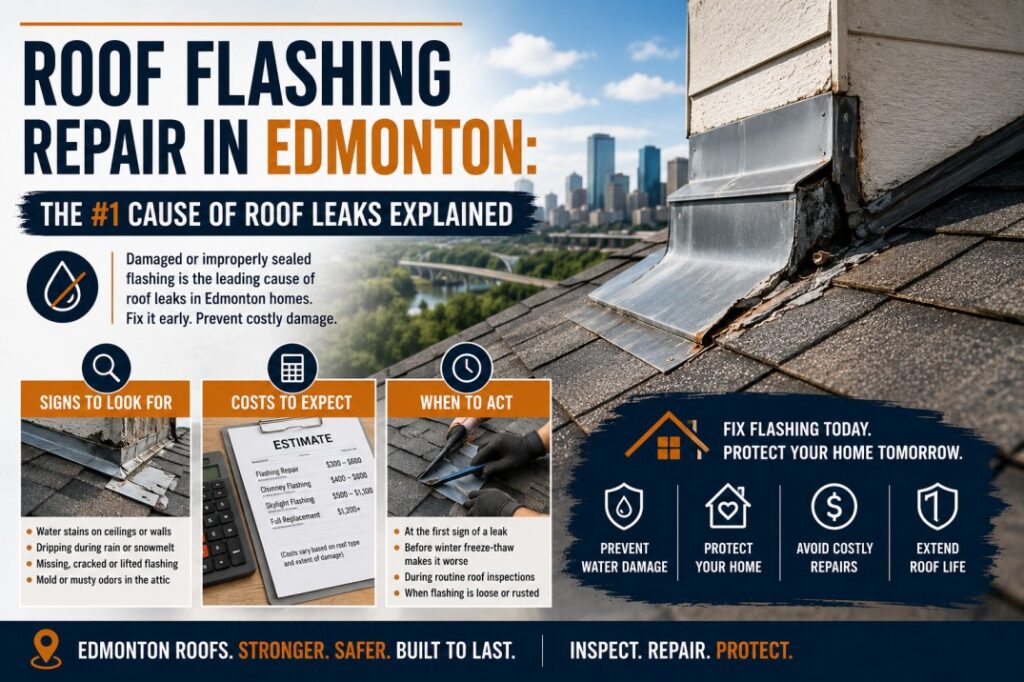
Roof Flashing Repair in Edmonton: The #1 Cause of Roof Leaks Explained

If your roof is leaking in Edmonton and your shingles look completely fine from the ground, you’re not imagining things. The most common cause of roof leaks in Edmonton has nothing to do with damaged or missing shingles — it’s flashing failure. By a significant margin. Roof flashing is the thin metal system installed wherever two different roof surfaces meet — around chimneys, skylights, vent pipes, dormers, walls, and in roof valleys. These transition points are where water always wants to find a way in, and flashing is the only thing standing between those openings and the interior of your home. When flashing fails in Edmonton’s climate, it almost never announces itself dramatically. It lets in a small amount of water that travels through the roof assembly and appears as a ceiling stain somewhere that has nothing to do with the actual entry point — which is why flashing leaks are consistently the most misdiagnosed and most expensive roof problems Edmonton homeowners deal with. This guide covers every type of flashing on your roof, exactly why Edmonton’s conditions destroy flashing faster than anywhere else in Canada, how to identify failure before it causes interior damage, and what repair and replacement actually costs in 2026. Why Edmonton’s Climate Is the Enemy of Roof Flashing Roof flashing is typically made from aluminum, galvanized steel, or lead-coated copper — all metals that expand when heated and contract when cooled. In a climate with mild temperature swings, this expansion and contraction is minimal and manageable. Edmonton is not that climate. Edmonton’s temperature range spans approximately 65 degrees Celsius between deep winter lows and peak summer highs. Every day that temperature swings significantly, every flashing component on your roof moves — expanding away from the sealed joints that hold it watertight, then contracting back. Over hundreds of thermal cycles across a single year, the sealant and caulking that keeps flashing watertight fatigues, cracks, and pulls away from the surfaces it’s meant to bond. The problem accelerates dramatically through Edmonton’s freeze-thaw season in late winter and spring. When water enters even the smallest gap at a flashing joint and freezes, it expands with enough force to widen the gap further. The next thaw lets more water in, which freezes again, widening it further still. What began as a hairline separation at a chimney counter-flashing becomes a meaningful gap within two or three freeze-thaw cycles — and water follows it directly into your home. This freeze-thaw flashing failure mechanism is why Edmonton roofing contractors see the majority of leak calls in March, April, and May — not during the heavy rains of summer, but after the winter’s repeated freeze-thaw events have done their work on the flashing system throughout the season. Every Type of Roof Flashing on Your Home — Explained Understanding where flashing exists on your roof helps you know where to look when a leak appears. Chimney Flashing Chimney flashing is the most complex and most failure-prone flashing system on most Edmonton homes. It consists of two layers: base flashing (sometimes called step flashing where it meets the sides of the chimney) that sits beneath the shingles and turns up the chimney face, and counter flashing that is embedded into the chimney mortar joints and overlaps the base flashing from above. Both components are required and both must work together. When the mortar joint holding the counter flashing deteriorates — a masonry issue, not a roofing issue — the counter flashing lifts and allows water to run behind the base flashing during any rain or thaw event. This is one of the most common winter leak sources in Edmonton homes with chimneys, and the repair involves a roofer for the flashing component and sometimes a mason for the mortar joint. Skylight Flashing Skylights sit in a cutout in the roof deck and are sealed to the surrounding shingles through an integrated flashing system. Edmonton’s conditions assault skylight flashing from two directions: UV degradation of the sealant through summer’s long high-UV days, and ice dam pressure in winter that can force water underneath the flashing perimeter. A critical distinction that Edmonton homeowners frequently miss: water appearing near a skylight is not always flashing failure. When warm interior air hits the cold skylight glass in winter, condensation forms on the interior surface and drips — mimicking a leak with no flashing failure present. The diagnostic test is whether the moisture appears during rain and thaw events (flashing) or consistently during cold weather regardless of precipitation (condensation and ventilation). For more on how attic moisture and condensation work in Edmonton homes, read our roof ventilation Edmonton guide. Pipe Boot Flashing (Vent Pipe Collars) Every plumbing vent stack that exits through your roof is sealed at the roof surface with a rubber boot — a cone-shaped rubber collar that fits tightly around the pipe and lays flat on the shingle surface around it. These rubber boots are the most age-sensitive flashing component on Edmonton roofs. The rubber compound used in pipe boots degrades under UV exposure and becomes brittle in cold. Most pipe boots in Edmonton show significant cracking within 10 to 15 years — well before the surrounding shingles reach the end of their life. A cracked pipe boot is a direct water entry pathway every time it rains, and because vent stacks are often located on rear slopes or near ridges, the resulting interior stain frequently appears far from the actual entry point. Replacing a pipe boot in Edmonton is one of the most cost-effective preventative repairs available — typically $150–$350 per boot — and it’s a standard item in any professional roof inspection. Valley Flashing Roof valleys — where two sloping roof planes meet and channel water downward — are the highest-volume water-flow points on any roof. Valley flashing protects the underlying deck from this concentrated water flow. Two types are used in Edmonton: open metal valley flashing, where a continuous metal channel is visible running down the valley, and closed-cut valleys where shingles from

Roof Flashing Repair in Edmonton: The #1 Cause of Roof Leaks Explained Read More »
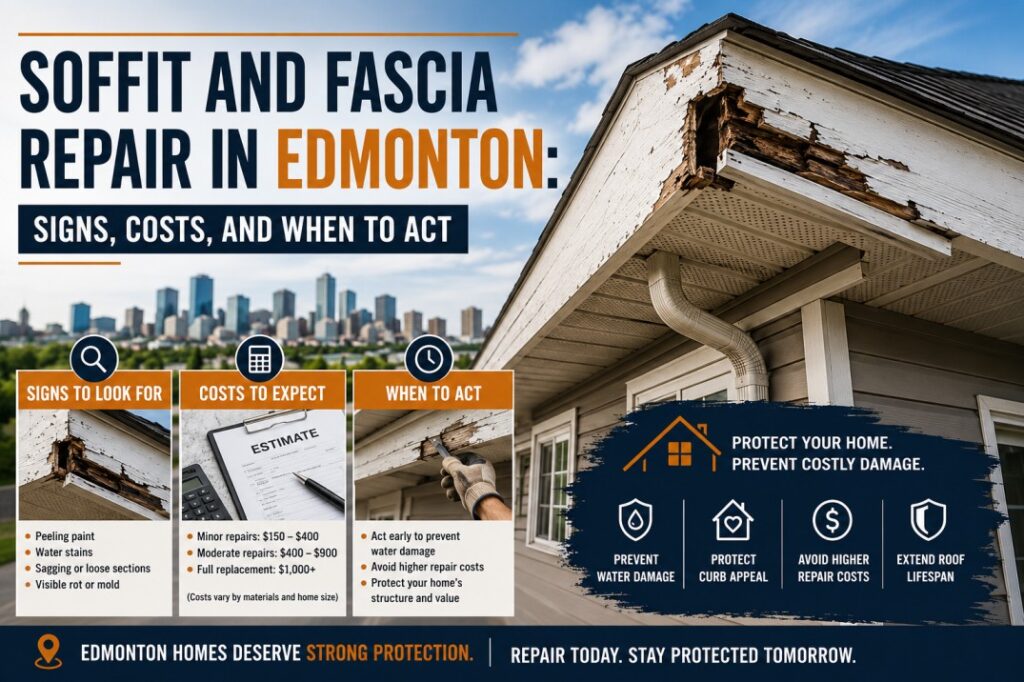
Soffit and Fascia Repair in Edmonton Signs, Costs, and When to Act

Soffit and Fascia Repair in Edmonton: Signs, Costs, and When to Act

Most Edmonton homeowners can describe their roof shingles and know roughly how old their eavestrough system is. Very few can tell you the last time anyone looked at their soffit and fascia — and that’s exactly the problem. Soffit and fascia sit at the intersection of three of your home’s most important systems: the roof, the exterior cladding, and the attic ventilation. When they’re working correctly, you’ll never think about them. When they start failing, the damage they allow doesn’t stay in one place — it moves into your attic insulation, your roof deck, your eavestroughs, and eventually your interior ceiling. And in Edmonton’s climate, that deterioration happens faster than in almost any other Canadian city. This guide covers exactly what soffit and fascia do, what failure looks like in Edmonton’s specific conditions, your material options and real 2026 costs, and when it makes financial sense to bundle soffit and fascia work with your roof replacement. What Soffit and Fascia Actually Do — and Why Both Matter Fascia is the vertical board that runs along the lowest edge of your roof, directly where your eavestrough attaches. It covers the ends of the roof rafters, gives the roofline a clean finished edge, and serves as the structural anchor for your gutter system. Without sound fascia, your eavestroughs have nothing solid to hang from — which is why sagging gutters and rotting fascia almost always appear together. Soffit is the material that covers the underside of your roof overhang — the horizontal surface you see when you stand near your exterior wall and look upward at the eave. Its job is dual: it seals the eave space against pest entry while providing the ventilation that allows fresh air to enter the attic through perforations or vented panels. The connection between soffit and attic ventilation is one that most homeowners don’t fully appreciate until something goes wrong. Fresh air enters through the soffit vents, travels through the attic, and exits through the ridge vent at the peak — creating the airflow that prevents moisture buildup, attic rain, and the ice dam formation that causes so much roof damage across Edmonton every winter. Damaged or blocked soffit disrupts this airflow at the source. For a full explanation of how this system works together, read our guide on roof ventilation in Edmonton. Why Edmonton Makes Soffit and Fascia Failure Happen Faster Edmonton’s climate does two specific things to soffit and fascia that milder cities simply don’t experience at the same pace. Freeze-thaw cycling destroys wood faster here than almost anywhere. Wooden fascia boards absorb moisture during Edmonton’s wet spring season. That moisture freezes in the wood grain during overnight temperature drops, expands as it freezes, then thaws and contracts when temperatures rise — sometimes multiple times in a single week during March and April. This repeated expansion-contraction splits paint, cracks sealant, opens the wood grain to deeper moisture penetration, and accelerates rot from the inside out. A wooden fascia board that might last 20 years in Vancouver can show serious rot in Edmonton in 8 to 12 years without regular maintenance. Eavestrough ice weight multiplies fascia stress. When eavestroughs fill with water and ice during Edmonton’s winter — a common occurrence when gutters aren’t properly cleared before freeze-up — the weight of that ice puts direct downward pressure on the fascia board the gutter is mounted to. Over multiple winters, this mechanical stress loosens the gutter mounting, separates the fascia from the rafter ends beneath, and creates gaps that admit moisture and wildlife. Wildlife and insect entry through damaged soffit is a significantly bigger issue in Edmonton than in denser urban environments. Squirrels, starlings, wasps, and hornets actively seek out gaps in damaged soffit panels as nest sites — particularly in the spring. Once an animal establishes a nesting space in your attic through a soffit gap, the insulation and structural damage it causes often runs into thousands of dollars of remediation on top of the soffit repair itself. 7 Warning Signs Your Edmonton Home Needs Soffit or Fascia Attention Look carefully at your roofline from the ground — ideally from multiple angles and in good light. These are the signs that warrant a closer professional look: 1. Peeling or bubbling paint on the fascia board. Paint failure is the first signal that moisture has breached the surface. By the time paint is visibly failing, the wood beneath has already begun absorbing water. 2. Soft, spongy, or discoloured wood on the fascia. Press gently on accessible fascia sections. Soft or springy wood indicates rot has begun. Discolouration without softness means moisture has been present but may not yet be structural. 3. Sagging eavestroughs pulling away from the fascia. When gutters begin separating from the roofline, the fascia they’re mounted to has either rotted enough to lose grip on the fasteners or has been mechanically stressed to the point of structural failure. This is not a gutter problem — it is a fascia problem with a gutter symptom. Read more about eavestrough repair in Edmonton and why fascia condition determines whether gutter repairs hold. 4. Visible holes, gaps, or cracked panels in the soffit. Any gap in soffit panels larger than a few millimetres is a potential wildlife or insect entry point as well as a moisture pathway into the eave cavity. 5. Staining or streaking on exterior siding below the roofline. Water that escapes through failed fascia or soffit doesn’t disappear — it runs down your exterior wall, causing staining that worsens with each rainfall and can eventually damage the wall structure behind the cladding. 6. Increased heating bills in winter or cooling costs in summer. When soffit ventilation is compromised, attic airflow is disrupted. A warm attic in winter drives ice dam formation and heat loss through the ceiling. A hot attic in summer increases your air conditioning load measurably. 7. Sounds of scratching or activity in the attic or eave space. If you can hear movement above your ceiling or in the

Soffit and Fascia Repair in Edmonton: Signs, Costs, and When to Act Read More »

Commercial Flat Roofing in Edmonton TPO, EPDM, and Modified Bitumen — Which Is Right for Your Property?

Commercial Flat Roofing in Edmonton: What Property Owners Need to Know

If you own or manage a commercial property in Edmonton — a retail strip, office building, industrial unit, multi-family complex, or commercial warehouse — your roof is one of the highest-value and highest-risk components of the entire asset. Commercial flat roofs in Edmonton face a specific set of demands that residential pitched roofs simply don’t: larger surface areas accumulating more water and debris, rooftop HVAC equipment that requires maintenance access, and the unforgiving physics of ponding water that flat and low-slope systems must manage precisely or fail early. Most Edmonton commercial property owners know they need a flat roofing system. Far fewer know the meaningful differences between the three primary options — TPO, EPDM, and modified bitumen — and which one performs best under the specific conditions their building faces. Making the wrong choice at the point of installation doesn’t just cost money upfront. It costs money every year of the roof’s life in energy, maintenance, and eventually premature replacement. This guide gives you the complete, honest picture — written specifically for Edmonton’s climate, not for a generic Canadian or North American audience. Why Flat Roofing in Edmonton Is More Demanding Than Most Property Owners Realise Edmonton’s climate creates a combination of stresses that commercial flat roofs in milder cities simply don’t experience at the same intensity. Spring thaw and ponding water is the single biggest risk factor for commercial flat roofs in Edmonton. When weeks of accumulated snowpack melts over a compressed spring period, enormous volumes of water arrive on the roof surface in a short window. If drainage is even partially blocked — by debris, ice, or inadequate slope design — water ponds on the membrane surface. Ponding water accelerates membrane degradation, stresses seams, and in severe cases creates structural load risk. A properly designed Edmonton flat roof must have drainage engineered to handle spring thaw volumes, not just typical rainfall. Freeze-thaw cycling through winter and early spring repeatedly stresses every seam, flashing, and membrane termination point on the roof. Each cycle is a small expansion-contraction event — and over hundreds of cycles per winter season, seam adhesives and mechanical fastener penetrations are tested in ways that warmer climates never produce. Temperature extremes in Edmonton span roughly 60°C between peak summer and deep winter. Roofing membranes that perform well across this full range are not the same as membranes chosen for temperate climates. Flexibility at -30°C and UV stability at +30°C are both non-negotiable requirements for any membrane system specified in Edmonton. Rooftop equipment access on commercial buildings — for HVAC maintenance, mechanical systems, and satellite/communication equipment — introduces foot traffic as an ongoing stress on commercial flat roof membranes that residential applications don’t face. The Three Primary Commercial Flat Roofing Systems for Edmonton Properties TPO (Thermoplastic Polyolefin) — The Modern Default TPO has become the most specified flat roofing membrane for new commercial installations across Edmonton and Canada broadly, and for well-founded reasons. A single-ply thermoplastic membrane available in white, grey, and tan, TPO is installed in large rolls that are heat-welded at the seams — creating a continuous, essentially permanent bond that is as strong as the surrounding membrane itself. The heat-welded seam advantage is TPO’s most important attribute for Edmonton. Unlike adhesive-bonded systems, heat-welded TPO seams don’t degrade through freeze-thaw cycling or UV exposure. The bond doesn’t age out. This is the primary reason experienced Edmonton commercial roofing contractors have shifted toward TPO as the default specification for new flat roof installations. TPO’s white reflective surface also provides meaningful energy performance benefits during Edmonton’s increasingly intense July and August. Roof surface temperatures on a white TPO membrane run 20–35°C cooler than black EPDM under the same solar exposure — translating directly to reduced cooling costs for any air-conditioned commercial space beneath. Edmonton TPO installed cost: $8.00 – $14.00 per square foot, including membrane, insulation, fasteners, and labour. Lifespan with quality installation: 25–35 years. For more on Silverline Roofing’s flat roofing services, visit our flat roofing Edmonton service page. EPDM (Ethylene Propylene Diene Monomer) — The Proven Cold-Climate Performer EPDM is the roofing membrane with the longest proven track record in North American commercial construction — commercially installed since the 1960s, with some original installations still functional today. A synthetic rubber membrane, EPDM is manufactured in large sheets (up to 15 metres wide), which dramatically reduces the number of seams compared to TPO and is one of its most meaningful practical advantages. EPDM’s rubber composition maintains flexibility at temperatures as low as -60°C — well below anything Edmonton winters produce. This cold-weather flexibility makes EPDM the most forgiving membrane for extreme freeze-thaw cycling, and it’s why EPDM remains the preferred specification for long-hold institutional properties like schools, hospitals, and warehouses where maximum lifespan and minimum replacement frequency are the primary objectives. The key trade-off versus TPO is seam technology. EPDM seams are adhesive-bonded rather than heat-welded. High-quality EPDM installations with premium seam tape perform well — but adhesive systems are inherently more dependent on installation conditions, surface preparation, and long-term adhesive durability than welded systems. Most EPDM roofs that fail before their rated lifespan do so at seams, typically between years 15 and 25. EPDM is also available in 45, 60, and 90-mil thicknesses. For Edmonton commercial applications, 60-mil is the industry standard minimum — 90-mil is specified where foot traffic, equipment access, or extreme hail exposure is a factor. Edmonton EPDM installed cost: $8.00 – $16.00 per square foot depending on membrane thickness and attachment method. Lifespan with quality 60-mil installation: 25–40 years. Modified Bitumen — The High-Traffic and Layered Performance Option Modified bitumen is a multi-layer asphalt-based system that has been used on Edmonton commercial roofs for decades and remains the right specification for specific building types and use conditions. Unlike single-ply membranes, modified bitumen is applied in multiple layers — typically a base sheet mechanically fastened to the deck, an interply layer, and a granulated or smooth cap sheet — creating a roofing assembly with inherent redundancy. Modified bitumen is the strongest

Commercial Flat Roofing in Edmonton: What Property Owners Need to Know Read More »

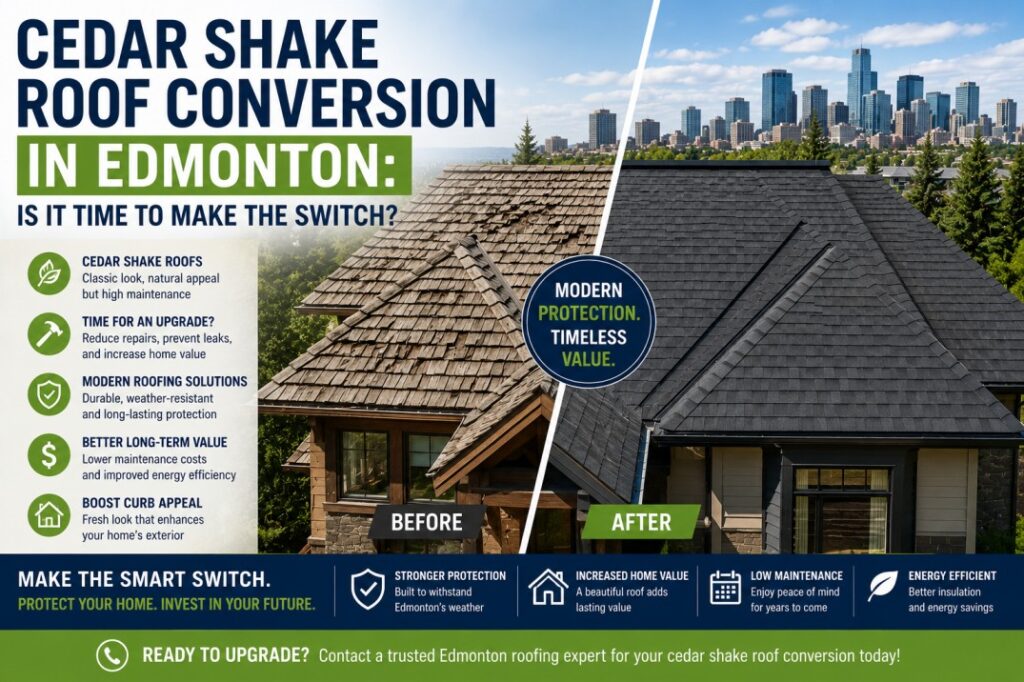
Cedar shake roof conversion to asphalt shingles on an Edmonton home.

Cedar Shake Roof Conversion in Edmonton: Is It Time to Make the Switch?

Cedar shake roofs have a look that is genuinely difficult to replicate. The natural texture, the warm tones, the way a cedar roof ages into a distinguished silver-grey — it’s easy to understand why homeowners in Edmonton’s older neighbourhoods like Glenora, Crestwood, Westmount, and Laurier Heights chose cedar when their homes were built. But cedar shake roofing was designed for a different era of home maintenance expectations. In Edmonton’s modern climate reality — with increasingly severe hail seasons, stricter municipal fire codes, rising insurance premiums, and the reality of what Alberta’s freeze-thaw cycles do to natural wood over 20 or 30 years — many homeowners are finding that the look they love is coming at a cost they didn’t fully anticipate. This guide covers everything Edmonton homeowners need to know about cedar shake roof conversion: the warning signs that tell you it’s time, your material options, what a proper conversion involves, and what it realistically costs in 2026. Why Edmonton’s Climate Is Particularly Hard on Cedar Shake Roofs Cedar performs reasonably well in dry climates with consistent temperatures. Edmonton is neither of those things. Alberta’s spring thaw cycles introduce repeated cycles of moisture absorption and drying that cause cedar shakes to swell, contract, split, and warp over time. The wet springs that follow Edmonton’s heavy snowpack seasons are particularly damaging — cedar that stays damp for extended periods is highly susceptible to moss growth, mould, and rot that spreads from the surface into the shake itself and eventually into the roof deck beneath. Alberta’s hail seasons compound the problem significantly. While asphalt shingles lose granules and rubber shingles absorb impact, cedar shakes crack and split under hail impact — and cracked shakes create immediate pathways for moisture penetration. A single significant hailstorm can take years off a cedar roof’s remaining useful life. Add the gradual degradation of the wood’s natural oils — which are what give cedar its moisture resistance — and most Edmonton cedar roofs show serious performance decline between 15 and 25 years, well short of cedar’s theoretical 30-year lifespan. 7 Signs Your Edmonton Cedar Roof Is Ready for Conversion Walk around your property and look carefully. If you’re seeing several of these signs, a full cedar shake roof conversion is likely a more cost-effective decision than continued repair: 1. Widespread splitting and cracking — Individual splits are a normal maintenance item. Splitting across large sections of the roof is a sign the wood has dried out and lost structural integrity. 2. Curling or cupped shakes — When the edges of shakes curl upward or the centre cups downward, the wood has warped from repeated moisture cycling. Water pools rather than shedding and accelerates the damage further. 3. Missing shakes after storms — Cedar shakes that have aged past their prime become brittle and detach under wind load. After storms, gaps in the roof surface allow direct water entry. 4. Moss or dark staining across the surface — Moss retains moisture against the shake surface continuously. Dark organic staining indicates the wood is already decomposing in affected areas. 5. Soft or spongy areas on the roof deck — If the deck beneath the shakes has absorbed enough moisture to begin rotting, the problem has moved beyond the shakes themselves. Deck repairs become a significant added cost in the conversion project. 6. Repeated leak repairs that don’t hold — One or two isolated leak repairs are normal maintenance. If you’re having the same areas repaired every season, the underlying wood structure is compromised and patches are not addressing the real problem. 7. Insurance renewal surprises — Many Alberta insurers are now declining to renew or sharply increasing premiums on homes with cedar shake roofs over 20 years old, particularly following hail damage claims. In some cases, conversion is a condition of continued coverage. Your Cedar Conversion Options in Edmonton — Compared Honestly A cedar shake roof conversion in Edmonton means a complete removal of the existing shake system, inspection and repair of the roof deck, and installation of a modern roofing material. Here are your main options: Dimensional Asphalt Shingles — Best Value Conversion Dimensional (architectural) asphalt shingles are the most common conversion choice for Edmonton cedar roofs. Modern dimensional shingles produce a textured, multi-layer appearance that reads as visually premium from the street — not as flat and plain as older 3-tab shingles. They handle Edmonton’s climate well, carry 30 to 50-year warranties, and represent the lowest upfront conversion cost. For homes where the cedar look was a priority, several manufacturers now offer cedar-profile dimensional shingles that closely replicate the visual character of wood shake without any of the maintenance demands. Installed cost for a cedar-to-asphalt conversion in Edmonton typically runs $8,000 – $15,000 for a standard residential home depending on roof size, pitch, and deck repair scope. Metal Roofing — Longest-Lasting Conversion Metal roofing — particularly steel shake profiles and standing seam systems — delivers the most complete long-term solution for Edmonton homeowners converting from cedar. Metal handles hail, fire, wind, and snow load better than any other commonly available roofing material. It carries 40 to 70-year lifespans, qualifies for insurance premium reductions as a fire-resistant and impact-resistant system, and requires virtually zero maintenance over its life. The visual match for homes that valued cedar’s appearance is excellent — steel shake profiles replicate the texture and shadow lines of wood shake with remarkable accuracy. Installed cost for a cedar-to-metal conversion in Edmonton typically runs $16,000 – $35,000 depending on the system and roof complexity. Learn more about metal roofing in Edmonton. Euroshield Rubber Roofing — Best for Hail Resistance Euroshield rubber shingles are a strong conversion choice specifically for Edmonton homeowners whose priority is protecting against future hail damage and reducing insurance premiums. Made from recycled tires in Canada and rated Class 4 under the UL 2218 impact standard — the highest available — Euroshield shingles absorb hail impact without cracking or splitting. The cedar-profile Euroshield product provides a compelling visual match for homes converting from

Cedar Shake Roof Conversion in Edmonton: Is It Time to Make the Switch? Read More »

Scroll to Top