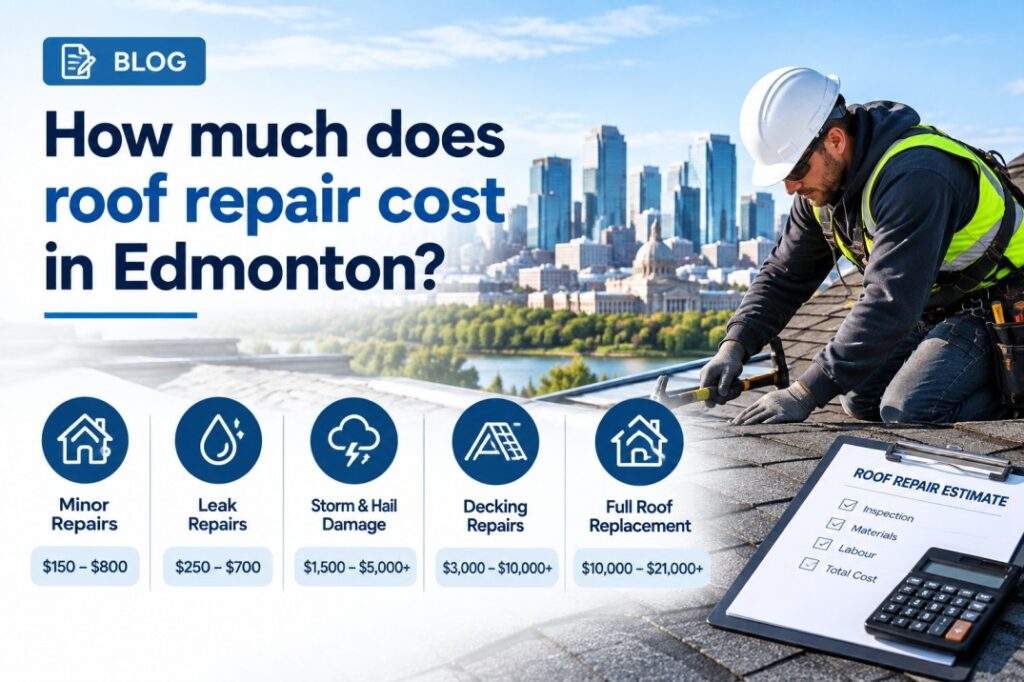
How much does roof repair cost in Edmonton?
Most roof repairs in Edmonton cost between $350 and $1,500 in 2026. Small fixes like replacing a few blown-off shingles or a cracked vent boot start around $250. Larger jobs, such as flat roof membrane repairs, chimney re-flashing or rotted decking, usually run $1,500 to $5,000. Emergency after-hours repairs add roughly 25–50% to the bill. That’s the short answer. The real price depends on what failed, how steep and high your roof is, and when you call. A $400 flashing fix in September can become a $4,000 ceiling, insulation and decking repair by March once Edmonton’s freeze-thaw cycles get into it. This guide breaks down real repair prices by job type, shows what pushes a quote up or down, and helps you decide when a repair stops making sense and a roof replacement is the smarter spend. Every number is in Canadian dollars and based on Edmonton-area conditions, from the team behind Silverline’s Edmonton roof repair services. Edmonton roof repair prices by repair type (2026) Use this table to benchmark any quote you get. Prices include labour and materials for a typical two-storey Edmonton home with a walkable pitch. Repair type Typical cost (CAD) Usual time on site Replace a few missing or damaged shingles $250 – $650 1–3 hours Pipe boot / plumbing vent seal replacement $200 – $500 1–2 hours Minor roof leak repair (source found and sealed) $350 – $1,000 Half day Complex leak repair (multiple entry points, decking) $1,000 – $2,500 1 day Chimney, skylight or wall flashing repair $400 – $1,500 Half to full day Full chimney re-flashing with cricket $1,200 – $2,500 1 day Roof deck / sheathing replacement $100 – $180 per 4×8 sheet installed Varies Flat roof patch (torch-on, SBS or EPDM) $400 – $1,800 Half to full day Hail damage section repair (non-insurance) $800 – $4,000 1–2 days Ice dam removal (steam) $500 – $1,500 2–5 hours Emergency tarp (temporary, after-hours) $350 – $900 1–2 hours Soffit and fascia repair $400 – $1,500 Half day Eavestrough repair or re-slope $150 – $600 1–3 hours Structural repair (rafters, trusses, sagging) $1,500 – $7,000+ 1–3 days Most Edmonton roofers charge a minimum service call of $200–$350, so bundling small fixes into one visit saves money. A professional free roof inspection first will tell you exactly which line on this table applies to your roof. For damage behind the gutters, see our soffit and fascia repair guide and structural roof repair guide. Roof leak repair cost in Edmonton A roof leak repair in Edmonton typically costs $350 to $1,000, and up to $2,500 if water has damaged the decking underneath. The hardest part of a leak isn’t the fix, it’s finding the source. Water often enters at a vent or flashing and travels along rafters before it drips through your ceiling several feet away. The most common leak sources we see on Edmonton homes are: What an emergency roof repair costs Emergency roof repair in Edmonton usually costs $350–$900 for a temporary tarp or seal, plus the cost of the permanent repair later. Nights, weekends and storm days carry a 25–50% premium because crews are pulled off scheduled work. To keep an emergency bill down: Ignoring a small leak is the most expensive choice. Wet insulation loses most of its R-value, and hidden moisture leads to mould remediation that can cost more than the roof repair itself. Cost to fix roof shingles, flashing, flat roofs and eavestroughs Shingle repair cost Replacing a handful of damaged asphalt shingles costs $250–$650; a larger section of 1–2 squares (100–200 sq ft) runs $600–$1,500. Matching is the hidden problem. Shingles fade, and discontinued colours mean a patch may be visible from the street. On roofs older than about 15 years, brittle shingles can crack when a roofer lifts them, which widens the repair. Compare options in our types of roof shingles guide or see asphalt shingle roofing in Edmonton. Flashing repair cost Flashing is the metal that seals joints around chimneys, skylights, walls and valleys. Spot repairs cost $400–$800; full chimney re-flashing costs $1,200–$2,500. It’s the single most common leak source we find, and it’s cheap to fix early. Flat roof repair cost Flat roof repairs in Edmonton usually cost $400–$1,800 for a patch and $5–$12 per sq ft when a section needs a new membrane. Torch-on SBS, EPDM rubber and TPO each repair differently, so the roofer needs to match the existing system. Ponding water, blistering and open seams are the signs to watch. Garages, additions and buildings with flat roofing in Edmonton should be checked every fall, and businesses can see our commercial roofing services. Eavestrough repair cost Eavestrough repairs cost $150–$600, covering resealing corners, re-sloping sagging runs and reattaching downspouts. Clogged or sagging eavestroughs are a leading cause of ice dams and fascia rot, so they’re worth fixing alongside any roof repair. More in our eavestrough repair guide, or see our eavestrough and gutter services. 7 things that change your roof repair price in Edmonton Two homeowners with the “same” leak can get quotes $1,000 apart. These are the reasons: Minor repairs in Edmonton don’t normally need a building permit, but structural work may. A licensed, insured roofer will know which jobs require one. Here’s why licensed vs unlicensed roofers matters for your wallet. Repair or replace? Use the 30% rule If a repair costs more than about 30% of a full replacement, or your asphalt roof is over 18–20 years old, replacement is usually the better investment. A typical Edmonton asphalt roof replacement runs roughly $9,000–$18,000 depending on size, so a $3,000+ repair on an aging roof is often money you’ll spend twice. Repair makes sense when… Replacement makes sense when… Damage is limited to one area Leaks show up in several spots Roof is under 15 years old Roof is 18–20+ years old Shingles are flexible and lie flat Shingles are curling, cracked or losing granules Decking is solid Decking feels soft or sags One storm event caused the damage You’ve paid
How much does roof repair cost in Edmonton? Read More »