
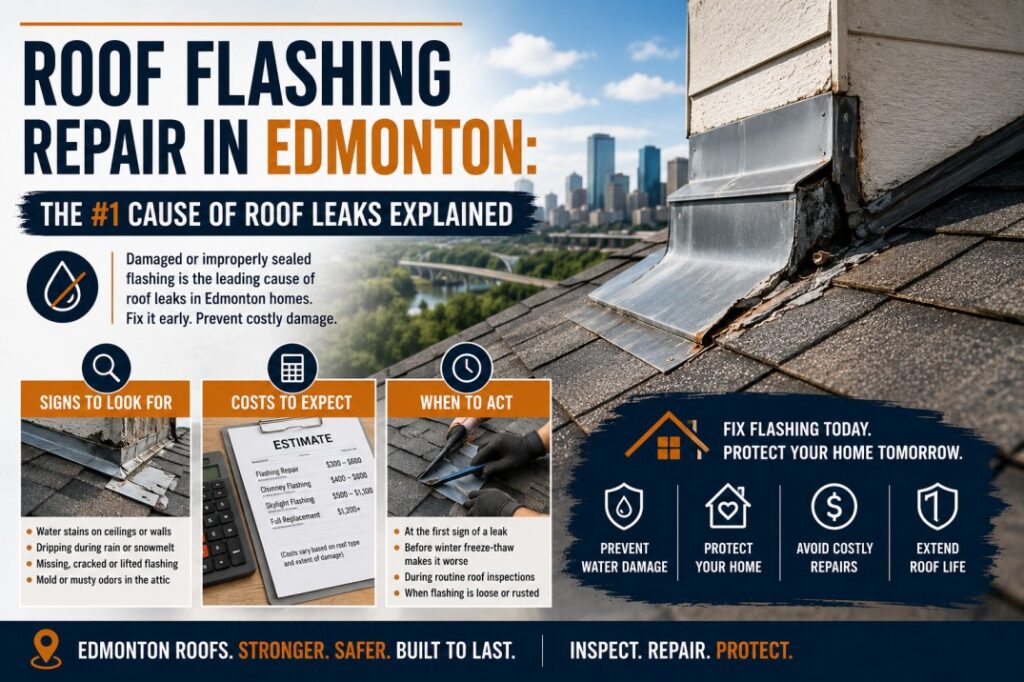
If your roof is leaking in Edmonton and your shingles look completely fine from the ground, you’re not imagining things. The most common cause of roof leaks in Edmonton has nothing to do with damaged or missing shingles — it’s flashing failure. By a significant margin.
Roof flashing is the thin metal system installed wherever two different roof surfaces meet — around chimneys, skylights, vent pipes, dormers, walls, and in roof valleys. These transition points are where water always wants to find a way in, and flashing is the only thing standing between those openings and the interior of your home. When flashing fails in Edmonton’s climate, it almost never announces itself dramatically. It lets in a small amount of water that travels through the roof assembly and appears as a ceiling stain somewhere that has nothing to do with the actual entry point — which is why flashing leaks are consistently the most misdiagnosed and most expensive roof problems Edmonton homeowners deal with.
This guide covers every type of flashing on your roof, exactly why Edmonton’s conditions destroy flashing faster than anywhere else in Canada, how to identify failure before it causes interior damage, and what repair and replacement actually costs in 2026.
Why Edmonton’s Climate Is the Enemy of Roof Flashing
Roof flashing is typically made from aluminum, galvanized steel, or lead-coated copper — all metals that expand when heated and contract when cooled. In a climate with mild temperature swings, this expansion and contraction is minimal and manageable. Edmonton is not that climate.
Edmonton’s temperature range spans approximately 65 degrees Celsius between deep winter lows and peak summer highs. Every day that temperature swings significantly, every flashing component on your roof moves — expanding away from the sealed joints that hold it watertight, then contracting back. Over hundreds of thermal cycles across a single year, the sealant and caulking that keeps flashing watertight fatigues, cracks, and pulls away from the surfaces it’s meant to bond.
The problem accelerates dramatically through Edmonton’s freeze-thaw season in late winter and spring. When water enters even the smallest gap at a flashing joint and freezes, it expands with enough force to widen the gap further. The next thaw lets more water in, which freezes again, widening it further still. What began as a hairline separation at a chimney counter-flashing becomes a meaningful gap within two or three freeze-thaw cycles — and water follows it directly into your home.
This freeze-thaw flashing failure mechanism is why Edmonton roofing contractors see the majority of leak calls in March, April, and May — not during the heavy rains of summer, but after the winter’s repeated freeze-thaw events have done their work on the flashing system throughout the season.
Every Type of Roof Flashing on Your Home — Explained
Understanding where flashing exists on your roof helps you know where to look when a leak appears.
Chimney Flashing
Chimney flashing is the most complex and most failure-prone flashing system on most Edmonton homes. It consists of two layers: base flashing (sometimes called step flashing where it meets the sides of the chimney) that sits beneath the shingles and turns up the chimney face, and counter flashing that is embedded into the chimney mortar joints and overlaps the base flashing from above.
Both components are required and both must work together. When the mortar joint holding the counter flashing deteriorates — a masonry issue, not a roofing issue — the counter flashing lifts and allows water to run behind the base flashing during any rain or thaw event. This is one of the most common winter leak sources in Edmonton homes with chimneys, and the repair involves a roofer for the flashing component and sometimes a mason for the mortar joint.
Skylight Flashing
Skylights sit in a cutout in the roof deck and are sealed to the surrounding shingles through an integrated flashing system. Edmonton’s conditions assault skylight flashing from two directions: UV degradation of the sealant through summer’s long high-UV days, and ice dam pressure in winter that can force water underneath the flashing perimeter.
A critical distinction that Edmonton homeowners frequently miss: water appearing near a skylight is not always flashing failure. When warm interior air hits the cold skylight glass in winter, condensation forms on the interior surface and drips — mimicking a leak with no flashing failure present. The diagnostic test is whether the moisture appears during rain and thaw events (flashing) or consistently during cold weather regardless of precipitation (condensation and ventilation). For more on how attic moisture and condensation work in Edmonton homes, read our roof ventilation Edmonton guide.
Pipe Boot Flashing (Vent Pipe Collars)
Every plumbing vent stack that exits through your roof is sealed at the roof surface with a rubber boot — a cone-shaped rubber collar that fits tightly around the pipe and lays flat on the shingle surface around it. These rubber boots are the most age-sensitive flashing component on Edmonton roofs.
The rubber compound used in pipe boots degrades under UV exposure and becomes brittle in cold. Most pipe boots in Edmonton show significant cracking within 10 to 15 years — well before the surrounding shingles reach the end of their life. A cracked pipe boot is a direct water entry pathway every time it rains, and because vent stacks are often located on rear slopes or near ridges, the resulting interior stain frequently appears far from the actual entry point.
Replacing a pipe boot in Edmonton is one of the most cost-effective preventative repairs available — typically $150–$350 per boot — and it’s a standard item in any professional roof inspection.
Valley Flashing
Roof valleys — where two sloping roof planes meet and channel water downward — are the highest-volume water-flow points on any roof. Valley flashing protects the underlying deck from this concentrated water flow. Two types are used in Edmonton: open metal valley flashing, where a continuous metal channel is visible running down the valley, and closed-cut valleys where shingles from one plane are cut over the valley with an underlying ice-and-water membrane.
Both systems can fail in Edmonton. Metal valley flashing can rust, develop pinholes, or separate at the edges through freeze-thaw cycling. Closed-cut valleys can develop shingle cracking at the cut edge from repeated ice dam pressure. Valley failures tend to produce high-volume leaks quickly because of the water concentration at the failure point.
Step Flashing and Wall Flashing
Wherever a sloped roof plane meets a vertical wall — at dormers, additions, or the side wall of a chimney — step flashing is installed. Step flashing consists of L-shaped metal pieces, one per shingle course, that interleave with the shingles and turn up the wall face. Where step flashing meets the wall, it is covered by counter flashing or integrated with the siding system.
Step flashing failures in Edmonton most commonly occur when the siding above the flashing has separated, allowing water to bypass the counter flashing and enter behind the step flashing entirely. This is a combined siding and roofing issue that requires both trades to address correctly.
How to Tell If Your Flashing Is Failing
You don’t need to go on your roof to identify the most common flashing failure signs. From safe vantage points and from inside your attic, look for:
Water staining on interior ceilings or walls that appears after rain or thaw events — and importantly, is located near a chimney, skylight, dormer, or exterior wall junction. The stain location will almost never be directly below the entry point due to the way water travels through the roof assembly.
Visible lifted, rusted, or separated metal edges on any flashing visible from the ground. Binoculars allow a useful ground-level inspection of chimney flashing from the yard.
Daylight visible around a chimney or skylight edge when viewed from inside the attic. Any light visible through the flashing perimeter is a confirmed gap.
Dark staining on attic rafters or sheathing near any roof penetration — vent stacks, chimney framing, or skylight curb framing. Staining indicates water has been reaching the structural assembly, even if no interior drip has appeared yet.
Cracked or missing caulking at any visible flashing joint accessible from a safe vantage point.
Roof Flashing Repair vs. Replacement — When Each Is Right
Repair is appropriate when failure is isolated to a sealant joint or a small section of counter flashing that has lifted at one point. Recaulking with a premium roofing sealant, or pressing and re-fastening a lifted counter flashing section, is a legitimate repair when the surrounding metal is structurally sound. Flashing repairs in Edmonton typically cost $200–$600 per location.
Replacement is the right call when:
- The metal has rusted through or developed pinholes
- The flashing was improperly installed originally and has never been watertight
- The rubber pipe boot has cracked (replacement, not repair)
- The chimney counter flashing has separated from deteriorated mortar joints (requires both mason and roofer)
- Multiple flashing locations are failing simultaneously — a sign that all flashing is the same age and approaching end-of-life
If your roof is also approaching the end of its shingle life, replacing the full flashing system at the time of a roof replacement in Edmonton is always the right approach. Leaving original flashing under new shingles is one of the most common causes of early failure in new roof installations across Edmonton.
What Roof Flashing Repair Costs in Edmonton — 2026
| Flashing Repair Type | Estimated Cost (2026) |
|---|---|
| Chimney flashing re-seal (caulking and reseating) | $200 – $450 |
| Chimney flashing replacement (full system, both layers) | $800 – $2,000 |
| Skylight flashing re-seal and repair | $200 – $500 |
| Skylight flashing replacement (full perimeter) | $600 – $1,500 |
| Pipe boot replacement (per boot) | $150 – $350 |
| Valley flashing replacement (per valley) | $400 – $1,200 |
| Step flashing replacement (per linear metre) | $35 – $75 installed |
| Emergency leak investigation + temporary repair | $200 – $500 |
These are Edmonton 2026 market ranges. Final cost depends on roof pitch, access difficulty, and whether surrounding shingles require removal and reinstallation to access the flashing properly.
What Your Roofer Should Actually Do for a Flashing Repair
A proper flashing repair in Edmonton isn’t a caulk-gun-from-the-ground service call. Here’s what a professional repair should involve:
Physical access to the failure point. The roofer must get on the roof and directly inspect the flashing, not estimate the problem from the ground.
Removal of surrounding shingles where necessary to access and replace underlying flashing components. Applying new sealant over old lifted flashing without addressing the underlying metal integrity is a temporary patch, not a repair.
A written scope of work before any repair begins, specifying exactly what is being repaired, what materials are being used, and what warranty covers the repair.
A check of all adjacent flashing components. A leak at one chimney flashing joint rarely indicates that the rest of the chimney flashing is in perfect condition. A responsible repair assessment covers the full perimeter of every penetration at the time of access.
Get Your Flashing Checked Before the Next Edmonton Rain Season
Flashing repair is one of the most important — and most neglected — maintenance actions Edmonton homeowners can take. A $250 pipe boot replacement prevents a $5,000 insulation and drywall remediation. A $400 chimney flashing reseal prevents a ceiling that collapses from a winter’s worth of slow water infiltration.
Silverline Roofing checks flashing condition as part of every roof inspection in Edmonton and every roof repair service call. We serve Edmonton and surrounding communities including Sherwood Park, St. Albert, Spruce Grove, Fort Saskatchewan, and Leduc.
Contact Silverline Roofing today for a free, no-obligation roof and flashing assessment — before the next rain season reveals what a freeze-thaw winter has been quietly doing to your roof.