How Much Does It Cost to Reshingle a House in Edmonton? (By House Size)

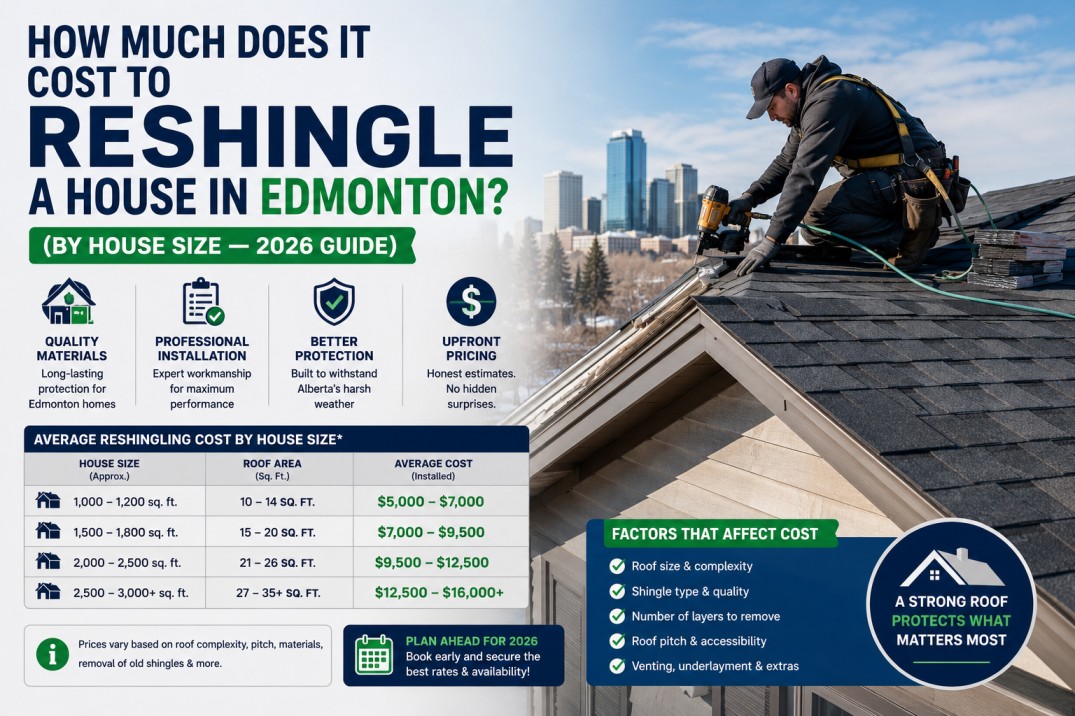
How Much Does It Cost to Reshingle a House in Edmonton? (By House Size — 2026 Guide)

The most searched roofing question in Edmonton — “how much does it cost to reshingle my house?” — has one honest answer: it depends on your house size, and on factors specific to your roof that no online calculator can account for without seeing it. That said, Edmonton homeowners planning a reshingle deserve real numbers to work with before picking up the phone. Generic national cost guides built on US data or across-Canada averages significantly understate what Edmonton roofing actually costs in 2026, and overstating the range to the point of uselessness (“$5,000 to $30,000 depending on factors”) leaves homeowners no better informed than when they started. This guide gives you real 2026 Edmonton pricing broken down by house size — from 1,000 to 2,500 square feet — with the specific factors that move costs up or down in Alberta’s market, and what every quote should include before you sign. Why Your House Size Isn’t the Same as Your Roof Size Before the numbers, one critical clarification that trips up almost every homeowner who tries to use online calculators: your house’s footprint in square feet is not the same as your roof’s surface area. A 1,500 square foot bungalow doesn’t have a 1,500 square foot roof. The actual roof surface is larger because of roof pitch (steeper roofs have more surface per square foot of footprint), overhangs that extend past the exterior walls on all sides, and any architectural complexity — dormers, multiple roof planes, hips, and valleys all add surface area and labour time. For Edmonton’s typical housing stock, here are the practical multipliers: This is why a roofer who quotes without measuring your actual roof — either on-site or via satellite measurement — is not giving you an accurate number. Always insist on a measured quote. Edmonton Reshingle Cost by House Size — 2026 The following ranges are based on dimensional asphalt shingles (the most common residential choice in Edmonton), include full tear-off of existing shingles, ice-and-water shield at eaves and valleys, synthetic underlayment, new drip edge, and labour. They assume standard pitch and reasonable roof complexity. 1,000 Sq Ft House (Approximate Roof Area: 1,100–1,250 sq ft) Typical reshingle cost in Edmonton: $7,500 – $11,000 A small bungalow or garage suite. At this size, mobilisation costs represent a larger proportion of the total — most Edmonton roofing crews have a minimum project size that affects the per-square-foot rate at the low end. Upgrading from standard dimensional shingles to an impact-resistant (Class 4) product like Euroshield adds $4,000–$6,000 to these numbers but can qualify you for an insurance premium reduction. 1,200 Sq Ft House (Approximate Roof Area: 1,350–1,500 sq ft) Typical reshingle cost in Edmonton: $8,500 – $13,000 Edmonton’s most common bungalow size. Most quotes for a 1,200 sq ft Edmonton home will land between $9,000 and $11,500 for mid-grade dimensional shingles with standard pitch. Variables that push toward the higher end include steep pitch, a chimney requiring full flashing replacement, multiple skylight penetrations, or deck damage discovered during tear-off that requires board replacement. This is the home size most frequently affected by hail season claims in Alberta. If you’ve had a hail event in the past three years, a professional roof inspection before getting reshingle quotes will clarify whether you have an insurance claim that should be offsetting this cost. 1,500 Sq Ft House (Approximate Roof Area: 1,700–1,900 sq ft) Typical reshingle cost in Edmonton: $10,000 – $15,500 The sweet spot of Edmonton’s residential market. A 1,500 sq ft two-storey home typically has a roof area larger than a same-footprint bungalow because of the way the roof geometry works on multi-storey homes with smaller footprints. Mid-grade architectural shingles for this size typically run $11,000–$13,500 installed in Edmonton’s 2026 labour market. <cite index=”31-1″>For a standard 1,500 sq ft home, a typical asphalt roof replacement in Alberta costs between $7,000 and $16,000</cite> depending on pitch and complexity — with Edmonton’s labour rates landing most quotes in the upper half of that range given current contractor demand. Budget an additional $1,500–$3,000 if the tear-off reveals deck damage requiring replacement across two or more sections. This is not unusual on Edmonton homes built between 1985 and 2005 where slow flashing leaks may have gone undetected for several seasons. 1,800 Sq Ft House (Approximate Roof Area: 2,050–2,300 sq ft) Typical reshingle cost in Edmonton: $13,000 – $19,000 At this size, roof complexity typically has more impact on total cost than the additional square footage alone. An 1,800 sq ft home with a simple gable roof will quote meaningfully lower than an 1,800 sq ft home with a hip roof, dormers, and two chimneys. For Edmonton roof replacement services at this size, expect quotes in the $14,000–$17,000 range for mid-grade dimensional shingles with a standard pitch and minimal penetrations. If you’re considering metal roofing at this size — steel shake or standing seam — budget $22,000–$38,000 for a complete installation. The higher upfront cost is offset by a 40–70-year lifespan and significantly reduced maintenance. Explore metal roofing in Edmonton for full detail on this option. 2,500 Sq Ft House (Approximate Roof Area: 2,900–3,200 sq ft) Typical reshingle cost in Edmonton: $18,000 – $28,000 Larger homes in Edmonton’s more established neighbourhoods — Glenora, Windsor Park, Riverbend — often have architectural complexity that adds meaningfully to the base cost. Hip roofs, multiple dormers, complex valley systems, and large chimney flashings are common at this size. Budget toward the higher end of the range if your roof has more than two planes or significant penetrations. What’s Included in a Proper Reshingle Quote — and What Isn’t Understanding what should be in your Edmonton reshingle quote protects you from lowball bids that exclude standard components and then add them as change orders after the job starts. Every legitimate reshingle quote in Edmonton should include: Items commonly excluded from low bids (ask specifically): If a quote doesn’t explicitly list these items as included or excluded, ask before you accept. A $2,000 difference between two quotes sometimes represents a

How Much Does It Cost to Reshingle a House in Edmonton? (By House Size — 2026 Guide) Read More »

Eavestrough Installation in Edmonton: Cost, Materials & What to Expect (2026)

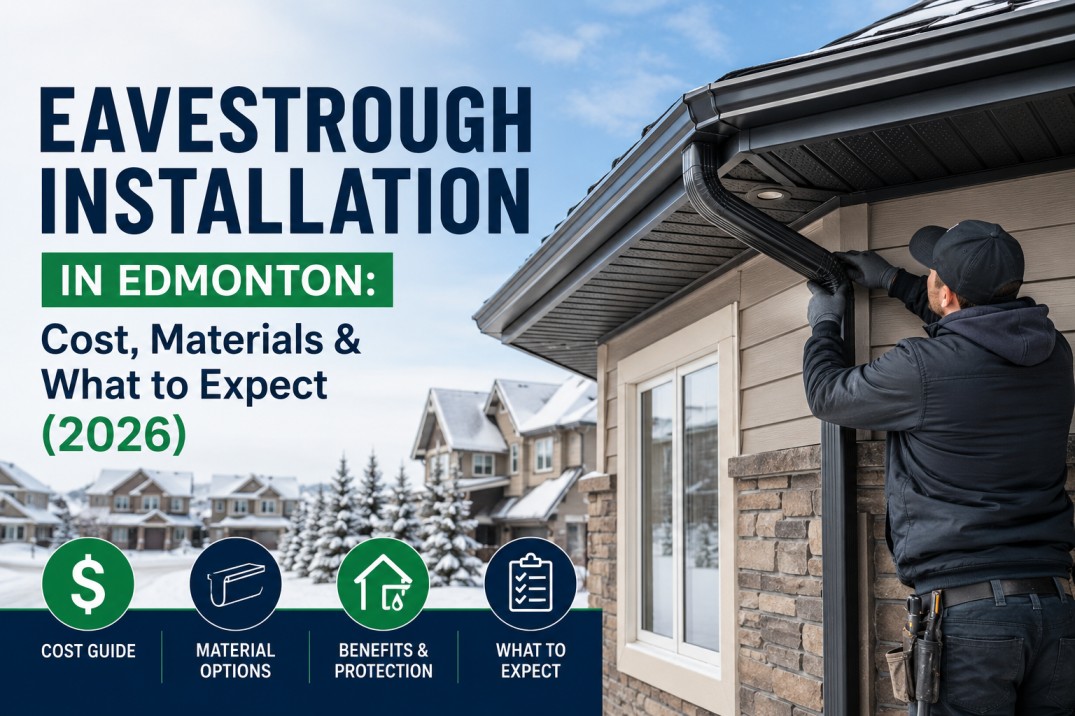
Eavestrough Installation in Edmonton: Cost, Materials & What to Expect (2026)

How Much Does Eavestrough Installation Cost in Edmonton? Eavestrough installation in Edmonton typically costs $8 to $16 per linear foot for seamless 5″ aluminum gutters, or $10 to $18 per linear foot for 6″ oversized systems, fully installed. A complete system for an average bungalow (140–180 linear feet) runs $1,500 to $2,800, while a two-storey home (180–240 linear feet) typically costs $2,200 to $4,200. If your current gutters are past saving, or you’re finishing a new build and need a first-time system installed, eavestrough installation is a different job from a repair — different materials, different sizing decisions, and a different price structure. This guide walks through exactly what goes into a proper eavestrough installation in Edmonton, what it costs in 2026, and how to tell whether you need a fresh install or just a repair. Why Proper Eavestrough Installation Matters in Edmonton Eavestroughs aren’t a cosmetic add-on — they’re your home’s primary defence against foundation damage. Water that isn’t captured and redirected away from your house pools against the foundation, seeps into basements, and causes frost-heave under walkways and driveways during Edmonton’s freeze-thaw cycles. Properly graded downspout discharge is also a requirement under the City of Edmonton’s lot grading and drainage bylaw, so an install that ignores drainage direction can put you offside with the city, not just risk water damage. A poorly installed system — wrong slope, undersized gutters, sectional joints in the wrong places — tends to fail within a few years regardless of material quality. This is why the installation itself matters as much as what you install. Seamless vs. Sectional Eavestroughs Seamless aluminum eavestroughs are formed on-site to the exact length of each roofline run, cut with a truck-mounted roll-former so there are no joints along the straight sections — only at corners and outlets. Fewer joints means fewer leak points, which matters enormously in a climate where expansion and contraction from -30°C to +30°C stresses every seam. Sectional eavestroughs are pre-cut lengths joined with sealant at regular intervals. They’re less expensive upfront but every joint is a future leak point, and Edmonton’s temperature swings degrade sectional sealant faster than milder climates. Sectional systems are increasingly rare on new installations for this reason — seamless has become the local standard. Choosing the Right Gutter Size: 5″ vs. 6″ Standard residential eavestroughs come in two sizes: Your installer should size this based on your actual roof area and pitch, not default to whichever size is cheaper to install. Materials Compared Material Durability in Edmonton’s Climate Typical Use Case Aluminum Excellent — lightweight, rust-resistant, doesn’t crack in cold Most common choice for residential homes Steel Superior strength, handles heavy snow/ice load Homes needing extra resilience, some commercial Vinyl Budget-friendly, but becomes brittle in deep cold Lower-cost option, less ideal for harsh winters Copper Premium, long lifespan, develops a patina over time Heritage homes, high-end architectural projects Aluminum remains the practical standard for most Edmonton homes because it resists rust, holds paint finishes well, and stays flexible enough to handle temperature swings without cracking — something vinyl struggles with once temperatures drop well below freezing. What a Proper Eavestrough Installation Involves Eavestrough Installation Cost in Edmonton — 2026 Item Estimated Cost (2026) Seamless aluminum, 5″ K-style (per linear foot, installed) $8 – $16 Seamless aluminum, 6″ oversized (per linear foot, installed) $10 – $18 Steel eavestrough (per linear foot, installed) $14 – $22 Downspout installation (per downspout) $100 – $250 Gutter guard installation (per linear foot) $6 – $12 Full bungalow system (140–180 linear feet) $1,500 – $2,800 Full two-storey system (180–240 linear feet) $2,200 – $4,200 These are Edmonton-area 2026 market ranges. Final pricing depends on roofline complexity, number of corners and outlets, fascia condition, and downspout routing. If your existing eavestroughs have isolated damage rather than widespread failure, a repair is almost always the more cost-effective route — full replacement makes sense once you’re seeing multiple sagging sections, rust throughout, or a system older than 20 years. Are Gutter Guards Worth It in Edmonton? For homes surrounded by mature trees — especially spruce and poplar — gutter guards significantly reduce how often you need to clean your eavestroughs and help prevent the clogs that lead to ice damming in winter. Aluminum mesh and micro-mesh guards perform well in Edmonton’s climate, though homeowners should be aware that no guard system is fully maintenance-free; an annual visual check is still recommended. New Construction Eavestroughing If you’re finishing a new build, eavestrough installation should be coordinated with your new roof installation so the drainage system is planned around your actual roof design from the start, rather than retrofitted afterward. This is also the ideal time to confirm your downspout discharge points meet city lot grading requirements before landscaping is finished. Repair or Full Installation? A Quick Way to Decide If you’re not sure which you need, our full eavestrough repair guide breaks down the specific warning signs, but as a general rule: Frequently Asked Questions How much does eavestrough installation cost per linear foot in Edmonton? Seamless aluminum installation typically runs $8–$16 per linear foot for 5″ K-style, and $10–$18 for 6″ oversized gutters, installed. Is seamless or sectional better for Edmonton homes? Seamless is the local standard because it eliminates the multiple joints that fail under Edmonton’s freeze-thaw temperature swings. Sectional systems cost less upfront but require more maintenance and repair over time. What size eavestrough do I need — 5″ or 6″? Most bungalows and moderate-pitch roofs do well with 5″ K-style gutters. Larger roof areas, steep pitches, or homes with heavy runoff should use 6″ oversized gutters, which carry roughly three times the water volume. How long does eavestrough installation take? A standard residential installation typically takes one day, since seamless gutters are formed on-site to exact lengths rather than assembled from pre-cut sections. Do I need new eavestroughs, or can mine be repaired? If damage is isolated to a section or two, repair is usually the more cost-effective choice. Full installation makes sense when

Eavestrough Installation in Edmonton: Cost, Materials & What to Expect (2026) Read More »

Structural Roof Repair in Edmonton: What It Is, What It Costs, and When You Need It

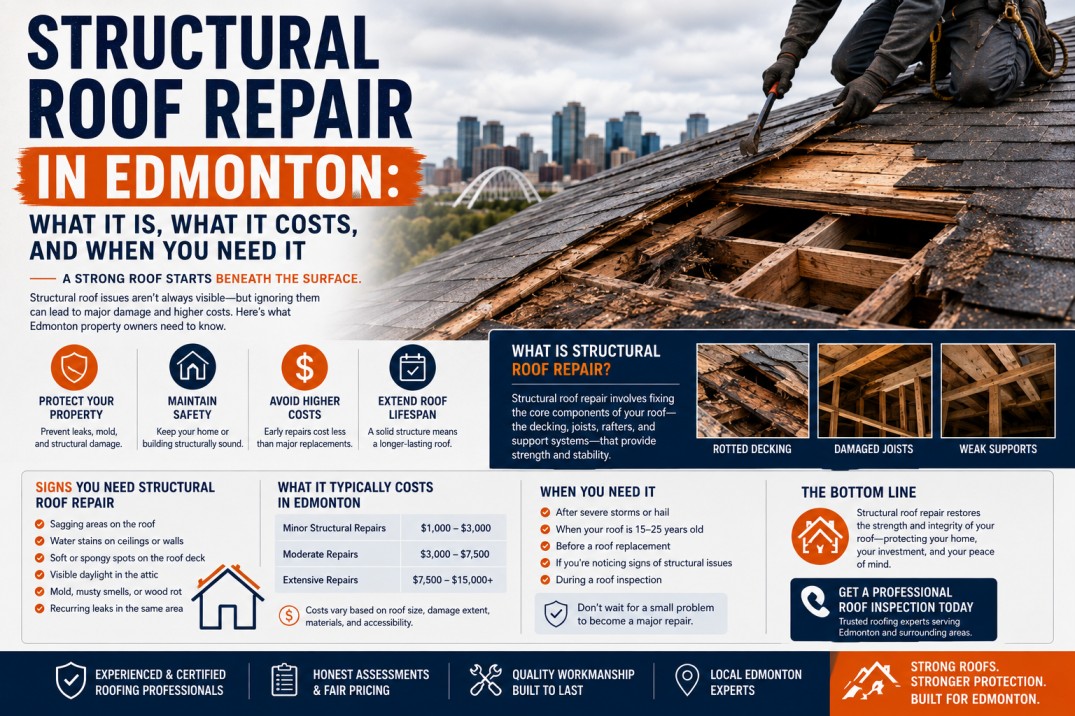
Structural Roof Repair in Edmonton: What It Is, What It Costs, and When You Need It

Most Edmonton homeowners think of roof repair as a shingles problem. A few missing shingles after a storm, some cracked tiles, a leaking flashing joint — these are the surface-level repairs that most people can identify from the ground and understand intuitively. Structural roof repair is something different, and understanding the difference matters enormously for how you plan, budget, and choose who you hire. Structural roof repair addresses the hidden framework beneath your shingles — the plywood or OSB roof decking, the rafters, the trusses, and the ridge board that form the load-bearing skeleton of your roof. When these components are compromised, the consequences don’t stop at a ceiling stain. They affect the structural integrity of the entire roof assembly, and in severe cases, of the home itself. Edmonton’s climate creates specific conditions that make structural roof damage more common here than in milder Canadian cities. This guide explains exactly what structural roof repair involves, how Edmonton’s conditions cause it, the warning signs that tell you it’s happening inside your roof, what Alberta’s 2026 building code requires, and what it realistically costs. Surface Repair vs. Structural Repair — The Difference Edmonton Homeowners Must Understand The simplest way to understand the difference is this: surface repair fixes what you can see. Structural repair fixes what holds everything else up. Surface repairs include replacing shingles, resealing flashing, fixing pipe boot collars, patching minor splits in flat roofing membranes, and re-hanging eavestroughs. These are important maintenance actions, but they don’t change the integrity of the roof’s load-bearing components. A qualified roofer can complete most surface repairs without affecting the structure beneath. Structural repairs address components that bear load — the weight of snow, wind pressure, HVAC equipment, and the roofing material itself. These include: When any of these components rot, crack, crush under load, or separate at connections, the roof’s ability to perform its structural function is compromised — regardless of how good the shingles look from the street. How Edmonton’s Climate Specifically Causes Structural Roof Damage Edmonton creates three conditions that drive structural roof damage at rates higher than most Canadian cities. Snow load accumulation. Edmonton’s heavy wet snowpack — particularly in late winter when snow density is highest — can exert significant downward pressure on a residential roof structure. The Alberta Building Code sets minimum design loads for residential roof structures in Edmonton at 1.8 to 2.4 kPa depending on roof slope, but homes built before modern code adoption or with deferred maintenance can carry compromised structural members that perform below design standard under heavy snow years. A sagging roofline visible from the street after a heavy winter is a structural warning, not a cosmetic issue. Moisture infiltration and wood rot. This is the most common structural damage mechanism in Edmonton residential roofing, and it’s almost always the result of a slow leak that wasn’t caught and addressed promptly. Water entering through failed flashing, a cracked pipe boot, or compromised valley flashing travels through the roof assembly along rafters and decking before appearing as a ceiling stain — often weeks or months after the infiltration began. Over years of repeated seasonal moisture exposure, the structural wood absorbs enough water to support mould growth and eventually structural rot. A single slow chimney flashing leak left unaddressed through two or three Edmonton winters can rot through a rafter — a structural repair that costs significantly more than the flashing fix that would have prevented it. This is why our guide on roof flashing repair in Edmonton emphasises catching flashing failures early. Freeze-thaw expansion at fastener points. Edmonton’s repeated freeze-thaw cycles through spring cause the moisture that penetrates nail and fastener penetrations in the roof deck to freeze, expand, and loosen the fastener’s grip in the surrounding wood. Over multiple seasons, this “nail backing out” effect — well-documented in Alberta’s construction industry — can compromise the connection between decking and rafters, reducing the roof’s wind uplift resistance. This is a less visible form of structural degradation that qualified roof inspectors in Edmonton specifically assess during post-winter inspections. 6 Warning Signs of Structural Roof Damage in Edmonton Homes These signs — some visible from inside the home, some from outside — indicate structural compromise that requires professional assessment promptly. 1. A visibly sagging or uneven roofline. A roofline that dips, bows, or shows a wave pattern between the ridge and the eaves indicates that rafters or trusses beneath the shingle surface have deflected under load. This is a structural emergency in severe cases. 2. Soft spots or bounce when walking the roof. Decking that flexes visibly or feels soft underfoot when a contractor is on the roof surface indicates the plywood or OSB has been saturated with moisture and is delaminating or rotting from within. 3. Cracked or split wood visible in the attic. If you can safely access your attic and see rafters or truss members that are visibly cracked, split, or show discolouration indicating moisture penetration, structural repair is needed before the next significant snow or wind load event. 4. Light visible through the roof deck. Daylight seen from inside the attic through the decking surface — not through a ventilation opening — indicates the deck has failed structurally at that point. 5. Persistent ceiling stains that reappear after repair. If your interior ceiling stain returns after a surface repair has been made, the water source is deeper in the roof assembly than the surface repair addressed. Recurring ceiling moisture following attempted surface fixes is one of the most consistent indicators of an underlying structural moisture problem. 6. A roofline that has changed visibly from previous years. Edmonton homeowners who look at their roofline regularly — or have comparison photos — sometimes notice a gradual change in profile over two to three years. Gradual structural deflection is often easier to identify when compared against an older reference image than when examined in isolation on a single inspection visit. Alberta’s 2026 Building Code: What Structural Roof Repairs Now Require As of March 1,

Structural Roof Repair in Edmonton: What It Is, What It Costs, and When You Need It Read More »

Roof Warranty in Edmonton - What's Actually Covered — and What Quietly Voids It

Roof Warranty in Edmonton: What’s Actually Covered — and What Quietly Voids It

When you get a new roof installed in Edmonton, you’ll almost certainly be handed a warranty document — sometimes two. Most homeowners file it away without reading it carefully, assuming they’re covered for whatever goes wrong over the next 25 to 50 years. That assumption costs Edmonton homeowners real money when claims are denied for reasons they never knew existed. Roof warranties in Edmonton are more conditional than they appear. The conditions aren’t hidden — they’re in the fine print that most people skip. This guide explains every type of roof warranty in plain English, what each one actually covers, the specific Edmonton climate actions that void coverage without most homeowners realising it, and how to make sure you’re actually protected before you need to make a claim. There Are Two Separate Warranties on Every New Roof — And Most Homeowners Only Know About One The single most important thing to understand about roofing warranties in Edmonton is that a new roof almost always comes with two distinct and entirely separate documents. They cover different things, come from different sources, and fail for different reasons. Treating them as one warranty is one of the most common and most expensive roofing mistakes Edmonton homeowners make. The Manufacturer’s Material Warranty is provided by the company that makes your shingles — IKO, Owens Corning, GAF, Malarkey, or another manufacturer. It covers defects in the roofing material itself: premature granule loss, cracking or splitting under normal conditions, delamination, and failure to meet the product’s stated performance specifications. It does not cover installation errors. It does not cover storm damage. And it does not cover any damage caused by conditions the manufacturer lists as exclusions — which, in Alberta, include some situations that are very common. Standard manufacturer warranties on architectural asphalt shingles in Edmonton run 25 to 50 years depending on the product tier. The word “lifetime” appears on premium product warranties and is used to mean the product is warranted for as long as the original purchaser owns the home — not 50 years, not forever. When you sell the home, a “lifetime” warranty either expires or transfers to the new owner in a reduced form, typically for the balance of a set number of years. The Contractor’s Workmanship Warranty is provided by the roofing company that installed your roof. It covers how the roof was installed — whether the shingles were correctly nailed, the flashing properly seated, the ventilation correctly configured, the drip edge correctly installed, and whether all the installation details were done in accordance with the manufacturer’s specifications and Alberta Building Code. This is the warranty that covers the vast majority of actual roof failures, because the research consistently shows that most roof leaks trace to installation errors, not material defects. Workmanship warranty terms in the Edmonton market vary significantly — from one year from budget contractors to ten or more years from quality installers. The length of workmanship warranty is one of the most meaningful indicators of a contractor’s confidence in their own installation quality. Short workmanship warranties from low-bid contractors should be a significant red flag before you sign any contract. Silverline Roofing provides written workmanship warranties on every installation — confirm the specific current terms when you receive your quote. For more on what to look for when selecting a roofing contractor, read our roof replacement Edmonton guide. What Specifically Voids Your Roof Warranty in Edmonton This is the section most homeowners never read until after a claim has been denied. These are real warranty exclusions that apply in Edmonton’s specific climate and maintenance environment. Inadequate attic ventilation. Every major shingle manufacturer requires that their product be installed on a roof with ventilation meeting the manufacturer’s minimum specifications — typically aligned with the 1/300 net free area rule under Alberta Building Code. If your attic ventilation is found to be inadequate at the time of a warranty claim — even if it was that way before your roof was installed — the manufacturer can deny the claim on the basis that their material failed due to an improper installation environment, not a product defect. This is why roof ventilation in Edmonton is assessed and corrected as a standard part of every Silverline Roofing installation. Unauthorized repairs. If any third party other than the original installing contractor or a manufacturer-authorised contractor performs repairs on your roof, most manufacturer warranties are voided for the sections affected — and sometimes for the entire roof. An emergency patch applied by an uncertified contractor after a storm can void coverage on a 30-year warranty. This is a specific Edmonton risk given the storm-chaser crews that arrive after hailstorms and offer fast, cheap repairs. Any repair on a warranted roof should be performed by the original installer or a manufacturer-certified contractor. Pressure washing. Cleaning moss or algae from asphalt shingles using a pressure washer strips granules — the protective UV coating on the shingle surface. Granule loss is the primary evidence manufacturers look for to assess whether a shingle has been maintained correctly. Pressure washing evidence found during a claim inspection voids coverage. If you have moss or organic growth on your Edmonton roof, mechanical cleaning with appropriate brushes and chemical treatment is the correct method. Ice dam damage. Most manufacturer warranties explicitly exclude damage caused by ice dams — including the water damage that results when ice dam meltwater backs up under shingles and into the home. Ice dam formation is considered a building performance issue (inadequate ventilation and insulation allowing the roof deck to stay warm) rather than a material defect. This exclusion is particularly significant in Edmonton, where ice dam formation is common in homes with older or insufficient attic insulation. The warranty excludes the damage, but your home insurance may cover it — understanding which protection applies in which situation is important before any claim. Modified or altered roof structure. If you add a dormer, solar panels, a rooftop HVAC unit, or any other penetration through or attachment

Roof Warranty in Edmonton: What’s Actually Covered — and What Quietly Voids It Read More »

Roof Flashing Repair Edmonton: Types, Costs & Leak Fixes (2026)

Roof Flashing Repair in Edmonton: The #1 Cause of Roof Leaks Explained

If your roof is leaking in Edmonton and your shingles look completely fine from the ground, you’re not imagining things. The most common cause of roof leaks in Edmonton has nothing to do with damaged or missing shingles — it’s flashing failure. By a significant margin. Roof flashing is the thin metal system installed wherever two different roof surfaces meet — around chimneys, skylights, vent pipes, dormers, walls, and in roof valleys. These transition points are where water always wants to find a way in, and flashing is the only thing standing between those openings and the interior of your home. When flashing fails in Edmonton’s climate, it almost never announces itself dramatically. It lets in a small amount of water that travels through the roof assembly and appears as a ceiling stain somewhere that has nothing to do with the actual entry point — which is why flashing leaks are consistently the most misdiagnosed and most expensive roof problems Edmonton homeowners deal with. This guide covers every type of flashing on your roof, exactly why Edmonton’s conditions destroy flashing faster than anywhere else in Canada, how to identify failure before it causes interior damage, and what repair and replacement actually costs in 2026. Why Edmonton’s Climate Is the Enemy of Roof Flashing Roof flashing is typically made from aluminum, galvanized steel, or lead-coated copper — all metals that expand when heated and contract when cooled. In a climate with mild temperature swings, this expansion and contraction is minimal and manageable. Edmonton is not that climate. Edmonton’s temperature range spans approximately 65 degrees Celsius between deep winter lows and peak summer highs. Every day that temperature swings significantly, every flashing component on your roof moves — expanding away from the sealed joints that hold it watertight, then contracting back. Over hundreds of thermal cycles across a single year, the sealant and caulking that keeps flashing watertight fatigues, cracks, and pulls away from the surfaces it’s meant to bond. The problem accelerates dramatically through Edmonton’s freeze-thaw season in late winter and spring. When water enters even the smallest gap at a flashing joint and freezes, it expands with enough force to widen the gap further. The next thaw lets more water in, which freezes again, widening it further still. What began as a hairline separation at a chimney counter-flashing becomes a meaningful gap within two or three freeze-thaw cycles — and water follows it directly into your home. This freeze-thaw flashing failure mechanism is why Edmonton roofing contractors see the majority of leak calls in March, April, and May — not during the heavy rains of summer, but after the winter’s repeated freeze-thaw events have done their work on the flashing system throughout the season. Every Type of Roof Flashing on Your Home — Explained Understanding where flashing exists on your roof helps you know where to look when a leak appears. Chimney Flashing Chimney flashing is the most complex and most failure-prone flashing system on most Edmonton homes. It consists of two layers: base flashing (sometimes called step flashing where it meets the sides of the chimney) that sits beneath the shingles and turns up the chimney face, and counter flashing that is embedded into the chimney mortar joints and overlaps the base flashing from above. Both components are required and both must work together. When the mortar joint holding the counter flashing deteriorates — a masonry issue, not a roofing issue — the counter flashing lifts and allows water to run behind the base flashing during any rain or thaw event. This is one of the most common winter leak sources in Edmonton homes with chimneys, and the repair involves a roofer for the flashing component and sometimes a mason for the mortar joint. Skylight Flashing Skylights sit in a cutout in the roof deck and are sealed to the surrounding shingles through an integrated flashing system. Edmonton’s conditions assault skylight flashing from two directions: UV degradation of the sealant through summer’s long high-UV days, and ice dam pressure in winter that can force water underneath the flashing perimeter. A critical distinction that Edmonton homeowners frequently miss: water appearing near a skylight is not always flashing failure. When warm interior air hits the cold skylight glass in winter, condensation forms on the interior surface and drips — mimicking a leak with no flashing failure present. The diagnostic test is whether the moisture appears during rain and thaw events (flashing) or consistently during cold weather regardless of precipitation (condensation and ventilation). For more on how attic moisture and condensation work in Edmonton homes, read our roof ventilation Edmonton guide. Pipe Boot Flashing (Vent Pipe Collars) Every plumbing vent stack that exits through your roof is sealed at the roof surface with a rubber boot — a cone-shaped rubber collar that fits tightly around the pipe and lays flat on the shingle surface around it. These rubber boots are the most age-sensitive flashing component on Edmonton roofs. The rubber compound used in pipe boots degrades under UV exposure and becomes brittle in cold. Most pipe boots in Edmonton show significant cracking within 10 to 15 years — well before the surrounding shingles reach the end of their life. A cracked pipe boot is a direct water entry pathway every time it rains, and because vent stacks are often located on rear slopes or near ridges, the resulting interior stain frequently appears far from the actual entry point. Replacing a pipe boot in Edmonton is one of the most cost-effective preventative repairs available — typically $150–$350 per boot — and it’s a standard item in any professional roof inspection. Valley Flashing Roof valleys — where two sloping roof planes meet and channel water downward — are the highest-volume water-flow points on any roof. Valley flashing protects the underlying deck from this concentrated water flow. Two types are used in Edmonton: open metal valley flashing, where a continuous metal channel is visible running down the valley, and closed-cut valleys where shingles from

Roof Flashing Repair in Edmonton: The #1 Cause of Roof Leaks Explained Read More »

Soffit and Fascia Repair in Edmonton Signs, Costs, and When to Act

Soffit and Fascia Repair in Edmonton: Signs, Costs, and When to Act

Most Edmonton homeowners can describe their roof shingles and know roughly how old their eavestrough system is. Very few can tell you the last time anyone looked at their soffit and fascia — and that’s exactly the problem. Soffit and fascia sit at the intersection of three of your home’s most important systems: the roof, the exterior cladding, and the attic ventilation. When they’re working correctly, you’ll never think about them. When they start failing, the damage they allow doesn’t stay in one place — it moves into your attic insulation, your roof deck, your eavestroughs, and eventually your interior ceiling. And in Edmonton’s climate, that deterioration happens faster than in almost any other Canadian city. This guide covers exactly what soffit and fascia do, what failure looks like in Edmonton’s specific conditions, your material options and real 2026 costs, and when it makes financial sense to bundle soffit and fascia work with your roof replacement. What Soffit and Fascia Actually Do — and Why Both Matter Fascia is the vertical board that runs along the lowest edge of your roof, directly where your eavestrough attaches. It covers the ends of the roof rafters, gives the roofline a clean finished edge, and serves as the structural anchor for your gutter system. Without sound fascia, your eavestroughs have nothing solid to hang from — which is why sagging gutters and rotting fascia almost always appear together. Soffit is the material that covers the underside of your roof overhang — the horizontal surface you see when you stand near your exterior wall and look upward at the eave. Its job is dual: it seals the eave space against pest entry while providing the ventilation that allows fresh air to enter the attic through perforations or vented panels. The connection between soffit and attic ventilation is one that most homeowners don’t fully appreciate until something goes wrong. Fresh air enters through the soffit vents, travels through the attic, and exits through the ridge vent at the peak — creating the airflow that prevents moisture buildup, attic rain, and the ice dam formation that causes so much roof damage across Edmonton every winter. Damaged or blocked soffit disrupts this airflow at the source. For a full explanation of how this system works together, read our guide on roof ventilation in Edmonton. Why Edmonton Makes Soffit and Fascia Failure Happen Faster Edmonton’s climate does two specific things to soffit and fascia that milder cities simply don’t experience at the same pace. Freeze-thaw cycling destroys wood faster here than almost anywhere. Wooden fascia boards absorb moisture during Edmonton’s wet spring season. That moisture freezes in the wood grain during overnight temperature drops, expands as it freezes, then thaws and contracts when temperatures rise — sometimes multiple times in a single week during March and April. This repeated expansion-contraction splits paint, cracks sealant, opens the wood grain to deeper moisture penetration, and accelerates rot from the inside out. A wooden fascia board that might last 20 years in Vancouver can show serious rot in Edmonton in 8 to 12 years without regular maintenance. Eavestrough ice weight multiplies fascia stress. When eavestroughs fill with water and ice during Edmonton’s winter — a common occurrence when gutters aren’t properly cleared before freeze-up — the weight of that ice puts direct downward pressure on the fascia board the gutter is mounted to. Over multiple winters, this mechanical stress loosens the gutter mounting, separates the fascia from the rafter ends beneath, and creates gaps that admit moisture and wildlife. Wildlife and insect entry through damaged soffit is a significantly bigger issue in Edmonton than in denser urban environments. Squirrels, starlings, wasps, and hornets actively seek out gaps in damaged soffit panels as nest sites — particularly in the spring. Once an animal establishes a nesting space in your attic through a soffit gap, the insulation and structural damage it causes often runs into thousands of dollars of remediation on top of the soffit repair itself. 7 Warning Signs Your Edmonton Home Needs Soffit or Fascia Attention Look carefully at your roofline from the ground — ideally from multiple angles and in good light. These are the signs that warrant a closer professional look: 1. Peeling or bubbling paint on the fascia board. Paint failure is the first signal that moisture has breached the surface. By the time paint is visibly failing, the wood beneath has already begun absorbing water. 2. Soft, spongy, or discoloured wood on the fascia. Press gently on accessible fascia sections. Soft or springy wood indicates rot has begun. Discolouration without softness means moisture has been present but may not yet be structural. 3. Sagging eavestroughs pulling away from the fascia. When gutters begin separating from the roofline, the fascia they’re mounted to has either rotted enough to lose grip on the fasteners or has been mechanically stressed to the point of structural failure. This is not a gutter problem — it is a fascia problem with a gutter symptom. Read more about eavestrough repair in Edmonton and why fascia condition determines whether gutter repairs hold. 4. Visible holes, gaps, or cracked panels in the soffit. Any gap in soffit panels larger than a few millimetres is a potential wildlife or insect entry point as well as a moisture pathway into the eave cavity. 5. Staining or streaking on exterior siding below the roofline. Water that escapes through failed fascia or soffit doesn’t disappear — it runs down your exterior wall, causing staining that worsens with each rainfall and can eventually damage the wall structure behind the cladding. 6. Increased heating bills in winter or cooling costs in summer. When soffit ventilation is compromised, attic airflow is disrupted. A warm attic in winter drives ice dam formation and heat loss through the ceiling. A hot attic in summer increases your air conditioning load measurably. 7. Sounds of scratching or activity in the attic or eave space. If you can hear movement above your ceiling or in the

Soffit and Fascia Repair in Edmonton: Signs, Costs, and When to Act Read More »

Commercial Flat Roofing in Edmonton TPO, EPDM, and Modified Bitumen — Which Is Right for Your Property?

Commercial Flat Roofing in Edmonton: What Property Owners Need to Know

If you own or manage a commercial property in Edmonton — a retail strip, office building, industrial unit, multi-family complex, or commercial warehouse — your roof is one of the highest-value and highest-risk components of the entire asset. Commercial flat roofs in Edmonton face a specific set of demands that residential pitched roofs simply don’t: larger surface areas accumulating more water and debris, rooftop HVAC equipment that requires maintenance access, and the unforgiving physics of ponding water that flat and low-slope systems must manage precisely or fail early. Most Edmonton commercial property owners know they need a flat roofing system. Far fewer know the meaningful differences between the three primary options — TPO, EPDM, and modified bitumen — and which one performs best under the specific conditions their building faces. Making the wrong choice at the point of installation doesn’t just cost money upfront. It costs money every year of the roof’s life in energy, maintenance, and eventually premature replacement. This guide gives you the complete, honest picture — written specifically for Edmonton’s climate, not for a generic Canadian or North American audience. Why Flat Roofing in Edmonton Is More Demanding Than Most Property Owners Realise Edmonton’s climate creates a combination of stresses that commercial flat roofs in milder cities simply don’t experience at the same intensity. Spring thaw and ponding water is the single biggest risk factor for commercial flat roofs in Edmonton. When weeks of accumulated snowpack melts over a compressed spring period, enormous volumes of water arrive on the roof surface in a short window. If drainage is even partially blocked — by debris, ice, or inadequate slope design — water ponds on the membrane surface. Ponding water accelerates membrane degradation, stresses seams, and in severe cases creates structural load risk. A properly designed Edmonton flat roof must have drainage engineered to handle spring thaw volumes, not just typical rainfall. Freeze-thaw cycling through winter and early spring repeatedly stresses every seam, flashing, and membrane termination point on the roof. Each cycle is a small expansion-contraction event — and over hundreds of cycles per winter season, seam adhesives and mechanical fastener penetrations are tested in ways that warmer climates never produce. Temperature extremes in Edmonton span roughly 60°C between peak summer and deep winter. Roofing membranes that perform well across this full range are not the same as membranes chosen for temperate climates. Flexibility at -30°C and UV stability at +30°C are both non-negotiable requirements for any membrane system specified in Edmonton. Rooftop equipment access on commercial buildings — for HVAC maintenance, mechanical systems, and satellite/communication equipment — introduces foot traffic as an ongoing stress on commercial flat roof membranes that residential applications don’t face. The Three Primary Commercial Flat Roofing Systems for Edmonton Properties TPO (Thermoplastic Polyolefin) — The Modern Default TPO has become the most specified flat roofing membrane for new commercial installations across Edmonton and Canada broadly, and for well-founded reasons. A single-ply thermoplastic membrane available in white, grey, and tan, TPO is installed in large rolls that are heat-welded at the seams — creating a continuous, essentially permanent bond that is as strong as the surrounding membrane itself. The heat-welded seam advantage is TPO’s most important attribute for Edmonton. Unlike adhesive-bonded systems, heat-welded TPO seams don’t degrade through freeze-thaw cycling or UV exposure. The bond doesn’t age out. This is the primary reason experienced Edmonton commercial roofing contractors have shifted toward TPO as the default specification for new flat roof installations. TPO’s white reflective surface also provides meaningful energy performance benefits during Edmonton’s increasingly intense July and August. Roof surface temperatures on a white TPO membrane run 20–35°C cooler than black EPDM under the same solar exposure — translating directly to reduced cooling costs for any air-conditioned commercial space beneath. Edmonton TPO installed cost: $8.00 – $14.00 per square foot, including membrane, insulation, fasteners, and labour. Lifespan with quality installation: 25–35 years. For more on Silverline Roofing’s flat roofing services, visit our flat roofing Edmonton service page. EPDM (Ethylene Propylene Diene Monomer) — The Proven Cold-Climate Performer EPDM is the roofing membrane with the longest proven track record in North American commercial construction — commercially installed since the 1960s, with some original installations still functional today. A synthetic rubber membrane, EPDM is manufactured in large sheets (up to 15 metres wide), which dramatically reduces the number of seams compared to TPO and is one of its most meaningful practical advantages. EPDM’s rubber composition maintains flexibility at temperatures as low as -60°C — well below anything Edmonton winters produce. This cold-weather flexibility makes EPDM the most forgiving membrane for extreme freeze-thaw cycling, and it’s why EPDM remains the preferred specification for long-hold institutional properties like schools, hospitals, and warehouses where maximum lifespan and minimum replacement frequency are the primary objectives. The key trade-off versus TPO is seam technology. EPDM seams are adhesive-bonded rather than heat-welded. High-quality EPDM installations with premium seam tape perform well — but adhesive systems are inherently more dependent on installation conditions, surface preparation, and long-term adhesive durability than welded systems. Most EPDM roofs that fail before their rated lifespan do so at seams, typically between years 15 and 25. EPDM is also available in 45, 60, and 90-mil thicknesses. For Edmonton commercial applications, 60-mil is the industry standard minimum — 90-mil is specified where foot traffic, equipment access, or extreme hail exposure is a factor. Edmonton EPDM installed cost: $8.00 – $16.00 per square foot depending on membrane thickness and attachment method. Lifespan with quality 60-mil installation: 25–40 years. Modified Bitumen — The High-Traffic and Layered Performance Option Modified bitumen is a multi-layer asphalt-based system that has been used on Edmonton commercial roofs for decades and remains the right specification for specific building types and use conditions. Unlike single-ply membranes, modified bitumen is applied in multiple layers — typically a base sheet mechanically fastened to the deck, an interply layer, and a granulated or smooth cap sheet — creating a roofing assembly with inherent redundancy. Modified bitumen is the strongest

Commercial Flat Roofing in Edmonton: What Property Owners Need to Know Read More »

Cedar shake roof conversion to asphalt shingles on an Edmonton home.

Cedar Shake Roof Conversion in Edmonton: Is It Time to Make the Switch?

Cedar shake roofs have a look that is genuinely difficult to replicate. The natural texture, the warm tones, the way a cedar roof ages into a distinguished silver-grey — it’s easy to understand why homeowners in Edmonton’s older neighbourhoods like Glenora, Crestwood, Westmount, and Laurier Heights chose cedar when their homes were built. But cedar shake roofing was designed for a different era of home maintenance expectations. In Edmonton’s modern climate reality — with increasingly severe hail seasons, stricter municipal fire codes, rising insurance premiums, and the reality of what Alberta’s freeze-thaw cycles do to natural wood over 20 or 30 years — many homeowners are finding that the look they love is coming at a cost they didn’t fully anticipate. This guide covers everything Edmonton homeowners need to know about cedar shake roof conversion: the warning signs that tell you it’s time, your material options, what a proper conversion involves, and what it realistically costs in 2026. Why Edmonton’s Climate Is Particularly Hard on Cedar Shake Roofs Cedar performs reasonably well in dry climates with consistent temperatures. Edmonton is neither of those things. Alberta’s spring thaw cycles introduce repeated cycles of moisture absorption and drying that cause cedar shakes to swell, contract, split, and warp over time. The wet springs that follow Edmonton’s heavy snowpack seasons are particularly damaging — cedar that stays damp for extended periods is highly susceptible to moss growth, mould, and rot that spreads from the surface into the shake itself and eventually into the roof deck beneath. Alberta’s hail seasons compound the problem significantly. While asphalt shingles lose granules and rubber shingles absorb impact, cedar shakes crack and split under hail impact — and cracked shakes create immediate pathways for moisture penetration. A single significant hailstorm can take years off a cedar roof’s remaining useful life. Add the gradual degradation of the wood’s natural oils — which are what give cedar its moisture resistance — and most Edmonton cedar roofs show serious performance decline between 15 and 25 years, well short of cedar’s theoretical 30-year lifespan. 7 Signs Your Edmonton Cedar Roof Is Ready for Conversion Walk around your property and look carefully. If you’re seeing several of these signs, a full cedar shake roof conversion is likely a more cost-effective decision than continued repair: 1. Widespread splitting and cracking — Individual splits are a normal maintenance item. Splitting across large sections of the roof is a sign the wood has dried out and lost structural integrity. 2. Curling or cupped shakes — When the edges of shakes curl upward or the centre cups downward, the wood has warped from repeated moisture cycling. Water pools rather than shedding and accelerates the damage further. 3. Missing shakes after storms — Cedar shakes that have aged past their prime become brittle and detach under wind load. After storms, gaps in the roof surface allow direct water entry. 4. Moss or dark staining across the surface — Moss retains moisture against the shake surface continuously. Dark organic staining indicates the wood is already decomposing in affected areas. 5. Soft or spongy areas on the roof deck — If the deck beneath the shakes has absorbed enough moisture to begin rotting, the problem has moved beyond the shakes themselves. Deck repairs become a significant added cost in the conversion project. 6. Repeated leak repairs that don’t hold — One or two isolated leak repairs are normal maintenance. If you’re having the same areas repaired every season, the underlying wood structure is compromised and patches are not addressing the real problem. 7. Insurance renewal surprises — Many Alberta insurers are now declining to renew or sharply increasing premiums on homes with cedar shake roofs over 20 years old, particularly following hail damage claims. In some cases, conversion is a condition of continued coverage. Your Cedar Conversion Options in Edmonton — Compared Honestly A cedar shake roof conversion in Edmonton means a complete removal of the existing shake system, inspection and repair of the roof deck, and installation of a modern roofing material. Here are your main options: Dimensional Asphalt Shingles — Best Value Conversion Dimensional (architectural) asphalt shingles are the most common conversion choice for Edmonton cedar roofs. Modern dimensional shingles produce a textured, multi-layer appearance that reads as visually premium from the street — not as flat and plain as older 3-tab shingles. They handle Edmonton’s climate well, carry 30 to 50-year warranties, and represent the lowest upfront conversion cost. For homes where the cedar look was a priority, several manufacturers now offer cedar-profile dimensional shingles that closely replicate the visual character of wood shake without any of the maintenance demands. Installed cost for a cedar-to-asphalt conversion in Edmonton typically runs $8,000 – $15,000 for a standard residential home depending on roof size, pitch, and deck repair scope. Metal Roofing — Longest-Lasting Conversion Metal roofing — particularly steel shake profiles and standing seam systems — delivers the most complete long-term solution for Edmonton homeowners converting from cedar. Metal handles hail, fire, wind, and snow load better than any other commonly available roofing material. It carries 40 to 70-year lifespans, qualifies for insurance premium reductions as a fire-resistant and impact-resistant system, and requires virtually zero maintenance over its life. The visual match for homes that valued cedar’s appearance is excellent — steel shake profiles replicate the texture and shadow lines of wood shake with remarkable accuracy. Installed cost for a cedar-to-metal conversion in Edmonton typically runs $16,000 – $35,000 depending on the system and roof complexity. Learn more about metal roofing in Edmonton. Euroshield Rubber Roofing — Best for Hail Resistance Euroshield rubber shingles are a strong conversion choice specifically for Edmonton homeowners whose priority is protecting against future hail damage and reducing insurance premiums. Made from recycled tires in Canada and rated Class 4 under the UL 2218 impact standard — the highest available — Euroshield shingles absorb hail impact without cracking or splitting. The cedar-profile Euroshield product provides a compelling visual match for homes converting from

Cedar Shake Roof Conversion in Edmonton: Is It Time to Make the Switch? Read More »

Professional roofing contractors installing a new asphalt shingle roof on a home in Edmonton, illustrating roof installation costs, process, and homeowner expectations.

New Roof Installation in Edmonton: What to Expect, What It Costs, and How to Get It Right

Whether you’re building a new home, replacing a roof that’s reached the end of its life, or upgrading to better materials after years of Alberta storms — a new roof installation in Edmonton is one of the largest and most important investments you’ll make as a property owner. Most homeowners go into the process knowing very little about what actually happens between signing a contract and the crew packing up their trailer. That information gap leads to surprises, miscommunication, and in some cases, costly mistakes that show up years down the line. This guide walks you through the entire new roof installation process in Edmonton — what happens at each stage, what it costs in 2026, what your contractor should be doing that some skip, and what questions to ask before you sign anything. Is It a New Installation or a Replacement? The Difference Matters Before diving into the process, it’s worth clarifying the difference between a new roof installation and a roof replacement — because they involve different scopes of work and different cost structures. A new construction roof installation is exactly what it sounds like — a roof being built on a new home or addition from scratch, starting with bare roof decking. There is no tear-off involved, no old material to remove, and the decking condition is known from the start. This is typically a faster, more straightforward project. A roof replacement involves removing your existing roofing system down to the deck, inspecting and repairing the deck where needed, and installing an entirely new roofing system on top. This is what most Edmonton homeowners are dealing with when their current roof has aged out or been damaged. Both are referred to as “new roof installation” in everyday conversation, and both are covered in this guide. The process is similar — the main difference is the tear-off and deck repair phase that replacements require. The Full New Roof Installation Process in Edmonton — Step by Step Step 1: Roof Assessment and Scope of Work Every professional new roof installation in Edmonton starts with a thorough assessment — not a glance from the driveway. A qualified contractor inspects the existing structure (or plans for new construction), documents the scope of work, confirms the ventilation requirements under Alberta Building Code, and provides a detailed written quote. Be cautious of any contractor who quotes a new roof installation without physically inspecting the roof and attic. Prices quoted without a proper site visit almost always change once the job starts — usually upward. A proper roof inspection in Edmonton is the foundation of an accurate quote. Step 2: Material Selection This is where you make the decision that affects the next 25 to 50+ years of your roof’s performance. Edmonton’s climate demands materials that can handle freeze-thaw cycling, heavy snow loads, UV exposure, and hail — often all in the same year. Your main options for a new roof installation in Edmonton: Asphalt shingles remain the most popular choice for residential homes. Dimensional (architectural) asphalt shingles offer the best balance of cost, durability, and aesthetics, with lifespans of 30–50 years when properly installed and ventilated. Standard installed cost runs $5,000–$13,000 for a typical Edmonton home. Read more about asphalt shingle installation in Edmonton. Metal roofing is the longest-lasting option, with a lifespan of 40–70 years and exceptional performance in snow and wind. It costs significantly more upfront — typically $15,000–$35,000 installed — but its longevity and near-zero maintenance often make it the more cost-effective choice over a 40-year horizon. Learn more about metal roofing in Edmonton. Euroshield rubber roofing is the top choice for hail resistance, carrying a Class 4 impact rating and a 50+ year lifespan. Made from recycled materials in Canada, it’s an ideal long-term investment for Edmonton homeowners who want to reduce insurance premiums and storm damage risk. Explore Euroshield rubber roofing in Edmonton. Flat roofing systems (modified bitumen, TPO, EPDM) are used for low-slope commercial and some residential applications. Silverline Roofing installs multiple flat roofing systems across Edmonton — learn more at our flat roofing Edmonton page. Step 3: Permits and Code Compliance A professional roofing contractor in Edmonton handles the permit process on your behalf. The City of Edmonton requires a Home Improvement Permit for most full roof installations, typically costing $150–$500 depending on the project scope. As of 2026, new Roof Truss Engineering Requirements also apply to projects involving major structural changes — your contractor must be aware of these and factor them into the project plan. A contractor who tells you permits aren’t necessary for a full roof installation is not someone you want on your roof. Step 4: Tear-Off and Deck Inspection (Replacements) For roof replacements, day one typically begins with removing the old roofing material completely down to the deck boards. This is important — laying new shingles over old ones traps moisture, adds weight, and prevents proper inspection of the deck underneath. Silverline Roofing always performs a complete tear-off on replacement projects. Once the deck is exposed, any soft, rot-damaged, or structurally compromised sections are identified and replaced before the new installation begins. This is also when ventilation corrections are made — blocked soffit channels cleared, baffles installed, ridge vent systems upgraded where needed. For more on why this matters, read our guide on roof ventilation in Edmonton. Step 5: Underlayment and Ice-and-Water Shield Before any shingles go down, the deck receives a layer of protective underlayment — typically synthetic felt — across the entire surface. Equally important in Edmonton’s climate is the ice-and-water shield membrane, a self-adhering waterproof barrier installed along the eaves (minimum 2 metres from the inside wall line, per Alberta Building Code) and in all valleys. Ice-and-water shield is not optional in Edmonton. It’s the barrier that prevents meltwater backing up under your shingles during freeze-thaw events from reaching your roof deck. Any quote that doesn’t mention it should prompt a question. Step 6: Shingle or Material Installation With the deck prepared and protected, the actual roofing

New Roof Installation in Edmonton: What to Expect, What It Costs, and How to Get It Right Read More »

Roof Ventilation Edmonton: Attic Rain, Ice Dams & Fixes (2026)

Roof Ventilation Edmonton: Why Most Homes Get It Wrong — And Pay for It

Here’s something most Edmonton homeowners don’t expect to hear: one of the most common causes of roof damage in this city has nothing to do with hail, wind, or snow. It’s the air trapped inside your own attic. Poor roof ventilation is behind a surprisingly large number of the premature shingle failures, winter ice dams, mould problems, and mysterious interior leaks that Edmonton roofing contractors deal with every single year. And the frustrating part is that most homeowners don’t find out until the damage is already significant — because the signs hide inside your attic, out of sight, for months before anything shows up on a ceiling. If your Edmonton home was built before 2005, there’s a good chance your roof ventilation system is either outdated, improperly balanced, or partially blocked. This guide explains exactly what roof ventilation does, what goes wrong in Edmonton’s climate, and what to do about it. What Roof Ventilation Actually Does Roof ventilation is the system that moves air continuously through your attic space — drawing fresh cool air in through intake vents at the soffits and pushing warm moist air out through exhaust vents at the ridge or near the roof peak. This airflow does three critical things for your home: In winter, it keeps the attic cold. That might sound counterintuitive, but a cold attic is exactly what you want in Edmonton. When attic temperatures stay near the outside air temperature, the snow on your roof stays frozen evenly — preventing the melt-refreeze cycle that causes ice dams. A warm attic melts the snow above it, and that water refreezes at the cold roof edge, forming the thick ice ridges that force water back under your shingles. In summer, it exhausts heat. Edmonton attics with inadequate ventilation can reach 60–70°C on hot July days. That extreme heat accelerates shingle granule loss, causes the asphalt mat to harden and crack prematurely, and drives up your air conditioning costs by forcing your HVAC system to fight the heat radiating down from above. Year-round, it removes moisture. Every time someone showers, cooks, or even breathes inside your home, moisture-laden warm air rises. In a well-ventilated attic, this air exits before it can cause damage. In an under-ventilated attic, it hits the cold underside of your roof deck and turns to frost — then melts when temperatures rise. Edmonton roofers have a name for that last problem. They call it attic rain. Attic Rain: Edmonton’s Most Misunderstood Roof Problem Attic rain is not a leak. It doesn’t come through damaged shingles or failed flashing. But it mimics a leak so closely that many homeowners — and even some contractors — mistake it for one and apply the wrong fix entirely. Here is what happens: during Edmonton’s deep freeze periods, warm humid air from your living space migrates into the attic and condenses on the cold roof deck as frost. Everything appears fine while temperatures stay below freezing. Then a chinook arrives or temperatures rise rapidly — as they frequently do in Edmonton — and all that accumulated frost melts at once, dripping through your insulation and down through your ceiling. The water appears suddenly, often after a mild spell, and stops when temperatures drop again. That on-off pattern is the clearest diagnostic signal that you’re dealing with attic rain rather than a roof penetration leak. The fix is not a new roof. The fix is correct attic ventilation. Watch for these warning signs of attic rain and ventilation failure in your Edmonton home: If you’re seeing any of these, a professional roof inspection in Edmonton should be your first call — not a roofing patch. The Alberta Building Code Rule Most Homeowners Don’t Know Alberta’s Building Code requires a minimum net free ventilation area equal to 1/300 of the insulated ceiling area — and that ventilation must be balanced, meaning roughly half the venting capacity must be intake at the soffits and the other half exhaust at or near the ridge. In practice, the most common ventilation failure Silverline Roofing finds in Edmonton homes is not insufficient exhaust — it’s blocked intake. Attic insulation that has been added over the years gradually migrates toward the soffit area, compressing against the eave and sealing off the intake vents entirely. Without fresh cold air coming in at the bottom, no amount of ridge venting at the top will create meaningful airflow. The second most common problem is conflicting vent types. Mixing ridge vents with upper-roof box vents or turbines short-circuits the system — the exhaust vents closest to the ridge pull air from the lower exhaust vents rather than drawing it through the soffit intake. The result is a small loop of recirculated attic air that does almost nothing to remove moisture. Types of Roof Ventilation Used on Edmonton Homes Understanding your options helps you have an informed conversation with your contractor when ventilation upgrades are on the table. Ridge vents run continuously along the roof peak and are the most effective passive exhaust system for pitched residential roofs. They are visually low-profile and, when paired with proper soffit intake, create the most consistent airflow pattern of any passive system. Soffit vents are the intake side of the equation. They can be continuous (a perforated strip running the full length of the soffit) or individual round or rectangular units placed at intervals. Continuous soffit vents provide the most consistent intake and are strongly preferred in Edmonton’s climate. Box vents (static vents) are cut into the roof deck near the peak and allow hot air to escape. They work adequately on their own but are generally outperformed by continuous ridge vents and should never be mixed with ridge vents on the same roof. Power vents (attic fans) are electrically powered exhaust units that actively pull air through the attic. They can be effective but must have adequate soffit intake to work correctly — otherwise they depressurize the attic and draw conditioned air out of your living space, raising your

Roof Ventilation Edmonton: Why Most Homes Get It Wrong — And Pay for It Read More »

Scroll to Top