Author name: Priyanshu

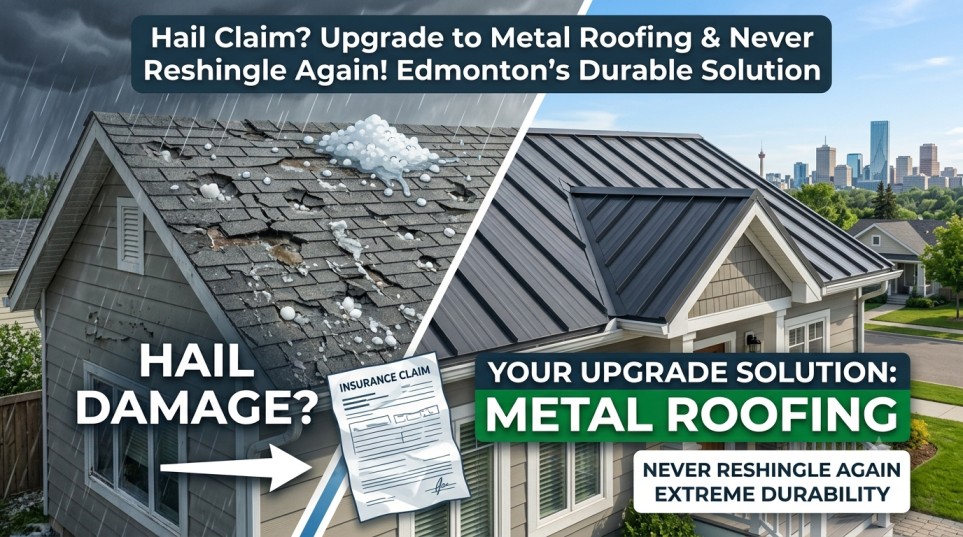
Edmonton hail damage? Thousands of homeowners use their insurance claim to upgrade to metal roofing — and pay little to nothing out of pocket. Here's exactly how it works in 2026.

Metal Roofing in Edmonton: How to Use Your Hail Claim to Upgrade — and Never Reshingle Again

Every summer, Edmonton homeowners go through the same cycle. A significant hailstorm hits. Granule damaged asphalt shingles get documented. An insurance claim is filed. A crew comes out and installs new asphalt shingles — the same material that just got damaged — and the homeowner waits for the next hailstorm to do it again. There’s a better path. And it starts with understanding one thing: your Alberta home insurance claim doesn’t require you to replace damaged shingles with the same material. You can upgrade. Thousands of Edmonton homeowners in recent years have used hail damage insurance claims as the financial foundation for a full asphalt to metal roof upgrade — paying little to nothing out of pocket while permanently eliminating future hail damage risk. This guide explains exactly how that works, what metal roofing delivers in Edmonton’s climate, and what the numbers look like in 2026. Why Metal Roofing Is the Conversation Edmonton Homeowners Are Having Right Now Alberta sits in Canada’s most active hail corridor. The Edmonton area has experienced multiple significant hail events in recent years — each producing thousands of claims and, in many cases, revealing asphalt shingles that were already compromised from previous storms. The insurance industry has noticed. Alberta home insurance premiums have risen 15–25% in two years as insurers reprice hail exposure across the province. For Edmonton homeowners who have filed one or more hail claims, the economics of asphalt roofing are shifting. A 30 year asphalt shingle roof that gets hail-damaged at year eight, repaired, damaged again at year fourteen, and replaced at year twenty isn’t actually delivering 30 years of trouble free performance — it’s delivering 30 years of claim cycles, premium increases, and exposure to $2,000–$5,000 deductibles. Metal roofing solves this structurally. A Class 4 impact rated steel roofing system — the highest available rating — is designed to absorb the hail impacts that leave asphalt shingles bruised, granule depleted, and heading toward a claim. The steel surface may show superficial denting on an extreme hailstorm, but it does not crack, does not lose protective coating, does not leak, and does not generate a claim. Most Edmonton homeowners who upgrade to metal after a hail event report that subsequent Alberta hailstorms become non events for their roof specifically. To understand more about the hail damage claim process and what’s involved before an upgrade decision is made, our hail damage roof Edmonton guide covers every step from documentation to settlement. How the Insurance Upgrade Works — The 2026 Edmonton Process Using a hail insurance claim to upgrade to metal roofing in Edmonton follows a specific sequence. Understanding each step protects you from common mistakes that either reduce the claim value or create issues with the contractor selection. Step 1: Document the damage before anything is touched. After any significant hailstorm — hailstones at or above pea size warrant inspection — photograph all visible exterior damage. Check your eavestroughs and downspouts for granule accumulation within 48 hours. Dark granule sediment in the gutter is the most accessible evidence of shingle impact damage. Save the Environment Canada severe weather alert for your area on the date of the event. Step 2: Get a professional written inspection report. Before contacting your insurer, have a qualified Edmonton roofing contractor inspect and document the damage in writing. A professional inspection report carries significantly more weight with an insurance adjuster than homeowner photos alone. Silverline Roofing provides written inspection reports for all post storm assessments. For the full inspection process, see our roof inspection Edmonton page. Step 3: Open the claim and understand your coverage type. Contact your insurer with your documentation. The most important question to clarify immediately: does your policy use Replacement Cost Value (RCV) or Actual Cash Value (ACV)? RCV pays the full cost of like for like replacement. ACV deducts depreciation — potentially significantly for roofs over 10 years old. RCV coverage gives you the most flexibility for an upgrade. With ACV coverage, the upgrade still works but the out of pocket calculation changes. Step 4: Understand what “upgrade differential” means. When you upgrade to a more expensive roofing material using an insurance claim, your insurer typically pays the RCV amount for what was damaged — in this case, asphalt shingles. The difference in cost between the insurance funded asphalt replacement and the metal roofing installation is the “upgrade differential” — the amount you pay out of pocket for the upgrade. On a typical Edmonton home, insurance might fund $10,000–$15,000 toward an asphalt replacement. A comparable metal installation costs $18,000–$30,000. Your out of pocket upgrade differential is the gap — typically $8,000–$15,000. The upgrade differential is paid once. An asphalt deductible, by contrast, is paid every time you file a claim — potentially two or three times over the metal roof’s lifespan. For many Edmonton homeowners, the financial comparison closes within the first or second avoided future claim cycle. Step 5: Confirm the Class 4 insurance discount before installation. This is the step most homeowners miss. Many Alberta insurers offer 10–30% premium discounts for Class 4 impact resistant roofing. To claim the discount, you typically need to provide your insurer with the contractor installation invoice and the manufacturer’s Class 4 specification sheet after completion. Call your broker before the installation date to confirm the discount percentage and exactly what documentation they require. Get the confirmation in writing. Step 6: Use a certified Edmonton metal roofing contractor. Manufacturer warranties on metal roofing systems are conditional on certified installation. A non-certified contractor can install the same product, but the manufacturer warranty is void from day one — meaning the 40 to 50 year warranty that makes metal roofing’s value proposition compelling is simply not available. Always ask for manufacturer installer certification documentation before signing any contract. What Metal Roofing Actually Delivers in Edmonton’s Climate For homeowners considering the upgrade but not yet certain it’s the right choice, here is what metal roofing specifically delivers in Edmonton’s conditions: Hail resistance: Class 4 steel roofing passes the

Metal Roofing in Edmonton: How to Use Your Hail Claim to Upgrade — and Never Reshingle Again Read More »

Edmonton's climate demands a specific roof maintenance routine — not a generic checklist. Get the complete season-by-season schedule for spring, summer, fall, and winter roof care with tasks, costs, and when to call a pro.

Roof Maintenance Schedule for Edmonton Homes: Your Complete Seasonal Guide

Edmonton’s climate doesn’t give roofs a break. Between deep winter freeze-thaw cycles, spring meltwater volumes that test every drainage system, June hailstorms that can damage shingles without leaving a visible mark from the ground, and poplar fluff season that blocks soffit vents and eavestroughs almost overnight — Edmonton homeowners are dealing with four distinct seasonal threats every single year. A generic roof maintenance checklist built for a milder Canadian climate will miss most of what matters here. This guide is structured specifically around Edmonton’s seasonal calendar — what to do, when to do it, what you can handle yourself, and what requires a professional. The difference between a proactive maintenance schedule and reactive repairs is almost always money. A $200 eavestrough cleaning prevents a $3,000 fascia replacement. A $150 pipe boot replacement prevents a $5,000 drywall and insulation remediation. A pre-winter roof inspection that catches a lifted flashing prevents a ceiling collapse from a winter’s worth of slow water infiltration. The math consistently favours maintenance, and Edmonton’s climate makes that margin larger than almost anywhere else in Canada. Why Edmonton’s Roof Maintenance Calendar Is Different From Other Cities Before the seasonal schedule, one important framing point: the standard advice of “inspect your roof twice a year — spring and fall” is correct for most of Canada. For Edmonton, it’s necessary but not sufficient. Edmonton layers on several additional maintenance triggers that other cities don’t face at the same intensity. The June poplar fluff event deposits fibrous material across the entire city within a two to three week window, blocking soffit vents and eavestrough drainage almost simultaneously. Alberta’s hail corridor means hail events requiring shingle inspection are not rare occurrences — they’re an expected annual risk. Attic rain — the Edmonton-specific phenomenon where accumulated winter frost melts rapidly during a chinook and mimics an interior leak — means attic inspections can’t wait for a ceiling stain to appear. And the freeze-up timing in October and November means eavestrough clearing must happen within a specific weather window or ice damage follows through winter. With that context, here is your complete Edmonton roof maintenance calendar. Spring Roof Maintenance — April to May Spring is the most important maintenance window on Edmonton’s roof calendar, and it should happen as soon as temperatures reliably stay above freezing overnight — typically mid to late April in Edmonton’s climate. Your spring roof maintenance checklist: Attic inspection first. Before going outside, go into your attic. Look for frost staining or dark discolouration on the underside of the roof deck — evidence of attic rain events through the winter. Check insulation near the eaves for compression or moisture damage. Look at rafter and truss members for any cracking or splitting that occurred under winter snow load. What you find in the attic tells you what kind of exterior inspection to prioritise. For a deeper understanding of what you’re looking for and why, read our guide on roof ventilation in Edmonton. Shingle inspection from the ground and roof. Look for shingles that lifted, curled, or split under winter ice dam pressure. Check valleys, eave edges, and ridges — the highest-stress points through freeze-thaw cycling. If you’ve had ice dams this winter, inspect the first two or three rows of shingles above the eave line for granule loss and edge damage. This is the inspection window that catches damage while it’s still a repair, not a replacement. A professional roof inspection in Edmonton this time of year includes thermal imaging in some cases to identify moisture in the deck that isn’t visible to the eye. Flashing check. Walk the perimeter and look at chimney flashing, pipe boot collars, and any visible valley flashing for separation, cracking, or lifted edges. Edmonton’s freeze-thaw cycling is particularly hard on caulked flashing joints — winter’s repeated expansion and contraction pulls sealant away from the bond surface. What looks like a sealed joint in October may have a gap by April. Our roof flashing repair guide explains exactly what to look for and what each repair costs in 2026. Eavestrough cleaning — round one. Clear winter debris — leaves, needles, and any ice residue — from all eavestrough sections and confirm downspouts are flowing freely. Check fascia boards for softness or discolouration from winter ice loading. Confirm all brackets are still firmly attached. Soffit inspection. Walk the perimeter looking upward at the soffit underside. Check for any gaps, cracked panels, or displaced sections that may have been exploited by wildlife through winter — squirrels and starlings begin nesting in spring and are actively looking for soffit entry points from late March. Learn more about what damaged soffit does to your roof system in our soffit and fascia repair guide. Professional spring inspection cost: $150–$350 for a full written assessment. This is the most cost-effective professional spend on the Edmonton roof maintenance calendar. Summer Roof Maintenance — June to August Summer maintenance in Edmonton is dominated by two priorities: poplar fluff and hail. Your summer roof maintenance checklist: Post-poplar-fluff eavestrough clearing — mid-June. The poplar fluff event in Edmonton typically runs from late May through mid-June. By the third week of June, a second eavestrough cleaning is needed regardless of how clean the gutters were in April. Poplar fibres create a dense mat inside eavestroughs that traps moisture against the eavestrough bottom and prevents drainage even from moderate rainfall. This is the single most Edmonton-specific maintenance task on this list — no generic Canadian checklist includes it because no other major Canadian city has the same poplar tree density and timing. Hail damage inspection after any significant storm. Edmonton sits in Canada’s hail corridor, and Alberta’s hail season peaks June through August. After any hailstorm where hailstones were pea-sized or larger, a ground-level and preferably professional roof inspection is warranted. Hail damage on asphalt shingles is often invisible from the ground — knocked granules, bruised shingle mats, and cracked rubber pipe boots don’t announce themselves until the shingle begins failing months later. Check your eavestroughs and

Roof Maintenance Schedule for Edmonton Homes: Your Complete Seasonal Guide Read More »

Can You Replace a Roof in Winter in Edmonton? The Honest 2026 Answer

Can You Replace a Roof in Winter in Edmonton? The Honest 2026 Answer

The question comes up every year as Edmonton homeowners realise their roof has issues heading into fall — and then the temperature drops faster than expected. Can you replace a roof in winter in Edmonton? Is it safe? Is it even legal? Will it void the warranty? The honest answer is more complicated than the yes-or-no responses that circulate online. Winter roofing in Edmonton is possible under specific conditions. It carries real technical constraints that affect material performance, installation method, and cost. And it’s the genuinely correct choice in some situations while being the wrong choice in others. This guide gives you the complete, technically accurate picture so you can make an informed decision — whether you’re dealing with an emergency, planning ahead, or just trying to understand what you’re being told by a contractor who wants to book your job in January. Why Winter Roofing in Edmonton Is Technically Challenging To understand winter roofing in Edmonton, you first need to understand what cold temperatures actually do to roofing materials — specifically to asphalt shingles, which cover the vast majority of Edmonton’s residential roofing stock. The adhesive seal strip problem. Every asphalt shingle has a strip of heat-activated adhesive on its underside. This strip bonds to the shingle below it after installation, creating the weathertight seal that holds your roof together under wind and weather. The adhesive requires sustained temperatures above approximately 4°C to activate and cure properly. Below that threshold — which Edmonton regularly reaches for four to five months of the year — the adhesive doesn’t bond. Shingles installed in cold weather must be hand-sealed individually by the installer to compensate, which adds labour time and cost to every row of shingles on the roof. Shingle brittleness in extreme cold. Asphalt shingles become significantly more brittle below -10°C. A shingle that flexes during warm-weather installation to lay flat on the roof deck resists that flex in cold weather — and if forced, can crack along the bend. Cracked shingles at installation mean immediate warranty failure at those points. This is why experienced Edmonton winter roofers are judicious about which temperature ranges they’ll work in and how they handle material storage on-site. Shingles brought directly from a cold truck to a cold roof are at highest risk — pre-warming stored materials is a standard cold-weather practice for quality contractors. Pneumatic tool reliability. Nail guns and pneumatic tools become unreliable in extreme cold, with o-rings stiffening and air pressure behaving inconsistently. Below approximately -15°C, hand-nailing becomes the only reliable installation method. Hand-nailing every shingle dramatically increases labour time — and labour cost — for any winter installation project. Ice and deck conditions. Working on an Edmonton roof in winter means working on a surface that may be icy, snow-covered, or both. This creates genuine safety risk that reputable contractors take seriously. Additional safety equipment, slower working pace, and more frequent weather-related stoppages all factor into winter project timelines and costs. Temperature Thresholds by Roofing Material — Edmonton Practical Guide Not all roofing materials have the same cold-weather limitations. Here’s what Edmonton homeowners need to know by material type: Material Workable Minimum Key Cold-Weather Risk Asphalt shingles (3-tab, dimensional) 4°C (without hand-sealing) Adhesive won’t activate; shingles brittle below -10°C Impact-resistant asphalt (Class 4) 4°C (without hand-sealing) Same as standard asphalt Euroshield rubber shingles -20°C Rubber stays flexible; cold installation is viable Metal roofing (steel shake, standing seam) No hard minimum Metal contracts in cold — fastener placement requires adjustment TPO flat membrane -10°C (with precautions) Seam welding is temperature-sensitive EPDM flat membrane -20°C Rubber composition maintains flexibility Modified bitumen (torch-on) -15°C (with experienced crew) Torch application compensates for cold The practical takeaway: metal roofing and rubber roofing systems (Euroshield, EPDM) are genuinely more suitable for Edmonton winter installation than standard asphalt shingles. An experienced Edmonton contractor installing Euroshield or metal in January faces fewer material constraints than one installing standard dimensional shingles. Explore Euroshield rubber roofing in Edmonton for more detail on this product’s cold-weather advantages. When Winter Roof Replacement in Edmonton Is the Right Call Despite the technical challenges, there are specific situations where replacing a roof in winter in Edmonton is not just acceptable but genuinely the correct decision. Emergency situations. If your roof has suffered structural damage, has a significant open penetration from storm damage, or is actively leaking in a way that threatens interior damage, the cost and inconvenience of winter installation is clearly preferable to the alternative. Emergency roof repair in Edmonton that addresses immediate risk — tarping, patching, emergency shingle replacement — is always available in winter regardless of temperature. Full replacement in an emergency context is evaluated case by case based on the severity of the situation and current conditions. When fall bookings are missed. Edmonton’s fall roofing season (September–October) is the highest-demand period of the year for quality roofing contractors. Homeowners who identify a roofing need in November or early December face a realistic choice: wait until spring (April–May) with the roof in its current condition through the winter, or proceed in winter with a contractor who has capacity and can work within the material constraints. For roofs in poor but stable condition, waiting is often acceptable. For roofs showing active failure points, winter replacement may be the financially sound choice compared to emergency interior repairs from winter water infiltration. Budget timing. Winter is genuinely lower-demand for roofing contractors in Edmonton. While some contractors charge winter premiums (15–25% more is a realistic range for the added complexity and risk), others offer more competitive pricing to maintain crew continuity. Homeowners who are flexible on timing and can negotiate effectively may find legitimate cost savings on non-urgent replacements booked for December or January. When to Wait for Spring — Edmonton’s Practical Reality For planned, non-emergency roof replacement in Edmonton, waiting until late April through early June is the recommendation most experienced contractors give their own family members. Here’s why spring is the optimal window in Edmonton specifically: Late April and May offer temperatures consistently

Can You Replace a Roof in Winter in Edmonton? The Honest 2026 Answer Read More »

How Much Does It Cost to Reshingle a House in Edmonton? (By House Size)

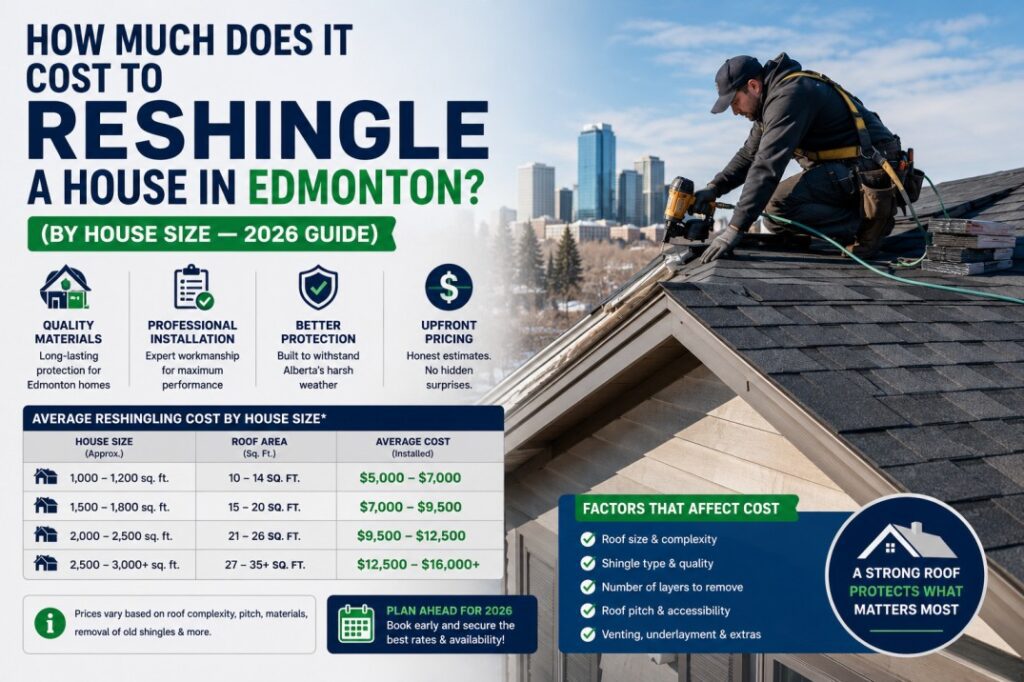
How Much Does It Cost to Reshingle a House in Edmonton? (By House Size — 2026 Guide)

The most searched roofing question in Edmonton — “how much does it cost to reshingle my house?” — has one honest answer: it depends on your house size, and on factors specific to your roof that no online calculator can account for without seeing it. That said, Edmonton homeowners planning a reshingle deserve real numbers to work with before picking up the phone. Generic national cost guides built on US data or across-Canada averages significantly understate what Edmonton roofing actually costs in 2026, and overstating the range to the point of uselessness (“$5,000 to $30,000 depending on factors”) leaves homeowners no better informed than when they started. This guide gives you real 2026 Edmonton pricing broken down by house size — from 1,000 to 2,500 square feet — with the specific factors that move costs up or down in Alberta’s market, and what every quote should include before you sign. Why Your House Size Isn’t the Same as Your Roof Size Before the numbers, one critical clarification that trips up almost every homeowner who tries to use online calculators: your house’s footprint in square feet is not the same as your roof’s surface area. A 1,500 square foot bungalow doesn’t have a 1,500 square foot roof. The actual roof surface is larger because of roof pitch (steeper roofs have more surface per square foot of footprint), overhangs that extend past the exterior walls on all sides, and any architectural complexity — dormers, multiple roof planes, hips, and valleys all add surface area and labour time. For Edmonton’s typical housing stock, here are the practical multipliers: This is why a roofer who quotes without measuring your actual roof — either on-site or via satellite measurement — is not giving you an accurate number. Always insist on a measured quote. Edmonton Reshingle Cost by House Size — 2026 The following ranges are based on dimensional asphalt shingles (the most common residential choice in Edmonton), include full tear-off of existing shingles, ice-and-water shield at eaves and valleys, synthetic underlayment, new drip edge, and labour. They assume standard pitch and reasonable roof complexity. 1,000 Sq Ft House (Approximate Roof Area: 1,100–1,250 sq ft) Typical reshingle cost in Edmonton: $7,500 – $11,000 A small bungalow or garage suite. At this size, mobilisation costs represent a larger proportion of the total — most Edmonton roofing crews have a minimum project size that affects the per-square-foot rate at the low end. Upgrading from standard dimensional shingles to an impact-resistant (Class 4) product like Euroshield adds $4,000–$6,000 to these numbers but can qualify you for an insurance premium reduction. 1,200 Sq Ft House (Approximate Roof Area: 1,350–1,500 sq ft) Typical reshingle cost in Edmonton: $8,500 – $13,000 Edmonton’s most common bungalow size. Most quotes for a 1,200 sq ft Edmonton home will land between $9,000 and $11,500 for mid-grade dimensional shingles with standard pitch. Variables that push toward the higher end include steep pitch, a chimney requiring full flashing replacement, multiple skylight penetrations, or deck damage discovered during tear-off that requires board replacement. This is the home size most frequently affected by hail season claims in Alberta. If you’ve had a hail event in the past three years, a professional roof inspection before getting reshingle quotes will clarify whether you have an insurance claim that should be offsetting this cost. 1,500 Sq Ft House (Approximate Roof Area: 1,700–1,900 sq ft) Typical reshingle cost in Edmonton: $10,000 – $15,500 The sweet spot of Edmonton’s residential market. A 1,500 sq ft two-storey home typically has a roof area larger than a same-footprint bungalow because of the way the roof geometry works on multi-storey homes with smaller footprints. Mid-grade architectural shingles for this size typically run $11,000–$13,500 installed in Edmonton’s 2026 labour market. <cite index=”31-1″>For a standard 1,500 sq ft home, a typical asphalt roof replacement in Alberta costs between $7,000 and $16,000</cite> depending on pitch and complexity — with Edmonton’s labour rates landing most quotes in the upper half of that range given current contractor demand. Budget an additional $1,500–$3,000 if the tear-off reveals deck damage requiring replacement across two or more sections. This is not unusual on Edmonton homes built between 1985 and 2005 where slow flashing leaks may have gone undetected for several seasons. 1,800 Sq Ft House (Approximate Roof Area: 2,050–2,300 sq ft) Typical reshingle cost in Edmonton: $13,000 – $19,000 At this size, roof complexity typically has more impact on total cost than the additional square footage alone. An 1,800 sq ft home with a simple gable roof will quote meaningfully lower than an 1,800 sq ft home with a hip roof, dormers, and two chimneys. For Edmonton roof replacement services at this size, expect quotes in the $14,000–$17,000 range for mid-grade dimensional shingles with a standard pitch and minimal penetrations. If you’re considering metal roofing at this size — steel shake or standing seam — budget $22,000–$38,000 for a complete installation. The higher upfront cost is offset by a 40–70-year lifespan and significantly reduced maintenance. Explore metal roofing in Edmonton for full detail on this option. 2,500 Sq Ft House (Approximate Roof Area: 2,900–3,200 sq ft) Typical reshingle cost in Edmonton: $18,000 – $28,000 Larger homes in Edmonton’s more established neighbourhoods — Glenora, Windsor Park, Riverbend — often have architectural complexity that adds meaningfully to the base cost. Hip roofs, multiple dormers, complex valley systems, and large chimney flashings are common at this size. Budget toward the higher end of the range if your roof has more than two planes or significant penetrations. What’s Included in a Proper Reshingle Quote — and What Isn’t Understanding what should be in your Edmonton reshingle quote protects you from lowball bids that exclude standard components and then add them as change orders after the job starts. Every legitimate reshingle quote in Edmonton should include: Items commonly excluded from low bids (ask specifically): If a quote doesn’t explicitly list these items as included or excluded, ask before you accept. A $2,000 difference between two quotes sometimes represents a

How Much Does It Cost to Reshingle a House in Edmonton? (By House Size — 2026 Guide) Read More »

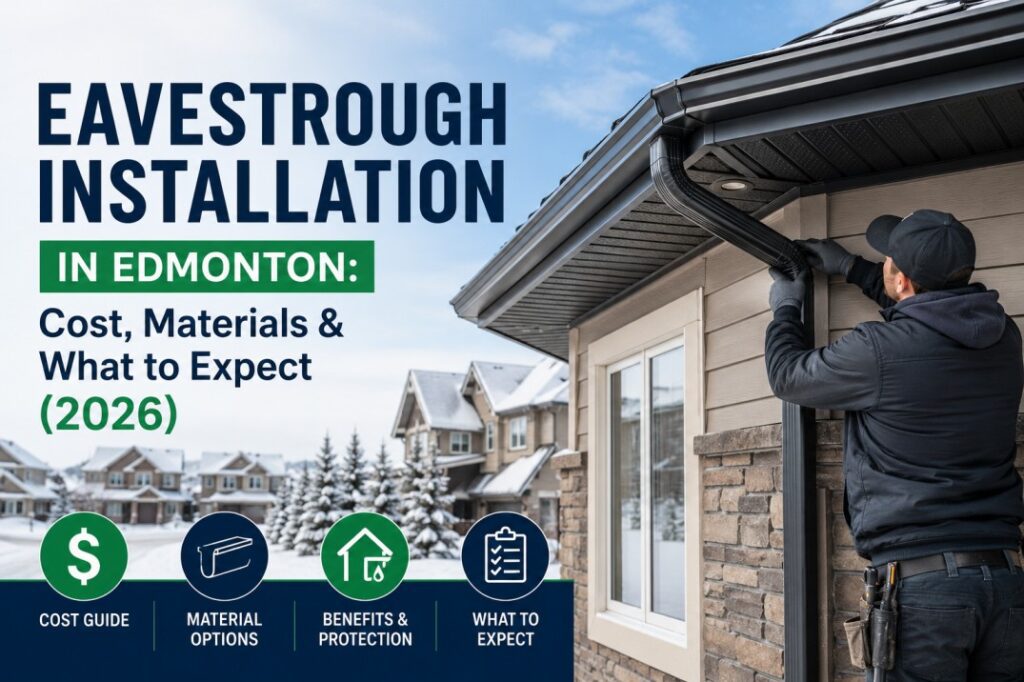
Eavestrough Installation in Edmonton: Cost, Materials & What to Expect (2026)

Eavestrough Installation in Edmonton: Cost, Materials & What to Expect (2026)

How Much Does Eavestrough Installation Cost in Edmonton? Eavestrough installation in Edmonton typically costs $8 to $16 per linear foot for seamless 5″ aluminum gutters, or $10 to $18 per linear foot for 6″ oversized systems, fully installed. A complete system for an average bungalow (140–180 linear feet) runs $1,500 to $2,800, while a two-storey home (180–240 linear feet) typically costs $2,200 to $4,200. If your current gutters are past saving, or you’re finishing a new build and need a first-time system installed, eavestrough installation is a different job from a repair — different materials, different sizing decisions, and a different price structure. This guide walks through exactly what goes into a proper eavestrough installation in Edmonton, what it costs in 2026, and how to tell whether you need a fresh install or just a repair. Why Proper Eavestrough Installation Matters in Edmonton Eavestroughs aren’t a cosmetic add-on — they’re your home’s primary defence against foundation damage. Water that isn’t captured and redirected away from your house pools against the foundation, seeps into basements, and causes frost-heave under walkways and driveways during Edmonton’s freeze-thaw cycles. Properly graded downspout discharge is also a requirement under the City of Edmonton’s lot grading and drainage bylaw, so an install that ignores drainage direction can put you offside with the city, not just risk water damage. A poorly installed system — wrong slope, undersized gutters, sectional joints in the wrong places — tends to fail within a few years regardless of material quality. This is why the installation itself matters as much as what you install. Seamless vs. Sectional Eavestroughs Seamless aluminum eavestroughs are formed on-site to the exact length of each roofline run, cut with a truck-mounted roll-former so there are no joints along the straight sections — only at corners and outlets. Fewer joints means fewer leak points, which matters enormously in a climate where expansion and contraction from -30°C to +30°C stresses every seam. Sectional eavestroughs are pre-cut lengths joined with sealant at regular intervals. They’re less expensive upfront but every joint is a future leak point, and Edmonton’s temperature swings degrade sectional sealant faster than milder climates. Sectional systems are increasingly rare on new installations for this reason — seamless has become the local standard. Choosing the Right Gutter Size: 5″ vs. 6″ Standard residential eavestroughs come in two sizes: Your installer should size this based on your actual roof area and pitch, not default to whichever size is cheaper to install. Materials Compared Material Durability in Edmonton’s Climate Typical Use Case Aluminum Excellent — lightweight, rust-resistant, doesn’t crack in cold Most common choice for residential homes Steel Superior strength, handles heavy snow/ice load Homes needing extra resilience, some commercial Vinyl Budget-friendly, but becomes brittle in deep cold Lower-cost option, less ideal for harsh winters Copper Premium, long lifespan, develops a patina over time Heritage homes, high-end architectural projects Aluminum remains the practical standard for most Edmonton homes because it resists rust, holds paint finishes well, and stays flexible enough to handle temperature swings without cracking — something vinyl struggles with once temperatures drop well below freezing. What a Proper Eavestrough Installation Involves Eavestrough Installation Cost in Edmonton — 2026 Item Estimated Cost (2026) Seamless aluminum, 5″ K-style (per linear foot, installed) $8 – $16 Seamless aluminum, 6″ oversized (per linear foot, installed) $10 – $18 Steel eavestrough (per linear foot, installed) $14 – $22 Downspout installation (per downspout) $100 – $250 Gutter guard installation (per linear foot) $6 – $12 Full bungalow system (140–180 linear feet) $1,500 – $2,800 Full two-storey system (180–240 linear feet) $2,200 – $4,200 These are Edmonton-area 2026 market ranges. Final pricing depends on roofline complexity, number of corners and outlets, fascia condition, and downspout routing. If your existing eavestroughs have isolated damage rather than widespread failure, a repair is almost always the more cost-effective route — full replacement makes sense once you’re seeing multiple sagging sections, rust throughout, or a system older than 20 years. Are Gutter Guards Worth It in Edmonton? For homes surrounded by mature trees — especially spruce and poplar — gutter guards significantly reduce how often you need to clean your eavestroughs and help prevent the clogs that lead to ice damming in winter. Aluminum mesh and micro-mesh guards perform well in Edmonton’s climate, though homeowners should be aware that no guard system is fully maintenance-free; an annual visual check is still recommended. New Construction Eavestroughing If you’re finishing a new build, eavestrough installation should be coordinated with your new roof installation so the drainage system is planned around your actual roof design from the start, rather than retrofitted afterward. This is also the ideal time to confirm your downspout discharge points meet city lot grading requirements before landscaping is finished. Repair or Full Installation? A Quick Way to Decide If you’re not sure which you need, our full eavestrough repair guide breaks down the specific warning signs, but as a general rule: Frequently Asked Questions How much does eavestrough installation cost per linear foot in Edmonton? Seamless aluminum installation typically runs $8–$16 per linear foot for 5″ K-style, and $10–$18 for 6″ oversized gutters, installed. Is seamless or sectional better for Edmonton homes? Seamless is the local standard because it eliminates the multiple joints that fail under Edmonton’s freeze-thaw temperature swings. Sectional systems cost less upfront but require more maintenance and repair over time. What size eavestrough do I need — 5″ or 6″? Most bungalows and moderate-pitch roofs do well with 5″ K-style gutters. Larger roof areas, steep pitches, or homes with heavy runoff should use 6″ oversized gutters, which carry roughly three times the water volume. How long does eavestrough installation take? A standard residential installation typically takes one day, since seamless gutters are formed on-site to exact lengths rather than assembled from pre-cut sections. Do I need new eavestroughs, or can mine be repaired? If damage is isolated to a section or two, repair is usually the more cost-effective choice. Full installation makes sense when

Eavestrough Installation in Edmonton: Cost, Materials & What to Expect (2026) Read More »

Scroll to Top