
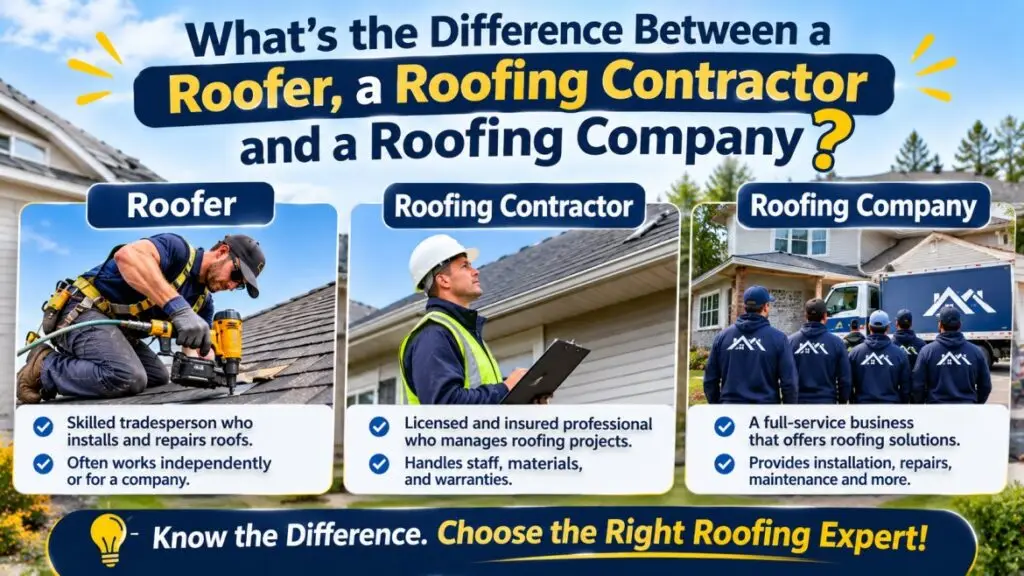
What’s the difference between a roofer, a roofing contractor and a roofing company?
A roofer is the tradesperson who does the hands-on work on the roof. A roofing contractor is the person or business that signs the contract with you and is responsible for the job. A roofing company is an established business with its own crews, insurance, warranties and office support that handles the whole project from inspection to clean-up. In Edmonton, the label matters less than the proof: a valid WCB Alberta account, liability insurance, a written contract and, if they take a deposit at your home, an Alberta prepaid contractor licence.
Type “roofing company Edmonton” or “roofers near me” into Google and you’ll get a mix of large companies, small two-person crews, general contractors, handymen and, after every hailstorm, out-of-province storm crews. They all call themselves roofers. But who you hire changes who is responsible if something goes wrong, what warranty you actually get and how well the job is managed.
This guide explains the difference in plain language, the Alberta-specific credentials to check (which most online guides get wrong because they’re written for the US), which type of roofer fits which job, and the questions that separate a professional from a risk.
Roofer, roofing contractor and roofing company compared
| Roofer | Roofing contractor | Roofing company | |
|---|---|---|---|
| Who they are | The tradesperson installing and repairing roofs | The individual or business you sign the contract with | An established business with its own crews and office |
| Who you deal with | Often works for someone else | Usually the owner, sometimes with a small crew or subcontractors | A project manager or estimator, plus the crew |
| Responsibility | Quality of their own work | The whole job, legally and financially | The whole job, backed by the business |
| Insurance and WCB | Covered by their employer, or their own if independent | Should carry their own; always verify | Company-wide coverage you can verify |
| Warranty | None on their own, unless independent | Workmanship warranty varies widely | Written workmanship warranty, plus access to manufacturer programs |
| Best for | You rarely hire one directly | Smaller repairs, simple jobs | Replacements, storm damage, insurance work, multi-trade exteriors |
Roofers: the people on the roof
A roofer is the skilled tradesperson who tears off old roofing, installs underlayment, flashing and shingles, and repairs leaks. In Alberta, roofer is a recognized apprenticeship trade, and experienced roofers may hold a journeyperson certificate. Most roofers work for a contractor or company rather than selling directly to homeowners.
Roofing contractors: the person responsible for the job
The roofing contractor is whoever signs the contract with you. That can be a one-person business, a small crew, or a larger firm. The contractor is responsible for the work, the schedule, the crew’s safety and any subcontractors they bring in. Many excellent contractors are small, local businesses, but the quality range is wide, so verification matters.
Roofing companies: the full-service option
A roofing company is a roofing contractor with the structure behind it: its own trained crews, an office, project management, company-wide insurance and WCB coverage, written warranties, and often relationships with manufacturers. For full roof replacements, storm damage and insurance claims, that structure usually means fewer surprises and someone to call years later if there’s a warranty issue. Learn how Silverline works as an Edmonton roofing company.
What about general contractors, handymen and storm crews?
General contractors. If you’re renovating, building an addition or doing a whole-home project, a general contractor may include the roof. Most general contractors subcontract the roofing to a roofing company or crew. That can work well, but ask who will actually do the roof, and make sure the roofing warranty is in writing and passes through to you.
Handymen. A handyman can be a good fit for very small tasks such as reattaching an eavestrough. For shingles, flashing and leaks, it’s a risk: roofing requires specific techniques, safety equipment and products, and incorrect repairs can void your shingle warranty. Many handymen also don’t carry WCB coverage, which matters if someone is injured on your property.
Storm chasers. After major hailstorms, crews from outside the region often go door to door offering quick replacements, sometimes promising to “handle your insurance” or cover your deductible. Some do reasonable work, but many leave before warranty problems appear, and some never finish. Warning signs include pressure to sign the same day, out-of-province plates with no local address, cash-only pricing and offers to cover the deductible.
The safest choice is a local business you can verify, one that will still answer the phone in five years when you need warranty service. Our guide on licensed vs unlicensed roofers explains the risks in more detail.
Alberta credentials: what actually exists, and what to check
Many online articles tell you to ask for a “roofing licence number.” That advice comes from US states with roofing-specific contractor licences. Alberta doesn’t have a single licence like that, so here’s what to check instead:
| Credential | What it means | How to check |
|---|---|---|
| Prepaid contractor licence | Required by Service Alberta when a contractor takes payment before the work is finished and signs the contract away from their business, such as at your kitchen table. The contractor must post a security. | Ask for the licence number and check it with Service Alberta |
| WCB Alberta coverage | Protects you if a worker is injured on your property | Ask for a clearance letter before work starts and again before the final payment |
| Liability insurance | Covers damage to your home or property during the job | Ask for a current certificate of insurance |
| Municipal business licence | Many municipalities, including Edmonton, require businesses to be licensed | Ask for it, or check with the municipality |
| Journeyperson roofer certificate | Shows formal trade training; not required for every roofer in Alberta | Ask who on the crew holds one |
| Manufacturer installer programs | Some shingle makers offer extended warranties only through approved installers | Ask which programs the company belongs to |
| Safety certification (such as COR) | Shows a formal, audited safety program; often required for commercial work | Ask for proof if you’re a business or property manager |
Your cancellation right. If you sign a contract in your own home, it’s generally a direct sales contract, and you can usually cancel within 10 days of receiving your copy. That gives you time to check every item above without pressure.
A reputable roofing contractor in Edmonton will hand over this information without hesitation. If someone gets defensive when you ask, that’s your answer.
Who should you hire for your job?
| Your situation | Best fit | Why |
|---|---|---|
| A few missing shingles or a cracked vent boot | A reputable roofing contractor or company | Small jobs still need proper materials, sealing and insurance |
| An active leak, especially in winter | A roofing company with emergency service | Fast response, temporary protection and a permanent fix |
| Full roof replacement | A roofing company | Crews, project management, disposal, warranties and manufacturer programs |
| Hail or storm damage with an insurance claim | A local roofing company | Documentation, photos and experience working with adjusters |
| Metal, rubber or flat roofing | A company that specializes in that system | Specialty systems need specific training and tools |
| Roof plus siding, soffit, fascia or eavestroughs | A company that does roofing and exteriors | One contractor coordinates the whole water path |
| A renovation or addition | A general contractor, with the roofing done by a roofing company | Ask who installs the roof and how the warranty passes to you |
| Commercial or multi-unit buildings | A commercial roofing company with a safety program | Larger roofs, safety requirements and operations planning |
For most homeowners, the decision comes down to the size of the job. For small repairs, a well-reviewed local contractor can be an excellent choice. For roof replacement in Edmonton, storm damage or anything involving insurance, an established roofing company usually offers more protection.
Not sure what you need? A professional roof inspection tells you whether a repair will do or whether it’s time to plan a replacement.
Why who installs your roof affects your warranty
Every new roof comes with two kinds of warranty, and the type of roofer you hire affects both.
Manufacturer warranty. This covers defects in the shingles or roofing materials. Many manufacturers require installation to their exact specifications, and some offer longer or enhanced warranties only when the roof is installed by a contractor in their approved installer program. Incorrect nailing, missing ventilation or the wrong underlayment can void the warranty, even on a premium product.
Workmanship warranty. This covers installation mistakes, such as leaks from poor flashing or shingles blowing off because of bad nailing. It’s provided by the contractor, not the manufacturer, so it’s only as good as the business behind it. A five-year workmanship warranty from a crew that leaves the province after storm season isn’t worth much.
What to ask about warranties:
- How long is your workmanship warranty, and what does it cover?
- Which manufacturer warranty applies to my roof, and who registers it?
- Are you part of the manufacturer’s installer program?
- Is the warranty transferable if I sell the home?
- What maintenance is required to keep it valid?
Get every answer in writing. For more detail, see our roof warranty guide.
10 questions to ask any roofer in Edmonton
- Are you a roofing company with your own crews, or will you subcontract the work?
- Who will be on my roof, and who is the site supervisor?
- Can I see your WCB Alberta clearance letter and certificate of insurance?
- If you’re taking a deposit, what is your prepaid contractor licence number?
- How long have you worked in the Edmonton area, and can I call recent customers?
- Which products will you use, and are you an approved installer for that manufacturer?
- How do you price rotten decking or other hidden damage?
- How will you handle ventilation, flashing and ice and water protection?
- What workmanship warranty do you offer, in writing?
- How will you protect my property and clean up afterward?
Red flags
- Pressure to sign today or a “today only” price
- No local address, only a cell number
- Reluctance to show WCB, insurance or licence information
- A quote with no product names or warranty details
- An offer to cover your insurance deductible
- Asking for most of the money up front, or cash only
- Recommending a full replacement without showing you photos of the damage
Hire an Edmonton roofing company you can verify
Silverline Roofing is a local Edmonton roofing company with our own crews, serving homeowners and businesses across Edmonton, St. Albert, Sherwood Park, Spruce Grove and Leduc. Ask us any of the questions above. We’ll show you photos of your roof, give you a detailed written quote, and put every warranty in writing.
Request your free roofing quote or call (587) 754-9495. Learn more about our roofing contractor services in Edmonton.
FAQs: hiring a roofer in Edmonton
Is a roofer the same as a roofing contractor?
Not quite. A roofer is the tradesperson who does the hands-on work. A roofing contractor is the person or business that signs the contract and is responsible for the job. Many roofing contractors are also roofers, but not every roofer is a contractor.
Do roofers need a licence in Alberta?
Alberta doesn’t have a single roofing licence like some US states. Contractors who take a deposit and sign contracts at your home need a prepaid contractor licence from Service Alberta, and every roofer should have WCB coverage and liability insurance. Many municipalities also require a business licence.
Is it better to hire a roofing company or an independent roofer?
For small repairs, a reputable independent roofer can be a good choice. For full replacements, storm damage and insurance work, a roofing company usually offers stronger warranties, more crews and better accountability.
How do I check a roofer’s WCB coverage?
Ask for a WCB Alberta clearance letter. It confirms the account is in good standing. Get one before work starts and again before you make the final payment.
Can a general contractor replace my roof?
Yes, but most general contractors subcontract the roofing. Ask who will actually install the roof, and make sure the roofing warranty is in writing and passes to you.
How can I tell if a roofer is a storm chaser?
Watch for door-to-door sales right after a storm, pressure to sign the same day, no local address, cash-only deals and offers to cover your insurance deductible.
Can I cancel a roofing contract I signed at home?
Generally yes. A contract signed in your home is usually a direct sales contract, and you can typically cancel within 10 days of receiving your copy.