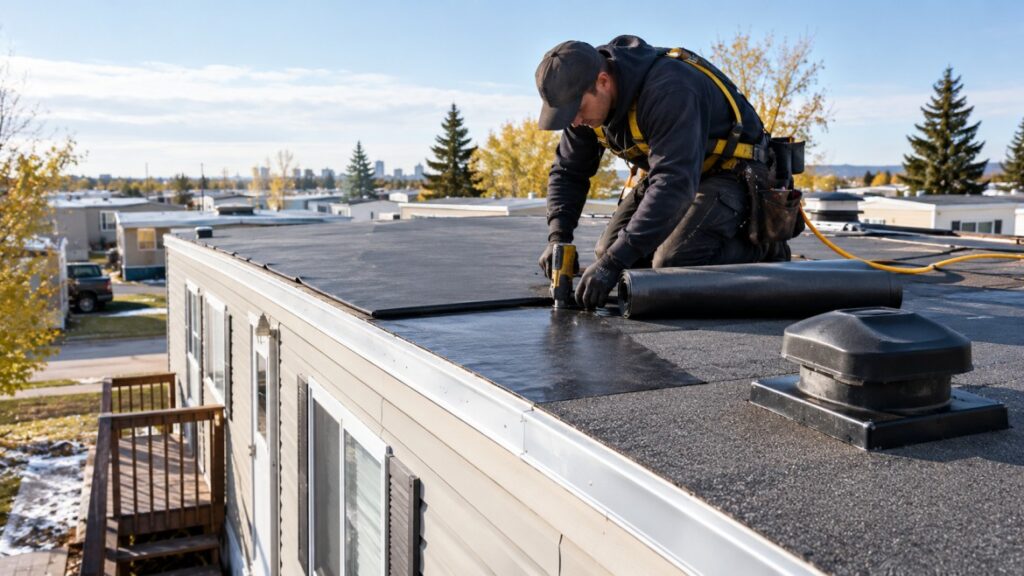
Most mobile home roof leaks in Edmonton can be fixed by resealing seams and fasteners, patching the damaged area, or recoating the whole roof. When the roof is worn out, the long-term fixes are a new membrane over the existing roof or a metal roof-over, which adds a new, stronger roof on top. The right choice depends on your roof type, its age, how much damage there is and how much snow your home’s roof is designed to carry.
Mobile and manufactured homes are a common part of the Edmonton area, from established communities in the city to parks in Spruce Grove, Leduc, Sherwood Park and beyond. Their roofs are built differently from a regular house: they’re usually lower-sloped, lighter and designed for a specific snow load. That makes them more vulnerable to leaks, condensation and snow damage in an Alberta winter, and it means the usual “just reshingle it” answer often doesn’t apply.
This guide explains the types of mobile home roofs, the problems we see most in Edmonton, every repair option from a small patch to a full roof-over, typical costs, and how to protect your roof through the winter.
What kind of roof does your mobile home have?
Before choosing a repair, it helps to know which roof you’re dealing with. Most mobile and manufactured homes in the Edmonton area have one of these:
| Roof type | What it looks like | Common on | Typical weak spots |
|---|---|---|---|
| Metal (rolled or “bowstring”) roof | Slightly curved or low-sloped sheet metal, often painted or coated | Older single-wides | Seams, fasteners, rust, condensation underneath |
| Low-slope membrane or coated roof | Flat-looking roof covered with rubber membrane or roof coating | Older homes and previous repairs | Cracked coating, open seams, ponding water |
| Pitched shingle roof | Looks like a regular house roof with asphalt shingles | Newer manufactured homes and double-wides | Shingles at low pitch, flashing, ventilation |
| Roof-over | A newer roof (often metal) built on top of the original | Homes that have already been upgraded | Flashing where it meets the walls, fasteners |
Look for the label. Manufactured homes built in Canada are normally certified to the CSA Z240 standard and carry a label, often inside a kitchen cabinet, closet or near the electrical panel, that lists the home’s design details. If you can find it, keep a photo. It helps your roofer understand how the home was built and what loads it was designed for.
The most common mobile home roof problems in Edmonton
Leaking seams and fasteners. Metal roofs expand in summer heat and shrink in -30°C cold. Over the years, that movement loosens screws and cracks the sealant along seams, and water gets in during the spring melt or a summer storm.
Cracked or worn coatings. Many older mobile home roofs rely on a roof coating for waterproofing. UV, hail and freeze-thaw cycles break it down, and once it cracks, water finds the gaps.
Ponding water. Low-slope roofs drain slowly. Where the roof has sagged slightly, water and melting snow sit in one spot and eventually work through seams or fasteners.
Condensation that looks like a leak. Warm, moist air from cooking, showers and people inside the home rises and hits the cold metal roof, especially on metal roofs with little insulation. It condenses or freezes, then drips back down, causing stains that look exactly like a roof leak. Bathroom fans, a range hood and moderate indoor humidity make a big difference.
Snow load. Mobile home roofs are lighter than a regular house roof and are designed for a set snow load. Heavy or drifted snow, especially wet spring snow, can overload an older roof and cause sagging, cracks in ceilings or doors that stick.
Ice at the edges. Like any roof, mobile homes can form ice along the edges when heat escapes and melts snow. On a low-slope roof, the trapped water has even more chance to get under seams. Our ice dam guide explains how they form.
Wind and hail damage. Lightweight roofs are more exposed to wind uplift, and hail can dent metal, crack coatings and puncture membranes. After a storm, look for loose edges, lifted panels and new stains inside.
Failed flashing around vents and skylights. Plumbing vents, furnace flues and skylights all cut through the roof. The seals around them are often the first thing to fail.
Mobile home roof repair options, from small fix to full upgrade
1. Reseal seams, screws and flashing
The simplest fix for many leaks. A roofer replaces worn fasteners, reseals seams and resets the flashing around vents and skylights with sealants made for the roof material. It’s quick and affordable, and it’s often all a younger roof needs.
Best for: isolated leaks on a roof that’s otherwise in good shape.
2. Patch the damaged area
Where a section is punctured, rusted through or torn, the roofer removes or covers the damage with a compatible patch. On membrane roofs, that means a new piece of membrane bonded over the area. On metal roofs, it may mean a new metal section.
Best for: storm damage, a fallen branch or a single bad spot.
3. Recoat the whole roof
A roof coating renews the waterproof surface over the entire roof. It seals small cracks and seams and can reflect summer heat. Coatings need dry weather and above-freezing temperatures to cure, so in Edmonton this is a late spring to early fall job, not a winter one.
Best for: an older coated or metal roof that’s leaking in many small places but is still structurally sound.
4. Install a new membrane
A single-ply membrane such as EPDM or TPO can be installed over the existing roof (with insulation board if needed) to create a new, continuous waterproof layer. It’s a long-term fix for low-slope roofs and handles freeze-thaw well when installed properly.
Best for: worn low-slope roofs where you want a lasting fix without changing the roof shape. Silverline also installs flat roofing in Edmonton, using the same systems.
5. Metal roof-over
A metal roof-over adds a lightweight frame on top of the existing roof and covers it with new steel panels. It often adds a slight slope for better drainage, an air space that reduces condensation, and room for extra insulation. Many homeowners say the home is quieter and more comfortable afterwards.
Best for: older mobile homes with recurring leaks, condensation problems or sagging, where you plan to stay for years. Learn more about metal roofing in Edmonton.
6. Pitched roof-over
The biggest upgrade: a new pitched roof framed over the home and finished with shingles or metal. It sheds snow and water like a regular house roof and changes the look of the home. Because it adds structure and weight, it needs careful design and is the option most likely to need a permit and engineering.
Best for: owners making a long-term investment in the home.
Which option is right?
| Option | Fixes | Typical lifespan | Disruption |
|---|---|---|---|
| Reseal / repair flashing | One or two leaks | A few years | Very low |
| Patch | Localized damage | Matches the rest of the roof | Low |
| Recoat | Many small leaks, aging surface | About 5–10 years | Low |
| New membrane | Worn low-slope roof | 20+ years | Moderate |
| Metal roof-over | Leaks, condensation, poor drainage | 40+ years | Moderate |
| Pitched roof-over | All of the above, plus snow shedding | 40+ years | Higher |
A good roofer will start with an inspection and tell you honestly whether a repair is enough or whether you’d be patching a roof that’s ready to retire.
How much does mobile home roof repair cost in Edmonton?
Small mobile home roof repairs in Edmonton usually cost a few hundred dollars, while recoating a whole roof typically runs a few thousand, and a metal roof-over is a five-figure investment. Size matters: a double-wide has roughly twice the roof area of a single-wide.
| Repair | Single-wide (approx.) | Double-wide (approx.) |
|---|---|---|
| Reseal seams, screws or flashing | $300 – $900 | $300 – $900 |
| Patch a damaged section | $400 – $1,500 | $400 – $1,500 |
| Recoat the whole roof | $2,500 – $5,000 | $4,000 – $8,000 |
| New membrane over existing roof | $8,000 – $14,000 | $12,000 – $22,000 |
| Metal roof-over | $10,000 – $18,000 | $15,000 – $28,000 |
| Pitched roof-over | $20,000+ | $30,000+ |
Approximate 2026 ranges in Canadian dollars. Your price depends on the home’s size, roof condition and access, and on what’s found once work begins.
What raises the price:
- Rotten roof decking or damaged framing under the leak
- Wet insulation that needs to be removed
- Additions, porches and attached carports that need to be tied in
- Skylights, vents and other roof penetrations
- Engineering or permit requirements for roof-overs
- Emergency or after-hours service
For small repairs, bundling several fixes into one visit saves on service-call costs. For a full comparison with regular homes, see our roof repair cost guide for Edmonton.
Protecting a mobile home roof through an Edmonton winter
Watch the snow load
Because mobile home roofs are lighter and lower-sloped than a regular house roof, snow doesn’t slide off easily, and it can build up after several storms. Wet spring snow is much heavier than fluffy January snow, and ice adds even more weight.
Warning signs that the roof is under strain:
- Doors or windows that suddenly stick or won’t latch
- New cracks in ceiling panels or drywall
- A ceiling that looks like it’s sagging
- Creaking or popping sounds from the roof
If you notice any of these, reduce the load and get a roofer to check the roof.
Clear snow safely
- Use a roof rake with a plastic blade from the ground to pull snow off the edges. Leave a thin layer on the roof so you don’t scrape the coating or membrane.
- Don’t climb onto a snowy or icy mobile home roof. It’s slippery, and the roof may not be designed for a person’s weight in every spot.
- Never use metal shovels, ice picks or salt on the roof surface.
- Keep snow from piling up where roofs meet, such as at additions or carports.
Control moisture inside
Condensation is one of the biggest winter roof problems in mobile homes. Run the bathroom fan during and after showers, use the range hood when cooking, and keep indoor humidity moderate during cold snaps. If frost forms on the inside of windows, humidity is probably too high.
If the roof leaks in winter
- Catch the water with buckets and towels, and move belongings away.
- Turn off power to any wet light fixture at the breaker.
- Take photos for your insurer.
- Note whether the drip started during a cold snap (often condensation) or a thaw (often a leak through the roof).
- Call for emergency roof repair. Temporary fixes are possible in cold weather, with permanent repairs such as coatings done once temperatures allow.
Our guide to roof leaks in winter explains how to tell condensation, ice dams and true leaks apart.
Before you start: approvals, permits and insurance
Check with your park or landlord. If your home sits in a mobile home community, the park may have rules about roof colours, materials, roof-overs and when contractors can work. Get approval in writing before a large project.
Ask about permits. Small repairs and recoating don’t usually need a permit, but roof-overs that add framing and weight often do, and may need engineering. Your municipality, whether that’s Edmonton, Strathcona County, Spruce Grove or Leduc, decides what’s required. A reputable roofer will know the process.
Talk to your insurer. Ask whether your policy covers sudden damage like hail and wind, and whether a new roof or roof-over changes your premium. Keep invoices and product details for your records.
Choosing a roofer for your mobile home
Not every roofer works on mobile homes, and the ones who do should understand how they’re built. Ask:
- Have you worked on mobile or manufactured home roofs before?
- What repair do you recommend, and why not a cheaper or more expensive option?
- How will you check the roof structure and insulation before adding weight?
- What warranty comes with the work?
- Are you covered by WCB Alberta and liability insurance?
A written quote should name the exact materials, explain how hidden damage will be priced, and include clean-up.
Get an honest assessment of your mobile home roof
Silverline Roofing repairs leaks, replaces worn roofing and installs metal and membrane roofing across Edmonton and nearby communities, including Spruce Grove, Sherwood Park, Leduc and Fort Saskatchewan. We’ll inspect your roof, show you photos of what we find, and tell you honestly whether a simple repair will do or whether an upgrade makes more sense.
Book a roof inspection or explore our Edmonton roof repair services.
Mobile home roof repair FAQs
Why does my mobile home roof leak only in winter?
Winter-only drips in mobile homes are often condensation: warm, moist indoor air freezes on the cold underside of the roof and drips when it thaws. Ice along the roof edges and snowmelt finding open seams are the other common causes.
Can you put shingles on a mobile home roof?
Only if the roof has enough pitch and the structure can carry the weight. Many mobile home roofs are too low-sloped for shingles, which is why membranes, coatings and metal roof-overs are more common.
What is a mobile home roof-over?
A roof-over is a new roof installed on top of the existing one, usually with a lightweight frame and steel panels. It improves drainage, reduces condensation, can add insulation, and lasts for decades.
How long does a mobile home roof last?
A roof coating usually needs renewing every 5 to 10 years. A new membrane typically lasts 20 years or more, and a metal roof-over can last 40 years or more with basic maintenance.
Should I remove snow from my mobile home roof?
Yes, if snow builds up heavily, especially wet spring snow. Use a plastic roof rake from the ground, leave a thin layer on the roof, and never climb onto an icy roof.
Can mobile home roofs be repaired in winter?
Temporary repairs and many small fixes can be done in winter. Coatings and some sealants need above-freezing temperatures to cure, so permanent repairs may be scheduled for milder weather.
Do I need a permit for a mobile home roof-over?
Often, yes. Roof-overs add framing and weight, so many municipalities require a permit and sometimes engineering. Check with your municipality and your park management before work starts.