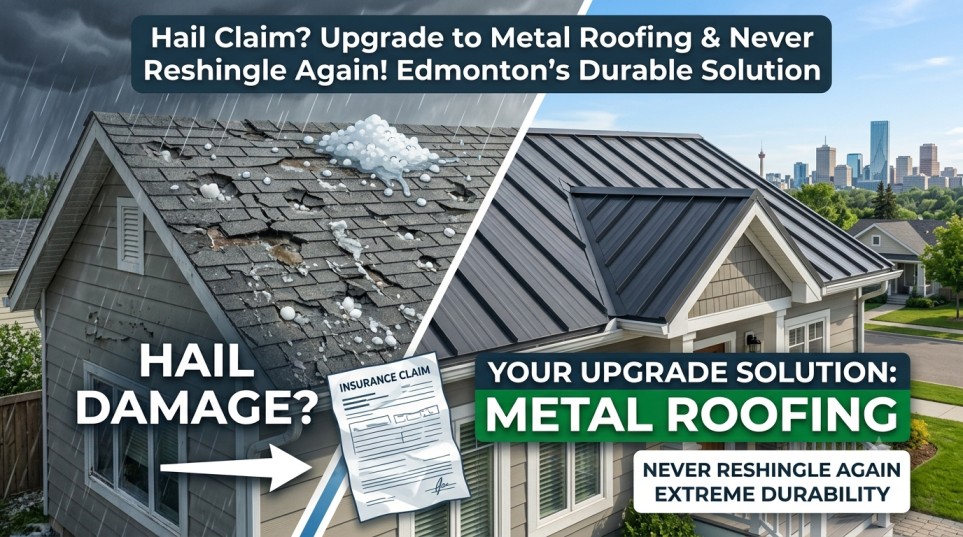
Metal Roofing in Edmonton: How to Use Your Hail Claim to Upgrade — and Never Reshingle Again
Every summer, Edmonton homeowners go through the same cycle. A significant hailstorm hits. Granule damaged asphalt shingles get documented. An insurance claim is filed. A crew comes out and installs new asphalt shingles — the same material that just got damaged — and the homeowner waits for the next hailstorm to do it again. There’s a better path. And it starts with understanding one thing: your Alberta home insurance claim doesn’t require you to replace damaged shingles with the same material. You can upgrade. Thousands of Edmonton homeowners in recent years have used hail damage insurance claims as the financial foundation for a full asphalt to metal roof upgrade — paying little to nothing out of pocket while permanently eliminating future hail damage risk. This guide explains exactly how that works, what metal roofing delivers in Edmonton’s climate, and what the numbers look like in 2026. Why Metal Roofing Is the Conversation Edmonton Homeowners Are Having Right Now Alberta sits in Canada’s most active hail corridor. The Edmonton area has experienced multiple significant hail events in recent years — each producing thousands of claims and, in many cases, revealing asphalt shingles that were already compromised from previous storms. The insurance industry has noticed. Alberta home insurance premiums have risen 15–25% in two years as insurers reprice hail exposure across the province. For Edmonton homeowners who have filed one or more hail claims, the economics of asphalt roofing are shifting. A 30 year asphalt shingle roof that gets hail-damaged at year eight, repaired, damaged again at year fourteen, and replaced at year twenty isn’t actually delivering 30 years of trouble free performance — it’s delivering 30 years of claim cycles, premium increases, and exposure to $2,000–$5,000 deductibles. Metal roofing solves this structurally. A Class 4 impact rated steel roofing system — the highest available rating — is designed to absorb the hail impacts that leave asphalt shingles bruised, granule depleted, and heading toward a claim. The steel surface may show superficial denting on an extreme hailstorm, but it does not crack, does not lose protective coating, does not leak, and does not generate a claim. Most Edmonton homeowners who upgrade to metal after a hail event report that subsequent Alberta hailstorms become non events for their roof specifically. To understand more about the hail damage claim process and what’s involved before an upgrade decision is made, our hail damage roof Edmonton guide covers every step from documentation to settlement. How the Insurance Upgrade Works — The 2026 Edmonton Process Using a hail insurance claim to upgrade to metal roofing in Edmonton follows a specific sequence. Understanding each step protects you from common mistakes that either reduce the claim value or create issues with the contractor selection. Step 1: Document the damage before anything is touched. After any significant hailstorm — hailstones at or above pea size warrant inspection — photograph all visible exterior damage. Check your eavestroughs and downspouts for granule accumulation within 48 hours. Dark granule sediment in the gutter is the most accessible evidence of shingle impact damage. Save the Environment Canada severe weather alert for your area on the date of the event. Step 2: Get a professional written inspection report. Before contacting your insurer, have a qualified Edmonton roofing contractor inspect and document the damage in writing. A professional inspection report carries significantly more weight with an insurance adjuster than homeowner photos alone. Silverline Roofing provides written inspection reports for all post storm assessments. For the full inspection process, see our roof inspection Edmonton page. Step 3: Open the claim and understand your coverage type. Contact your insurer with your documentation. The most important question to clarify immediately: does your policy use Replacement Cost Value (RCV) or Actual Cash Value (ACV)? RCV pays the full cost of like for like replacement. ACV deducts depreciation — potentially significantly for roofs over 10 years old. RCV coverage gives you the most flexibility for an upgrade. With ACV coverage, the upgrade still works but the out of pocket calculation changes. Step 4: Understand what “upgrade differential” means. When you upgrade to a more expensive roofing material using an insurance claim, your insurer typically pays the RCV amount for what was damaged — in this case, asphalt shingles. The difference in cost between the insurance funded asphalt replacement and the metal roofing installation is the “upgrade differential” — the amount you pay out of pocket for the upgrade. On a typical Edmonton home, insurance might fund $10,000–$15,000 toward an asphalt replacement. A comparable metal installation costs $18,000–$30,000. Your out of pocket upgrade differential is the gap — typically $8,000–$15,000. The upgrade differential is paid once. An asphalt deductible, by contrast, is paid every time you file a claim — potentially two or three times over the metal roof’s lifespan. For many Edmonton homeowners, the financial comparison closes within the first or second avoided future claim cycle. Step 5: Confirm the Class 4 insurance discount before installation. This is the step most homeowners miss. Many Alberta insurers offer 10–30% premium discounts for Class 4 impact resistant roofing. To claim the discount, you typically need to provide your insurer with the contractor installation invoice and the manufacturer’s Class 4 specification sheet after completion. Call your broker before the installation date to confirm the discount percentage and exactly what documentation they require. Get the confirmation in writing. Step 6: Use a certified Edmonton metal roofing contractor. Manufacturer warranties on metal roofing systems are conditional on certified installation. A non-certified contractor can install the same product, but the manufacturer warranty is void from day one — meaning the 40 to 50 year warranty that makes metal roofing’s value proposition compelling is simply not available. Always ask for manufacturer installer certification documentation before signing any contract. What Metal Roofing Actually Delivers in Edmonton’s Climate For homeowners considering the upgrade but not yet certain it’s the right choice, here is what metal roofing specifically delivers in Edmonton’s conditions: Hail resistance: Class 4 steel roofing passes the