
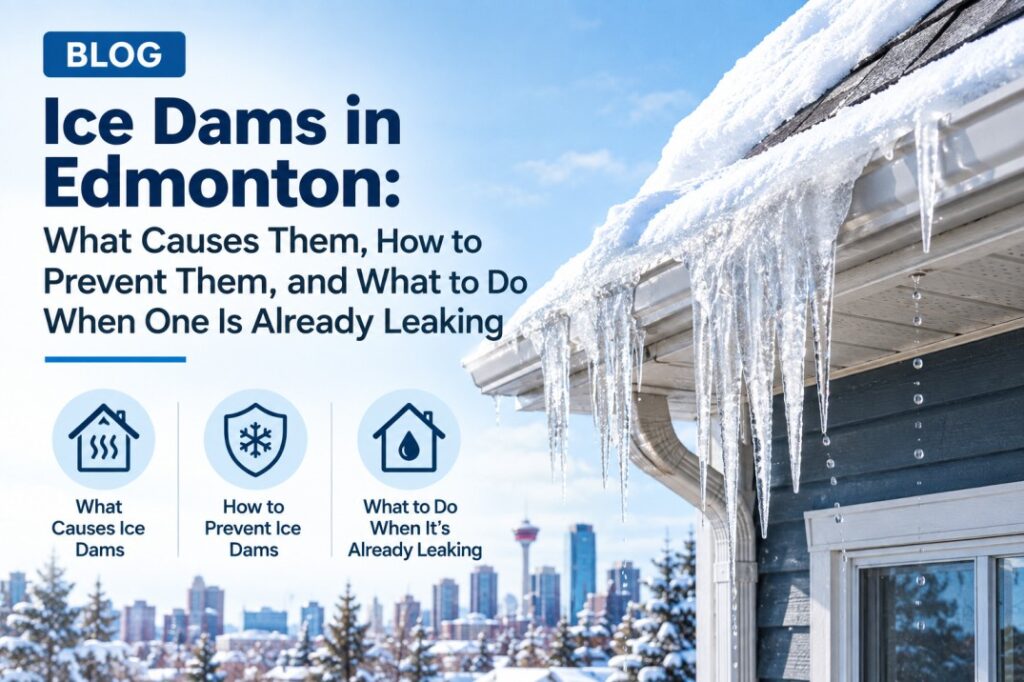
ice dams Edmonton

Ice dams are Edmonton's most damaging winter roof problem — and most homeowners misunderstand what actually causes them. Get the complete 2026 prevention, repair, and emergency response guide.

Ice Dams in Edmonton: What Causes Them, How to Prevent Them, and What to Do When One Is Already Leaking

Every Edmonton winter, the same calls start arriving in roofing offices across the city: water dripping from a ceiling near an exterior wall, a brown stain appearing above a window, icicles the size of fence posts hanging off the eaves. The homeowner assumes there’s a hole in the roof. There usually isn’t. There’s an ice dam – and fixing it requires understanding something that the ceiling stain doesn’t tell you at all. Ice dams are the most damaging and most preventable winter roofing problem in Edmonton. They’re also one of the most misunderstood. This guide explains exactly what causes them in Edmonton’s specific climate, the proven prevention methods ranked by effectiveness, what an active ice dam leak requires right now, and the permanent fixes that eliminate the problem before next winter. What Is an Ice Dam and Why Does Edmonton Get So Many of Them? An ice dam is a ridge of ice that forms at the edge of a roof – at the eave, or in a valley – that prevents meltwater from draining off the roof surface. Once that ridge forms, water pools behind it, backs up under the shingles, and eventually finds a pathway through the roof assembly and into the home. The mechanism that creates ice dams is straightforward: heat escaping from your living space warms the roof deck above, melting the underside of the snow sitting on the roof. That meltwater runs down the slope until it reaches the cold eave overhang – the section of roof that extends beyond the exterior wall, with no heated space beneath it. The water hits that cold surface and refreezes. Layer by layer, the ice ridge builds. The snow above keeps melting. The dam keeps growing. Edmonton has a specific ice dam trigger that milder Canadian cities don’t deal with at the same frequency: the chinook. Chinooks are warm, dry wind events that can raise Edmonton-area temperatures by 15–25°C in a matter of hours – sometimes arriving in the middle of extended cold snaps in January or February. When a chinook hits, the snow that has been sitting frozen on your roof for weeks begins melting rapidly, all at once, while the eave overhang is still at sub-zero temperature from the preceding cold. This sudden, high-volume melt event produces ice dam formation far faster than the gradual day-by-day melt that Ontario guides describe. It also explains why Edmonton homeowners sometimes report their “leak” appearing after a warm spell with no rain whatsoever – and then stopping again when the next cold front arrives. The Root Cause: It’s a Building Performance Problem, Not a Roofing Material Problem This is the most important thing to understand about ice dams: they are caused by heat escaping from inside your home through the attic floor and into the roof assembly. The shingles on your roof are not the cause. New shingles will not prevent ice dams from forming. The cause is above the ceiling and below the roof deck – in your attic. Three building performance conditions drive ice dam formation: Insufficient attic insulation. When your attic doesn’t have enough insulation, heat from your living space conducts through the ceiling into the attic air, warming the roof deck from below. Alberta’s current recommended minimum for attic insulation is R-50. Many Edmonton homes built before 2000 carry R-12 to R-30 – far below this threshold. The improvement from upgrading insulation to R-50 is typically immediate and dramatic. Homeowners who have dealt with ice dams every winter report they disappear entirely after a proper insulation upgrade. Inadequate or imbalanced attic ventilation. A properly ventilated attic stays close to outdoor air temperature – because outside air is continuously flowing through the attic space from soffit intake vents to ridge exhaust vents, carrying heat out before it can warm the roof deck. When soffit intake vents are blocked by insulation shifted toward the eaves – one of the most common attic conditions found in Edmonton homes – the ventilation system short-circuits and heat accumulates. For a detailed explanation of how this system works and what it looks like when it fails, read our roof ventilation Edmonton guide. Air leaks from the living space into the attic. Warm, moist air from your home finds pathways into the attic through pot light cutouts, attic hatches, plumbing stack penetrations, bathroom fan duct connections, and electrical boxes in the ceiling. Each of these bypasses carries heat and moisture directly into the attic space. Air sealing – blocking these pathways before adding or upgrading insulation – is the foundational step that insulation alone doesn’t replace. Ice Dam Prevention: The Methods Ranked by Effectiveness Not all ice dam solutions are equal. Here is an honest ranking from most effective to least, based on what Edmonton roofing and building performance contractors consistently find. 1. Attic insulation upgrade to R-50 – Most effective long-term solution Bringing attic insulation to Alberta’s R-50 recommended minimum eliminates the primary heat transfer pathway driving ice dam formation. Blown-in insulation is the most practical method for existing Edmonton homes – it can be added directly over existing insulation to any required depth without removing what’s already there. Cost in Edmonton: approximately $2,500–$5,000 for a typical residential home, depending on current insulation depth and attic size. 2. Attic air sealing – Essential foundation step Air sealing before insulation is added stops warm air infiltration pathways that insulation alone can’t address. Even the highest R-value insulation doesn’t stop convective heat transfer through gaps and bypasses. In Edmonton homes with unfinished attics, DIY air sealing with foam and caulk is accessible. Full professional air sealing typically costs $800–$2,000. 3. Attic ventilation correction – High impact when the system is compromised If your soffit intake vents are blocked by insulation pushed toward the eaves, or if your ventilation system mixes vent types that short-circuit airflow, correction can dramatically reduce attic temperatures. Our roof inspection service includes attic ventilation assessment as a standard component – identifying blocked soffit channels, inadequate intake-to-exhaust ratios, and
Ice Dams in Edmonton: What Causes Them, How to Prevent Them, and What to Do When One Is Already Leaking Read More »

Roof Ventilation Edmonton: Attic Rain, Ice Dams & Fixes (2026)

Roof Ventilation Edmonton: Why Most Homes Get It Wrong — And Pay for It

Here’s something most Edmonton homeowners don’t expect to hear: one of the most common causes of roof damage in this city has nothing to do with hail, wind, or snow. It’s the air trapped inside your own attic. Poor roof ventilation is behind a surprisingly large number of the premature shingle failures, winter ice dams, mould problems, and mysterious interior leaks that Edmonton roofing contractors deal with every single year. And the frustrating part is that most homeowners don’t find out until the damage is already significant — because the signs hide inside your attic, out of sight, for months before anything shows up on a ceiling. If your Edmonton home was built before 2005, there’s a good chance your roof ventilation system is either outdated, improperly balanced, or partially blocked. This guide explains exactly what roof ventilation does, what goes wrong in Edmonton’s climate, and what to do about it. What Roof Ventilation Actually Does Roof ventilation is the system that moves air continuously through your attic space — drawing fresh cool air in through intake vents at the soffits and pushing warm moist air out through exhaust vents at the ridge or near the roof peak. This airflow does three critical things for your home: In winter, it keeps the attic cold. That might sound counterintuitive, but a cold attic is exactly what you want in Edmonton. When attic temperatures stay near the outside air temperature, the snow on your roof stays frozen evenly — preventing the melt-refreeze cycle that causes ice dams. A warm attic melts the snow above it, and that water refreezes at the cold roof edge, forming the thick ice ridges that force water back under your shingles. In summer, it exhausts heat. Edmonton attics with inadequate ventilation can reach 60–70°C on hot July days. That extreme heat accelerates shingle granule loss, causes the asphalt mat to harden and crack prematurely, and drives up your air conditioning costs by forcing your HVAC system to fight the heat radiating down from above. Year-round, it removes moisture. Every time someone showers, cooks, or even breathes inside your home, moisture-laden warm air rises. In a well-ventilated attic, this air exits before it can cause damage. In an under-ventilated attic, it hits the cold underside of your roof deck and turns to frost — then melts when temperatures rise. Edmonton roofers have a name for that last problem. They call it attic rain. Attic Rain: Edmonton’s Most Misunderstood Roof Problem Attic rain is not a leak. It doesn’t come through damaged shingles or failed flashing. But it mimics a leak so closely that many homeowners — and even some contractors — mistake it for one and apply the wrong fix entirely. Here is what happens: during Edmonton’s deep freeze periods, warm humid air from your living space migrates into the attic and condenses on the cold roof deck as frost. Everything appears fine while temperatures stay below freezing. Then a chinook arrives or temperatures rise rapidly — as they frequently do in Edmonton — and all that accumulated frost melts at once, dripping through your insulation and down through your ceiling. The water appears suddenly, often after a mild spell, and stops when temperatures drop again. That on-off pattern is the clearest diagnostic signal that you’re dealing with attic rain rather than a roof penetration leak. The fix is not a new roof. The fix is correct attic ventilation. Watch for these warning signs of attic rain and ventilation failure in your Edmonton home: If you’re seeing any of these, a professional roof inspection in Edmonton should be your first call — not a roofing patch. The Alberta Building Code Rule Most Homeowners Don’t Know Alberta’s Building Code requires a minimum net free ventilation area equal to 1/300 of the insulated ceiling area — and that ventilation must be balanced, meaning roughly half the venting capacity must be intake at the soffits and the other half exhaust at or near the ridge. In practice, the most common ventilation failure Silverline Roofing finds in Edmonton homes is not insufficient exhaust — it’s blocked intake. Attic insulation that has been added over the years gradually migrates toward the soffit area, compressing against the eave and sealing off the intake vents entirely. Without fresh cold air coming in at the bottom, no amount of ridge venting at the top will create meaningful airflow. The second most common problem is conflicting vent types. Mixing ridge vents with upper-roof box vents or turbines short-circuits the system — the exhaust vents closest to the ridge pull air from the lower exhaust vents rather than drawing it through the soffit intake. The result is a small loop of recirculated attic air that does almost nothing to remove moisture. Types of Roof Ventilation Used on Edmonton Homes Understanding your options helps you have an informed conversation with your contractor when ventilation upgrades are on the table. Ridge vents run continuously along the roof peak and are the most effective passive exhaust system for pitched residential roofs. They are visually low-profile and, when paired with proper soffit intake, create the most consistent airflow pattern of any passive system. Soffit vents are the intake side of the equation. They can be continuous (a perforated strip running the full length of the soffit) or individual round or rectangular units placed at intervals. Continuous soffit vents provide the most consistent intake and are strongly preferred in Edmonton’s climate. Box vents (static vents) are cut into the roof deck near the peak and allow hot air to escape. They work adequately on their own but are generally outperformed by continuous ridge vents and should never be mixed with ridge vents on the same roof. Power vents (attic fans) are electrically powered exhaust units that actively pull air through the attic. They can be effective but must have adequate soffit intake to work correctly — otherwise they depressurize the attic and draw conditioned air out of your living space, raising your

Roof Ventilation Edmonton: Why Most Homes Get It Wrong — And Pay for It Read More »

Scroll to Top