
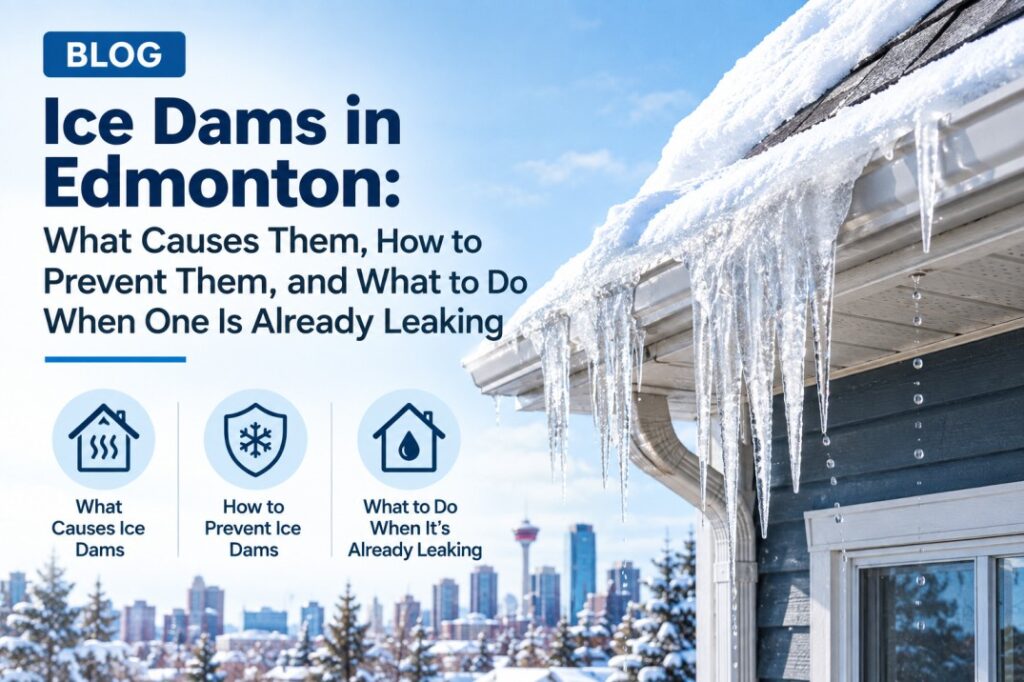
Every Edmonton winter, the same calls start arriving in roofing offices across the city: water dripping from a ceiling near an exterior wall, a brown stain appearing above a window, icicles the size of fence posts hanging off the eaves. The homeowner assumes there’s a hole in the roof. There usually isn’t. There’s an ice dam – and fixing it requires understanding something that the ceiling stain doesn’t tell you at all.
Ice dams are the most damaging and most preventable winter roofing problem in Edmonton. They’re also one of the most misunderstood. This guide explains exactly what causes them in Edmonton’s specific climate, the proven prevention methods ranked by effectiveness, what an active ice dam leak requires right now, and the permanent fixes that eliminate the problem before next winter.
What Is an Ice Dam and Why Does Edmonton Get So Many of Them?
An ice dam is a ridge of ice that forms at the edge of a roof – at the eave, or in a valley – that prevents meltwater from draining off the roof surface. Once that ridge forms, water pools behind it, backs up under the shingles, and eventually finds a pathway through the roof assembly and into the home.
The mechanism that creates ice dams is straightforward: heat escaping from your living space warms the roof deck above, melting the underside of the snow sitting on the roof. That meltwater runs down the slope until it reaches the cold eave overhang – the section of roof that extends beyond the exterior wall, with no heated space beneath it. The water hits that cold surface and refreezes. Layer by layer, the ice ridge builds. The snow above keeps melting. The dam keeps growing.
Edmonton has a specific ice dam trigger that milder Canadian cities don’t deal with at the same frequency: the chinook.
Chinooks are warm, dry wind events that can raise Edmonton-area temperatures by 15–25°C in a matter of hours – sometimes arriving in the middle of extended cold snaps in January or February. When a chinook hits, the snow that has been sitting frozen on your roof for weeks begins melting rapidly, all at once, while the eave overhang is still at sub-zero temperature from the preceding cold. This sudden, high-volume melt event produces ice dam formation far faster than the gradual day-by-day melt that Ontario guides describe. It also explains why Edmonton homeowners sometimes report their “leak” appearing after a warm spell with no rain whatsoever – and then stopping again when the next cold front arrives.
The Root Cause: It’s a Building Performance Problem, Not a Roofing Material Problem
This is the most important thing to understand about ice dams: they are caused by heat escaping from inside your home through the attic floor and into the roof assembly. The shingles on your roof are not the cause. New shingles will not prevent ice dams from forming. The cause is above the ceiling and below the roof deck – in your attic.
Three building performance conditions drive ice dam formation:
Insufficient attic insulation. When your attic doesn’t have enough insulation, heat from your living space conducts through the ceiling into the attic air, warming the roof deck from below. Alberta’s current recommended minimum for attic insulation is R-50. Many Edmonton homes built before 2000 carry R-12 to R-30 – far below this threshold. The improvement from upgrading insulation to R-50 is typically immediate and dramatic. Homeowners who have dealt with ice dams every winter report they disappear entirely after a proper insulation upgrade.
Inadequate or imbalanced attic ventilation. A properly ventilated attic stays close to outdoor air temperature – because outside air is continuously flowing through the attic space from soffit intake vents to ridge exhaust vents, carrying heat out before it can warm the roof deck. When soffit intake vents are blocked by insulation shifted toward the eaves – one of the most common attic conditions found in Edmonton homes – the ventilation system short-circuits and heat accumulates. For a detailed explanation of how this system works and what it looks like when it fails, read our roof ventilation Edmonton guide.
Air leaks from the living space into the attic. Warm, moist air from your home finds pathways into the attic through pot light cutouts, attic hatches, plumbing stack penetrations, bathroom fan duct connections, and electrical boxes in the ceiling. Each of these bypasses carries heat and moisture directly into the attic space. Air sealing – blocking these pathways before adding or upgrading insulation – is the foundational step that insulation alone doesn’t replace.
Ice Dam Prevention: The Methods Ranked by Effectiveness
Not all ice dam solutions are equal. Here is an honest ranking from most effective to least, based on what Edmonton roofing and building performance contractors consistently find.
1. Attic insulation upgrade to R-50 – Most effective long-term solution
Bringing attic insulation to Alberta’s R-50 recommended minimum eliminates the primary heat transfer pathway driving ice dam formation. Blown-in insulation is the most practical method for existing Edmonton homes – it can be added directly over existing insulation to any required depth without removing what’s already there. Cost in Edmonton: approximately $2,500–$5,000 for a typical residential home, depending on current insulation depth and attic size.
2. Attic air sealing – Essential foundation step
Air sealing before insulation is added stops warm air infiltration pathways that insulation alone can’t address. Even the highest R-value insulation doesn’t stop convective heat transfer through gaps and bypasses. In Edmonton homes with unfinished attics, DIY air sealing with foam and caulk is accessible. Full professional air sealing typically costs $800–$2,000.
3. Attic ventilation correction – High impact when the system is compromised
If your soffit intake vents are blocked by insulation pushed toward the eaves, or if your ventilation system mixes vent types that short-circuit airflow, correction can dramatically reduce attic temperatures. Our roof inspection service includes attic ventilation assessment as a standard component – identifying blocked soffit channels, inadequate intake-to-exhaust ratios, and conflicting vent configurations.
4. Ice-and-water shield upgrade during re-roofing – Damage limitation layer
Ice-and-water shield is a self-adhering waterproof membrane installed on the roof deck at the eaves, in valleys, and around penetrations before shingles go on. Alberta Building Code requires a minimum of two metres from the interior wall line – but a broader application across the full eave zone provides better protection in Edmonton’s ice dam climate. This solution doesn’t prevent ice dams from forming, but it prevents the water backing up behind a dam from reaching the roof deck and entering the home. When a full roof replacement in Edmonton is in your near future, specifying extended ice-and-water shield coverage is the single most impactful upgrade available at re-roofing time.
5. Roof raking after heavy snowfall – Maintenance approach
Removing the bottom four feet of snow from the roof edge after significant snowfall – using a roof rake from the ground, never a ladder – eliminates the snow that would melt and feed the dam. This is an effective management tool for Edmonton winters when structural solutions haven’t yet been completed, but it is ongoing maintenance, not a permanent fix. It also needs to happen within 24–48 hours of a snowfall before melt cycles begin.
6. Heat cables at the eaves – Symptom management only
Self-regulating heat cables installed in a zigzag pattern along the eave zone create a melt channel through the ice dam that allows water to drain. They address the symptom – the ice ridge – without addressing the root cause, and they use electricity continuously through winter. In Edmonton’s 2026 market, professional heat cable installation runs approximately $800–$1,800 for a typical single-storey eave run, plus ongoing electricity costs. Useful as a temporary measure while permanent insulation and ventilation work is planned, but not recommended as a standalone solution.
Ice Dam Prevention Cost Summary – Edmonton 2026
| Solution | Estimated Cost | Effectiveness | Permanence |
|---|---|---|---|
| Attic insulation to R-50 | $2,500 – $5,000 | ⭐⭐⭐⭐⭐ | Permanent |
| Attic air sealing | $800 – $2,000 | ⭐⭐⭐⭐⭐ | Permanent |
| Ventilation correction | $600 – $2,000 | ⭐⭐⭐⭐ | Permanent |
| Ice-and-water shield (at re-roof) | Included in re-roof | ⭐⭐⭐⭐ | Permanent |
| Roof raking (seasonal) | DIY / $150–$300 per event | ⭐⭐⭐ | Seasonal only |
| Heat cables | $800 – $1,800 installed | ⭐⭐ | Ongoing cost |
What to Do If an Ice Dam Is Actively Leaking Right Now
If you have active water entry from an ice dam this winter, the sequence matters:
Step 1 – Protect your interior immediately. Move belongings away from the drip area. Place buckets and towels. If the ceiling is bulging with trapped water, carefully puncture it at the lowest point to allow controlled drainage rather than a ceiling collapse.
Step 2 – Do not attempt to chip ice off the roof. Physical ice removal with hammers, axes, or chisels damages shingles and creates more entry points. The risk of injury from ladder work on an icy roof is significant.
Step 3 – Create a melt channel through the dam. The safest DIY emergency method is filling a nylon stocking or pantyhose with calcium chloride ice melt (not rock salt – it damages shingles and metal). Lay the filled stocking vertically across the ice dam, perpendicular to the eave. The calcium chloride slowly melts a channel through the dam, allowing water to drain.
Step 4 – Call for professional assessment. Once the immediate drip is controlled, a professional roof repair assessment establishes the extent of any shingle or deck damage from water infiltration and documents the condition for any insurance claim. Some insurance policies cover ice dam interior damage – check with your insurer before starting any repairs.
Step 5 – Plan the permanent fix before next winter. An active ice dam in year one is a warning. An active ice dam in year two is a pattern. The permanent solution – insulation upgrade, ventilation correction, air sealing – is significantly less expensive than the interior water damage repairs that repeat ice dam seasons eventually produce.
The Pre-Winter Deadline for Edmonton Homeowners
Ice dam prevention work has a hard seasonal deadline in Edmonton. Attic insulation and air sealing can be completed any time of year – but ventilation corrections, soffit work, and any roofline modifications require above-freezing conditions. In Edmonton’s climate, that window reliably closes in late October to early November.
Roof inspections, eavestrough clearing, and any outstanding soffit and fascia repairs must be completed before freeze-up. Eavestrough clearing in particular has a hard Edmonton deadline – gutters blocked at freeze-up fill with ice through the winter and exert downward mechanical load on the fascia, contributing to the very conditions that worsen ice dam formation at the eave.
Book Your Pre-Winter Roof Assessment Before October Closes
Silverline Roofing provides pre-winter roof and attic assessments across Edmonton and surrounding communities – including Sherwood Park, St. Albert, Spruce Grove, Fort Saskatchewan, and Leduc. Every assessment covers shingle and flashing condition, attic insulation depth and air sealing status, ventilation balance, soffit and eavestrough condition, and a clear prioritised action list before winter arrives.
Contact Silverline Roofing today to book your pre-winter assessment – before the October deadline closes the window on this season’s prevention work.