
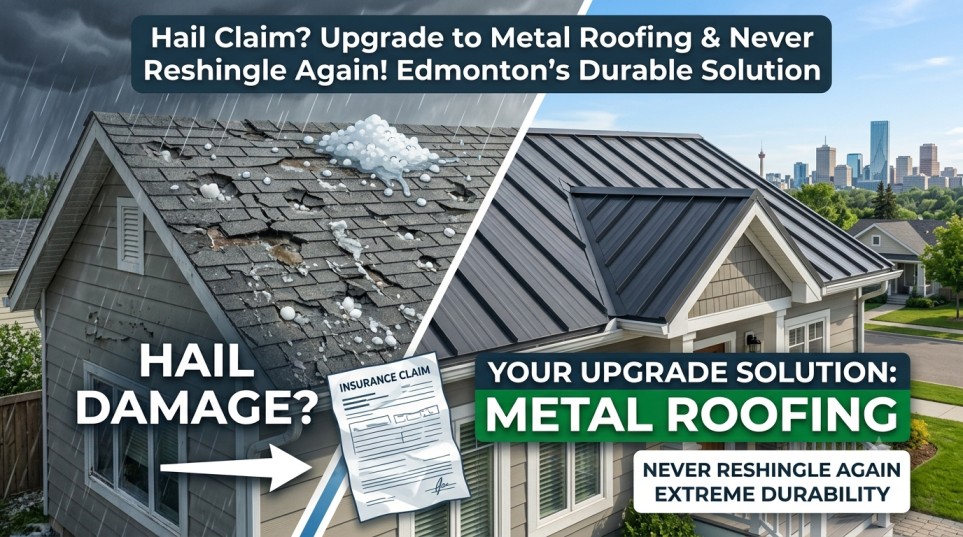
Every summer, Edmonton homeowners go through the same cycle. A significant hailstorm hits. Granule damaged asphalt shingles get documented. An insurance claim is filed. A crew comes out and installs new asphalt shingles — the same material that just got damaged — and the homeowner waits for the next hailstorm to do it again.
There’s a better path. And it starts with understanding one thing: your Alberta home insurance claim doesn’t require you to replace damaged shingles with the same material. You can upgrade. Thousands of Edmonton homeowners in recent years have used hail damage insurance claims as the financial foundation for a full asphalt to metal roof upgrade — paying little to nothing out of pocket while permanently eliminating future hail damage risk. This guide explains exactly how that works, what metal roofing delivers in Edmonton’s climate, and what the numbers look like in 2026.
Why Metal Roofing Is the Conversation Edmonton Homeowners Are Having Right Now
Alberta sits in Canada’s most active hail corridor. The Edmonton area has experienced multiple significant hail events in recent years — each producing thousands of claims and, in many cases, revealing asphalt shingles that were already compromised from previous storms. The insurance industry has noticed. Alberta home insurance premiums have risen 15–25% in two years as insurers reprice hail exposure across the province.
For Edmonton homeowners who have filed one or more hail claims, the economics of asphalt roofing are shifting. A 30 year asphalt shingle roof that gets hail-damaged at year eight, repaired, damaged again at year fourteen, and replaced at year twenty isn’t actually delivering 30 years of trouble free performance — it’s delivering 30 years of claim cycles, premium increases, and exposure to $2,000–$5,000 deductibles.
Metal roofing solves this structurally. A Class 4 impact rated steel roofing system — the highest available rating — is designed to absorb the hail impacts that leave asphalt shingles bruised, granule depleted, and heading toward a claim. The steel surface may show superficial denting on an extreme hailstorm, but it does not crack, does not lose protective coating, does not leak, and does not generate a claim. Most Edmonton homeowners who upgrade to metal after a hail event report that subsequent Alberta hailstorms become non events for their roof specifically.
To understand more about the hail damage claim process and what’s involved before an upgrade decision is made, our hail damage roof Edmonton guide covers every step from documentation to settlement.
How the Insurance Upgrade Works — The 2026 Edmonton Process
Using a hail insurance claim to upgrade to metal roofing in Edmonton follows a specific sequence. Understanding each step protects you from common mistakes that either reduce the claim value or create issues with the contractor selection.
Step 1: Document the damage before anything is touched. After any significant hailstorm — hailstones at or above pea size warrant inspection — photograph all visible exterior damage. Check your eavestroughs and downspouts for granule accumulation within 48 hours. Dark granule sediment in the gutter is the most accessible evidence of shingle impact damage. Save the Environment Canada severe weather alert for your area on the date of the event.
Step 2: Get a professional written inspection report. Before contacting your insurer, have a qualified Edmonton roofing contractor inspect and document the damage in writing. A professional inspection report carries significantly more weight with an insurance adjuster than homeowner photos alone. Silverline Roofing provides written inspection reports for all post storm assessments. For the full inspection process, see our roof inspection Edmonton page.
Step 3: Open the claim and understand your coverage type. Contact your insurer with your documentation. The most important question to clarify immediately: does your policy use Replacement Cost Value (RCV) or Actual Cash Value (ACV)? RCV pays the full cost of like for like replacement. ACV deducts depreciation — potentially significantly for roofs over 10 years old. RCV coverage gives you the most flexibility for an upgrade. With ACV coverage, the upgrade still works but the out of pocket calculation changes.
Step 4: Understand what “upgrade differential” means. When you upgrade to a more expensive roofing material using an insurance claim, your insurer typically pays the RCV amount for what was damaged — in this case, asphalt shingles. The difference in cost between the insurance funded asphalt replacement and the metal roofing installation is the “upgrade differential” — the amount you pay out of pocket for the upgrade. On a typical Edmonton home, insurance might fund $10,000–$15,000 toward an asphalt replacement. A comparable metal installation costs $18,000–$30,000. Your out of pocket upgrade differential is the gap — typically $8,000–$15,000.
The upgrade differential is paid once. An asphalt deductible, by contrast, is paid every time you file a claim — potentially two or three times over the metal roof’s lifespan. For many Edmonton homeowners, the financial comparison closes within the first or second avoided future claim cycle.
Step 5: Confirm the Class 4 insurance discount before installation. This is the step most homeowners miss. Many Alberta insurers offer 10–30% premium discounts for Class 4 impact resistant roofing. To claim the discount, you typically need to provide your insurer with the contractor installation invoice and the manufacturer’s Class 4 specification sheet after completion. Call your broker before the installation date to confirm the discount percentage and exactly what documentation they require. Get the confirmation in writing.
Step 6: Use a certified Edmonton metal roofing contractor. Manufacturer warranties on metal roofing systems are conditional on certified installation. A non-certified contractor can install the same product, but the manufacturer warranty is void from day one — meaning the 40 to 50 year warranty that makes metal roofing’s value proposition compelling is simply not available. Always ask for manufacturer installer certification documentation before signing any contract.
What Metal Roofing Actually Delivers in Edmonton’s Climate
For homeowners considering the upgrade but not yet certain it’s the right choice, here is what metal roofing specifically delivers in Edmonton’s conditions:
Hail resistance: Class 4 steel roofing passes the UL 2218 test using a 2 inch steel ball dropped from 20 feet — the most demanding impact test available. In real Edmonton hail events, this translates to a roof that absorbs what standard asphalt cannot. After Edmonton’s 2024 hail season, many homeowners who had upgraded to metal reported that their neighbours were filing claims while their own roof was undamaged.
Snow and ice performance: Metal roofing’s smooth surface sheds snow more efficiently than textured asphalt shingles, reducing ice dam formation risk along the eaves. Edmonton homes with metal roofing consistently require less snow management through the winter months. Our roof ventilation Edmonton guide explains the related attic conditions that complete the ice dam prevention picture.
Lifespan: A quality steel roofing system in Edmonton carries a realistic 40–70 year lifespan with minimal maintenance. In the 50 year financial model, a homeowner who installs metal at the point of a hail claim typically installs one roof in their ownership period. An asphalt homeowner installs one and a half to two.
Fire resistance: Metal roofing carries a Class A fire rating — the highest available. For Edmonton homeowners in areas with any wildfire interface designation, this is a meaningful risk reduction alongside the hail protection.
Metal Roofing Cost in Edmonton — 2026
| Home Size | Asphalt Reshingle Cost | Metal Roofing Cost | Upgrade Differential |
|---|---|---|---|
| 1,200 sq ft | $8,500 – $13,000 | $15,000 – $22,000 | ~$6,500 – $9,000 |
| 1,500 sq ft | $10,000 – $15,500 | $18,000 – $28,000 | ~$8,000 – $12,500 |
| 1,800 sq ft | $13,000 – $19,000 | $22,000 – $34,000 | ~$9,000 – $15,000 |
| 2,500 sq ft | $18,000 – $28,000 | $30,000 – $45,000 | ~$12,000 – $17,000 |
These ranges represent installed costs for standard residential pitches in Edmonton’s 2026 market. Steeper pitches, complex roof geometry, and additional chimney or skylight flashings add to both columns. For more detail on cost variables, our Edmonton reshingle cost guide provides the most detailed Edmonton market breakdown available.
Is Metal Roofing Right for Your Edmonton Situation?
Strong case for upgrading: You’ve filed one or more hail claims in the past five years. You plan to stay in your home for 15 or more years. Your insurer offers a Class 4 discount. You want to permanently eliminate hail season anxiety about your roof.
Weaker case for upgrading: You’re planning to sell within three to five years and are unlikely to recover the upgrade differential in sale price. Your budget requires the minimum out of pocket at the time of the claim. Your specific roof is complex enough that the metal installation cost is significantly above the ranges above.
For Edmonton homeowners with a current hail claim or a roof approaching the end of its life, the upgrade conversation is worth having before committing to an asphalt replacement that starts the cycle again.
Talk to Silverline Roofing About Your Metal Roofing Upgrade
Silverline Roofing installs metal roofing systems across Edmonton and surrounding communities — and we’re experienced in guiding homeowners through the insurance upgrade process. We provide written inspection reports for claims, attend adjuster meetings on your behalf, and quote metal installations alongside the insurance settlement figures so you have a clear picture of the upgrade differential before committing.
We serve Sherwood Park, St. Albert, Spruce Grove, Fort Saskatchewan, and Leduc, in addition to all Edmonton neighbourhoods. Contact Silverline Roofing today for a free, no obligation metal roofing assessment and upgrade cost comparison.
Visit our metal roofing Edmonton page for the complete guide to steel roofing profiles, profiles, warranties, and installer certification details.