
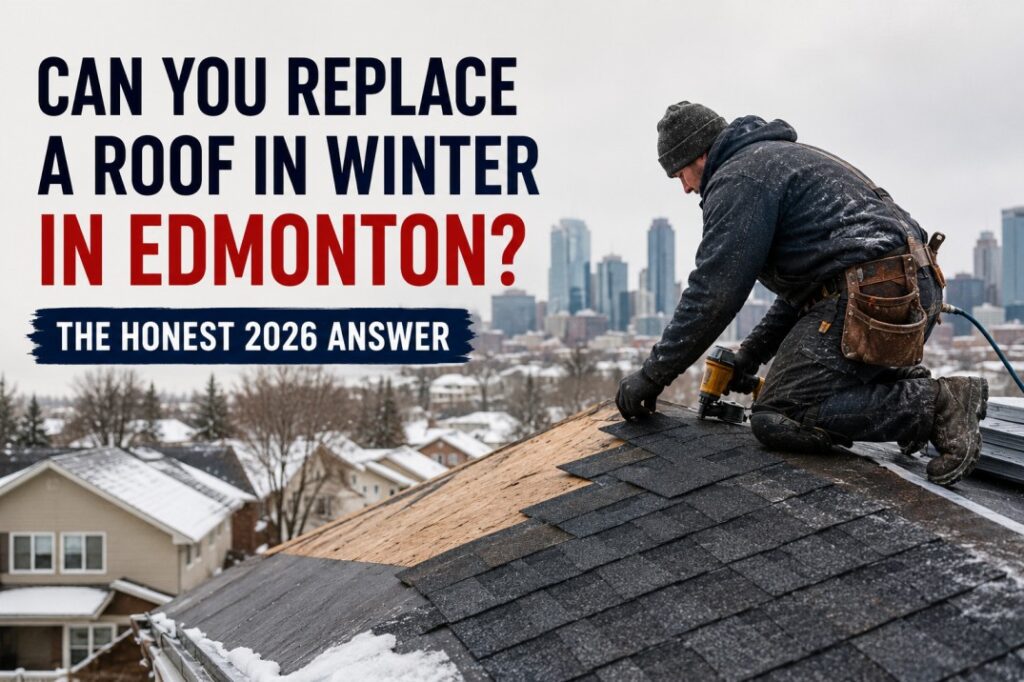
The question comes up every year as Edmonton homeowners realise their roof has issues heading into fall — and then the temperature drops faster than expected. Can you replace a roof in winter in Edmonton? Is it safe? Is it even legal? Will it void the warranty?
The honest answer is more complicated than the yes-or-no responses that circulate online. Winter roofing in Edmonton is possible under specific conditions. It carries real technical constraints that affect material performance, installation method, and cost. And it’s the genuinely correct choice in some situations while being the wrong choice in others.
This guide gives you the complete, technically accurate picture so you can make an informed decision — whether you’re dealing with an emergency, planning ahead, or just trying to understand what you’re being told by a contractor who wants to book your job in January.
Why Winter Roofing in Edmonton Is Technically Challenging
To understand winter roofing in Edmonton, you first need to understand what cold temperatures actually do to roofing materials — specifically to asphalt shingles, which cover the vast majority of Edmonton’s residential roofing stock.
The adhesive seal strip problem. Every asphalt shingle has a strip of heat-activated adhesive on its underside. This strip bonds to the shingle below it after installation, creating the weathertight seal that holds your roof together under wind and weather. The adhesive requires sustained temperatures above approximately 4°C to activate and cure properly. Below that threshold — which Edmonton regularly reaches for four to five months of the year — the adhesive doesn’t bond. Shingles installed in cold weather must be hand-sealed individually by the installer to compensate, which adds labour time and cost to every row of shingles on the roof.
Shingle brittleness in extreme cold. Asphalt shingles become significantly more brittle below -10°C. A shingle that flexes during warm-weather installation to lay flat on the roof deck resists that flex in cold weather — and if forced, can crack along the bend. Cracked shingles at installation mean immediate warranty failure at those points. This is why experienced Edmonton winter roofers are judicious about which temperature ranges they’ll work in and how they handle material storage on-site. Shingles brought directly from a cold truck to a cold roof are at highest risk — pre-warming stored materials is a standard cold-weather practice for quality contractors.
Pneumatic tool reliability. Nail guns and pneumatic tools become unreliable in extreme cold, with o-rings stiffening and air pressure behaving inconsistently. Below approximately -15°C, hand-nailing becomes the only reliable installation method. Hand-nailing every shingle dramatically increases labour time — and labour cost — for any winter installation project.
Ice and deck conditions. Working on an Edmonton roof in winter means working on a surface that may be icy, snow-covered, or both. This creates genuine safety risk that reputable contractors take seriously. Additional safety equipment, slower working pace, and more frequent weather-related stoppages all factor into winter project timelines and costs.
Temperature Thresholds by Roofing Material — Edmonton Practical Guide
Not all roofing materials have the same cold-weather limitations. Here’s what Edmonton homeowners need to know by material type:
| Material | Workable Minimum | Key Cold-Weather Risk |
|---|---|---|
| Asphalt shingles (3-tab, dimensional) | 4°C (without hand-sealing) | Adhesive won’t activate; shingles brittle below -10°C |
| Impact-resistant asphalt (Class 4) | 4°C (without hand-sealing) | Same as standard asphalt |
| Euroshield rubber shingles | -20°C | Rubber stays flexible; cold installation is viable |
| Metal roofing (steel shake, standing seam) | No hard minimum | Metal contracts in cold — fastener placement requires adjustment |
| TPO flat membrane | -10°C (with precautions) | Seam welding is temperature-sensitive |
| EPDM flat membrane | -20°C | Rubber composition maintains flexibility |
| Modified bitumen (torch-on) | -15°C (with experienced crew) | Torch application compensates for cold |
The practical takeaway: metal roofing and rubber roofing systems (Euroshield, EPDM) are genuinely more suitable for Edmonton winter installation than standard asphalt shingles. An experienced Edmonton contractor installing Euroshield or metal in January faces fewer material constraints than one installing standard dimensional shingles. Explore Euroshield rubber roofing in Edmonton for more detail on this product’s cold-weather advantages.
When Winter Roof Replacement in Edmonton Is the Right Call
Despite the technical challenges, there are specific situations where replacing a roof in winter in Edmonton is not just acceptable but genuinely the correct decision.
Emergency situations. If your roof has suffered structural damage, has a significant open penetration from storm damage, or is actively leaking in a way that threatens interior damage, the cost and inconvenience of winter installation is clearly preferable to the alternative. Emergency roof repair in Edmonton that addresses immediate risk — tarping, patching, emergency shingle replacement — is always available in winter regardless of temperature. Full replacement in an emergency context is evaluated case by case based on the severity of the situation and current conditions.
When fall bookings are missed. Edmonton’s fall roofing season (September–October) is the highest-demand period of the year for quality roofing contractors. Homeowners who identify a roofing need in November or early December face a realistic choice: wait until spring (April–May) with the roof in its current condition through the winter, or proceed in winter with a contractor who has capacity and can work within the material constraints. For roofs in poor but stable condition, waiting is often acceptable. For roofs showing active failure points, winter replacement may be the financially sound choice compared to emergency interior repairs from winter water infiltration.
Budget timing. Winter is genuinely lower-demand for roofing contractors in Edmonton. While some contractors charge winter premiums (15–25% more is a realistic range for the added complexity and risk), others offer more competitive pricing to maintain crew continuity. Homeowners who are flexible on timing and can negotiate effectively may find legitimate cost savings on non-urgent replacements booked for December or January.
When to Wait for Spring — Edmonton’s Practical Reality
For planned, non-emergency roof replacement in Edmonton, waiting until late April through early June is the recommendation most experienced contractors give their own family members. Here’s why spring is the optimal window in Edmonton specifically:
Late April and May offer temperatures consistently above 10°C — well above the threshold for proper shingle adhesive activation. The winter’s freeze-thaw damage is fully visible, making the scope of required work clearer and reducing post-tear-off surprises. Contractor availability recovers from winter slowdowns, and the competition for quality crews is lower than in peak summer. Most importantly, new shingles installed in spring have the full summer season ahead of them to fully seal before the next Alberta winter tests the installation.
For context on seasonal timing across the full replacement process, our Edmonton roof replacement guide covers scheduling, lead times, and how to book effectively in Edmonton’s market.
What Winter Roofing in Edmonton Actually Costs More
If you’re getting quotes for a winter roof installation in Edmonton, understanding the cost premium is important for budget planning.
Hand-sealing labour: When temperatures prevent adhesive activation, installers must hand-apply roofing cement to each shingle tab individually. On a typical Edmonton home, this adds 8–15 hours of additional labour — roughly $400–$900 at Edmonton 2026 labour rates.
Slow-down factor: Icy conditions, equipment management in cold, and increased safety protocols add 20–40% to total labour time on most winter projects.
Material pre-warming: Storing and warming shingle bundles to safe installation temperature before use requires management that adds minor cost and logistical complexity.
Safety equipment: Additional harness systems, de-icing of work surfaces, and crew equipment for cold conditions are costs that quality contractors factor into winter quotes.
Total winter premium on a typical Edmonton residential reshingle: realistically $1,000–$3,000 above the same project in optimal spring or fall conditions, depending on temperature during the installation window. For context on what a full reshingle costs by house size, visit our Edmonton reshingle cost guide.
5 Questions to Ask Any Edmonton Contractor Offering Winter Roofing
Not every contractor who offers winter roofing in Edmonton is equipped or experienced to do it correctly. These questions separate qualified winter installers from contractors simply trying to fill slow-season calendars.
1. What is the minimum temperature your crew will install shingles at? A contractor without a clear answer — or one that says “any temperature” — is not being honest about material constraints. Any qualified answer should reference the 4°C adhesive threshold for asphalt.
2. Are you hand-sealing every shingle tab when temperatures are below 4°C? This is the quality checkpoint. Hand-sealing in cold weather is industry standard practice — not an optional upgrade.
3. How are you storing and handling materials before installation? Pre-warming shingle bundles is standard cold-weather practice. A contractor who doesn’t address material handling in cold is skipping an important quality step.
4. What happens if temperature drops below your working threshold during the project? A professional answer includes a specific protocol — work stops, materials are secured, the job resumes when conditions meet specifications. An answer that implies they’ll work regardless of temperature is a quality risk.
5. Does the manufacturer warranty cover installation completed at this temperature? Manufacturers typically specify minimum installation temperatures in their warranty terms. A warranty that doesn’t cover the installation conditions is not coverage you can rely on.
The Bottom Line on Winter Roofing in Edmonton
Replacing a roof in winter in Edmonton is possible, technically constrained, more expensive, and — in genuine emergency situations — sometimes the right decision. For planned replacements on non-urgent timelines, waiting for the spring installation window gives you better material performance, a more reliable installation process, stronger warranty coverage, and a roof that enters its first winter fully sealed rather than freshly installed.
If you have a roofing situation that isn’t clearly in either category, Silverline Roofing provides honest assessments of whether your roof can safely wait for spring or whether winter intervention is warranted.
We serve Edmonton and surrounding communities including Sherwood Park, St. Albert, Spruce Grove, Fort Saskatchewan, and Leduc. Contact Silverline Roofing for a free, no-obligation assessment — winter or otherwise.