
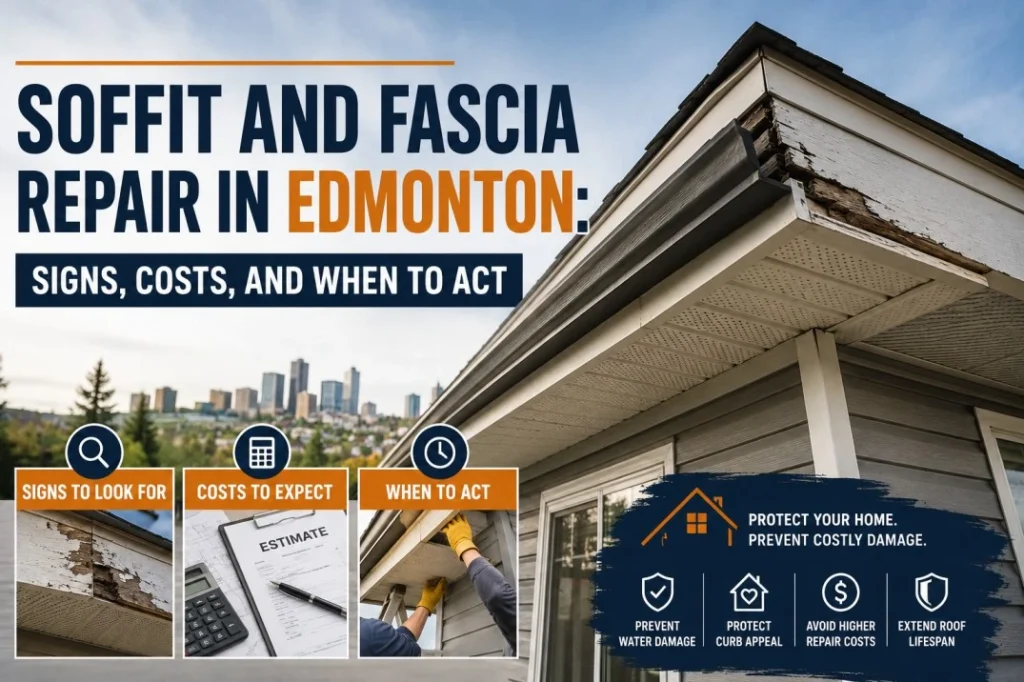
Most Edmonton homeowners can describe their roof shingles and know roughly how old their eavestrough system is. Very few can tell you the last time anyone looked at their soffit and fascia — and that’s exactly the problem.
Soffit and fascia sit at the intersection of three of your home’s most important systems: the roof, the exterior cladding, and the attic ventilation. When they’re working correctly, you’ll never think about them. When they start failing, the damage they allow doesn’t stay in one place — it moves into your attic insulation, your roof deck, your eavestroughs, and eventually your interior ceiling. And in Edmonton’s climate, that deterioration happens faster than in almost any other Canadian city.
This guide covers exactly what soffit and fascia do, what failure looks like in Edmonton’s specific conditions, your material options and real 2026 costs, and when it makes financial sense to bundle soffit and fascia work with your roof replacement.
What Soffit and Fascia Actually Do — and Why Both Matter
Fascia is the vertical board that runs along the lowest edge of your roof, directly where your eavestrough attaches. It covers the ends of the roof rafters, gives the roofline a clean finished edge, and serves as the structural anchor for your gutter system. Without sound fascia, your eavestroughs have nothing solid to hang from — which is why sagging gutters and rotting fascia almost always appear together.
Soffit is the material that covers the underside of your roof overhang — the horizontal surface you see when you stand near your exterior wall and look upward at the eave. Its job is dual: it seals the eave space against pest entry while providing the ventilation that allows fresh air to enter the attic through perforations or vented panels.
The connection between soffit and attic ventilation is one that most homeowners don’t fully appreciate until something goes wrong. Fresh air enters through the soffit vents, travels through the attic, and exits through the ridge vent at the peak — creating the airflow that prevents moisture buildup, attic rain, and the ice dam formation that causes so much roof damage across Edmonton every winter. Damaged or blocked soffit disrupts this airflow at the source. For a full explanation of how this system works together, read our guide on roof ventilation in Edmonton.
Why Edmonton Makes Soffit and Fascia Failure Happen Faster
Edmonton’s climate does two specific things to soffit and fascia that milder cities simply don’t experience at the same pace.
Freeze-thaw cycling destroys wood faster here than almost anywhere. Wooden fascia boards absorb moisture during Edmonton’s wet spring season. That moisture freezes in the wood grain during overnight temperature drops, expands as it freezes, then thaws and contracts when temperatures rise — sometimes multiple times in a single week during March and April. This repeated expansion-contraction splits paint, cracks sealant, opens the wood grain to deeper moisture penetration, and accelerates rot from the inside out. A wooden fascia board that might last 20 years in Vancouver can show serious rot in Edmonton in 8 to 12 years without regular maintenance.
Eavestrough ice weight multiplies fascia stress. When eavestroughs fill with water and ice during Edmonton’s winter — a common occurrence when gutters aren’t properly cleared before freeze-up — the weight of that ice puts direct downward pressure on the fascia board the gutter is mounted to. Over multiple winters, this mechanical stress loosens the gutter mounting, separates the fascia from the rafter ends beneath, and creates gaps that admit moisture and wildlife.
Wildlife and insect entry through damaged soffit is a significantly bigger issue in Edmonton than in denser urban environments. Squirrels, starlings, wasps, and hornets actively seek out gaps in damaged soffit panels as nest sites — particularly in the spring. Once an animal establishes a nesting space in your attic through a soffit gap, the insulation and structural damage it causes often runs into thousands of dollars of remediation on top of the soffit repair itself.
7 Warning Signs Your Edmonton Home Needs Soffit or Fascia Attention
Look carefully at your roofline from the ground — ideally from multiple angles and in good light. These are the signs that warrant a closer professional look:
1. Peeling or bubbling paint on the fascia board. Paint failure is the first signal that moisture has breached the surface. By the time paint is visibly failing, the wood beneath has already begun absorbing water.
2. Soft, spongy, or discoloured wood on the fascia. Press gently on accessible fascia sections. Soft or springy wood indicates rot has begun. Discolouration without softness means moisture has been present but may not yet be structural.
3. Sagging eavestroughs pulling away from the fascia. When gutters begin separating from the roofline, the fascia they’re mounted to has either rotted enough to lose grip on the fasteners or has been mechanically stressed to the point of structural failure. This is not a gutter problem — it is a fascia problem with a gutter symptom. Read more about eavestrough repair in Edmonton and why fascia condition determines whether gutter repairs hold.
4. Visible holes, gaps, or cracked panels in the soffit. Any gap in soffit panels larger than a few millimetres is a potential wildlife or insect entry point as well as a moisture pathway into the eave cavity.
5. Staining or streaking on exterior siding below the roofline. Water that escapes through failed fascia or soffit doesn’t disappear — it runs down your exterior wall, causing staining that worsens with each rainfall and can eventually damage the wall structure behind the cladding.
6. Increased heating bills in winter or cooling costs in summer. When soffit ventilation is compromised, attic airflow is disrupted. A warm attic in winter drives ice dam formation and heat loss through the ceiling. A hot attic in summer increases your air conditioning load measurably.
7. Sounds of scratching or activity in the attic or eave space. If you can hear movement above your ceiling or in the eave area — especially in spring when wildlife is actively seeking nesting sites — a soffit inspection is urgent. The access point is almost always a damaged or missing soffit panel.
Soffit and Fascia Materials: Your Options for Edmonton’s Climate
When repairing or replacing soffit and fascia in Edmonton, material selection matters significantly for long-term performance. Three options dominate the market:
Aluminum is the most popular and most recommended choice for Edmonton homes. It does not rot, does not absorb moisture, is not a food source for insects, and handles freeze-thaw cycling without cracking or splitting. Available in a wide range of colours to match virtually any exterior, aluminum soffit and fascia carry a realistic lifespan of 25 to 40 years with minimal maintenance. It is also lightweight, which reduces mechanical stress on the rafter structure and eavestrough mounting.
Vinyl is a cost-effective alternative that also resists rot and moisture. The trade-off in Edmonton’s climate is brittleness in extreme cold. Vinyl becomes significantly more fragile below -20°C and can crack under impact — including from hail and falling ice — during Alberta winters. For budget-conscious repairs on sheltered sections of the roofline, vinyl is acceptable. For full perimeter replacement in Edmonton, aluminum is the more durable investment.
Wood retains visual appeal for homeowners in heritage neighbourhoods who want to maintain the original character of their home. However, Edmonton’s climate demands a genuine maintenance commitment — regular painting or staining every three to five years, annual inspection, and prompt repair of any surface damage. Without that commitment, wood fascia will fail early, often before the surrounding roofing system requires attention.
Soffit and Fascia Repair vs. Replacement: How to Decide
Repair is the right call when damage is genuinely isolated. A single cracked soffit panel, a short section of fascia with surface paint failure and no structural rot, or a minor gap that appeared after a storm — these are repair territory. A competent contractor can address them cleanly without disturbing the surrounding material.
Replacement becomes the right call when:
- Rot has progressed beyond the surface into the wood structure of the fascia
- More than 20 percent of the soffit run shows cracking, gaps, or panel displacement
- Multiple sections of fascia have separated from rafter ends
- The existing material is wood on a home whose climate exposure warrants upgrading to aluminum
- Gutter mounting has failed across multiple sections due to fascia deterioration
A critical decision point: if your roof is also approaching replacement or has recently been replaced, soffit and fascia work should be scheduled at the same time. The labour overlap is significant — the same crew accessing the roofline for a roof replacement can complete soffit and fascia work with minimal additional mobilisation cost. Doing it separately means paying twice for access, scaffolding, and cleanup. Learn more about Edmonton roof replacement services and how bundling exterior work reduces your overall project cost.
Soffit and Fascia Repair Costs in Edmonton — 2026
| Service | Estimated Cost (2026) |
|---|---|
| Fascia board repair (single section, surface rot) | $200 – $500 |
| Fascia board replacement (per linear metre) | $25 – $55 installed |
| Soffit panel replacement (per linear metre) | $20 – $45 installed |
| Full perimeter fascia replacement (typical Edmonton home) | $1,800 – $4,500 |
| Full soffit + fascia replacement (combined, aluminum) | $3,500 – $8,000 |
| Pest exclusion + soffit repair (wildlife damage) | $400 – $1,200 |
These ranges reflect Edmonton 2026 labour and material pricing. Homes with extensive rot discovered after removal, or those requiring rafter end repair before new fascia can be installed, will fall toward the upper end. Getting a written on-site assessment before budgeting is always the most accurate approach.
Don’t Let a Small Roofline Problem Become a Large Interior Problem
Soffit and fascia failure in Edmonton is rarely dramatic until it’s already caused significant consequential damage. The sequence is predictable: paint fails → wood absorbs moisture → rot begins → eavestrough mounts loosen → gutters pull away → water directs toward foundation → fascia gap admits wildlife → attic damage follows.
Every step in that sequence is avoidable when the initial surface failure is caught and addressed early.
Silverline Roofing assesses soffit and fascia condition as part of every roof inspection in Edmonton and every roof replacement project — because the roofline is one connected system, and incomplete work in one area always creates problems in the others.
We serve Edmonton and the surrounding area including Sherwood Park, St. Albert, Spruce Grove, Fort Saskatchewan, and Leduc. Contact Silverline Roofing for a free, no-obligation soffit and fascia assessment today.